For years, part of my office decor has been a framed copy of the Declaration of Independence. This is the document that was signed on this day, the fourth of July in 1776, by a group of men who were expressing their dream of freedom and independence. They proclaimed that there were “self-evident” truths, “that all men are created equal, that they are endowed by their Creator with certain unalienable Rights, that among these are Life, Liberty and the pursuit of Happiness.” And with these words the experiment in democracy, the United States of America, was born.
I find these thoughtful and beautifully crafted words to be sacred, because they express the inner dreams of humankind. In the Declaration of Independence can be heard the cries of the human soul for rights and equalities. Certainly, true religion has and always must advocate for those rights.
Join me this week as we take an Armodoxy dive into freedom and independence, in one minute for summertime.
https://epostle.net/wp-content/uploads/2025/07/Copilot_20250703_211503.png1114904Vazken Movsesianhttps://epostle.net/wp-content/uploads/2022/07/final_logo_large_for_epostle_web-300x189.pngVazken Movsesian2026-06-29 00:10:372026-06-28 21:57:57Declarando con belleza
Scripture recounts that the religious elite of the first century was constantly trying to trap Jesus into contradicting himself. Their traps were of no avail, Jesus’ responses to their questions were always precise and left them (and today, us) with new thoughts to ponder. Such was the case in this moment recorded in the Gospel of Mark (chapter 12).
They approached Jesus, but this time they buttered him up first with words of flattery. “Teacher, we know that you are a man of integrity. You aren’t swayed by others, because you pay no attention to who they are; but you teach the way of God in accordance with the truth.” This was probably Jesus’ first tip-off that a stinger was to follow. They asked, “Is it right to pay the imperial tax to Caesar or not? Should we pay or shouldn’t we?”
Mark writes, “Jesus knew their hypocrisy. ‘Why are you trying to trap me?’ he asked. ‘Bring me a denarius and let me look at it.’ They brought the coin, and he asked them, “Whose image is this? And whose inscription?”
“Caesar’s,” they replied. Then Jesus said to them, “Give back to Caesar what is Caesar’s and to God what is God’s.” And they were amazed at him.
With this one statement, Jesus has continued to amaze generations until today. Render unto Ceasar what is Ceasar’s and what is God’s to God, is the phrases that is the foundation for concepts such as the separation of Church and State.
It is too easy to quote Jesus with this single line and claim that as Church, or people of Faith, we need to distance ourselves from politics. But as the history of Armodoxy demonstrates, everything is interconnected and certainly did not make this statement to distance himself from the reality of daily life.
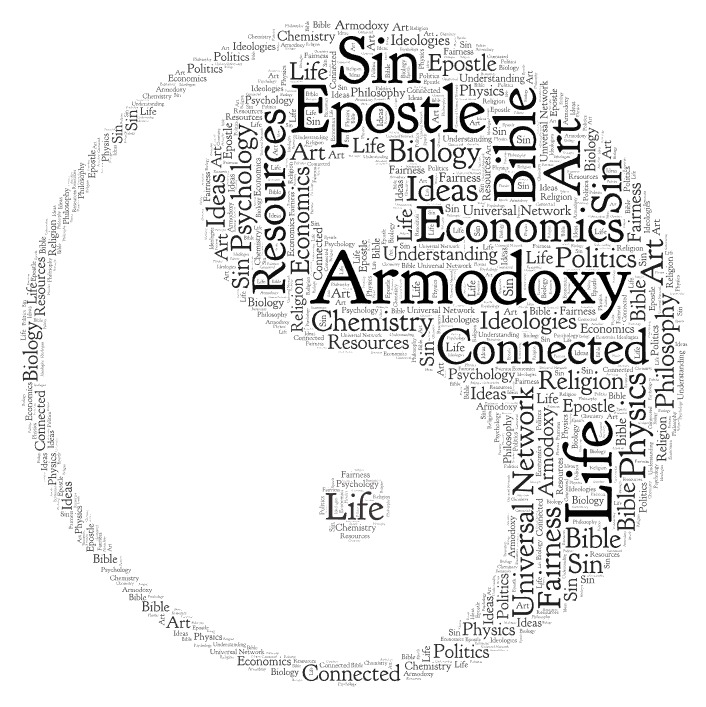
All things are connected to one another in a universal network of life. Economics gives us the resources to buy the Bible, which defines sin, which psychology attempts to diminish. Physics explains the movement of the building blocks which chemistry and biology exploit into physical realities, art presents in forms that express ideas that form ideologies that philosophy dissects and analyses. Politics creates systems that organize those ideologies, and religion is there to ensure the equity of distribution, claiming to have a connection to a higher understanding of fairness.
Yes, everything is connected. It is too easy to pretend that reality is void of spirituality or that religious entities do not have concerns for their community and world. Separation of Church and State does not mean that clergy should not and cannot comment on political realities. Quite the contrary, they are the ones who might align those realities to higher understandings of selfhood and responsibility.
It was not easy for Jesus to make this statement. Tomorrow we continue, today we pray, O Breath of All that Lives, You who move in the pulse of galaxies and in the quiet rhythm of a single human heart, open my eyes to the sacred thread that binds all creation. Amen.
https://epostle.net/wp-content/uploads/2025/09/all-connected-e1758160133399.jpg1125908Vazken Movsesianhttps://epostle.net/wp-content/uploads/2022/07/final_logo_large_for_epostle_web-300x189.pngVazken Movsesian2026-04-20 00:10:182026-04-19 23:10:52Eso es demasiado fácil
El primer milagro de Jesús está registrado en el Evangelio de San Juan: “Al tercer día hubo una boda en Caná de Galilea, y la madre de Jesús estaba allí. Jesús y sus discípulos también habían sido invitados a la boda. Cuando el vino se acabó, la madre de Jesús le dijo: ‘No tienen vino’. Y Jesús le dijo: ‘Mujer, ¿qué tiene que ver eso contigo y conmigo? Mi hora aún no ha llegado’. Su madre dijo a los sirvientes: ‘Hagan todo lo que él les diga’. Había allí seis tinajas de piedra para los ritos de purificación de los judíos, cada una con capacidad de veinte o treinta galones. Jesús les dijo: ‘Llenen las tinajas con agua’. Y las llenaron hasta el borde. Les dijo: ‘Ahora saquen un poco y llévenlo al maestresala’. Así lo hicieron. Cuando el maestresala probó el agua que se había convertido en vino, sin saber de dónde venía (aunque los sirvientes que habían sacado el agua lo sabían), llamó al novio y le dijo: ‘Todo el mundo sirve primero el buen vino, y luego el vino inferior después de que los invitados se han embriagado. Pero tú has guardado el buen vino hasta ahora’. Jesús hizo esto, el primero de sus signos, en Caná de Galilea, y reveló su gloria; y sus discípulos creyeron en él. (2:1-11)
Esta es una de esas historias que sirven de gran ilustración para las tareas de colorear de los alumnos de la escuela dominical. La imagen es poderosa y los crayones ayudan a resaltar el agua clara transformada en vino tinto. Como sacerdote, muchas personas me han ofrecido una copa de vino y, pensando que me revelan un gran acertijo, me dicen con una risita: “Adelante, después de todo, Jesús convirtió el agua en vino”. Lo dicen de tal manera como si yo no hubiera disfrutado de la bebida si Jesús no hubiera hecho este pequeño truco de magia. Y a veces, con un guiño, intentan insinuar que a Jesús le interesaban las características embriagantes de la bebida.
St. Paul writes, When I was a child, I spoke like a child, I thought like a child, I reasoned like a child; when I became an adult, I put an end to childish ways. (I Corinthians 13:11) Unfortunately, when it comes to religion and issues of faith, often our understanding of God comes from childhood memories of these fascinating and sensationalized miracles of Jesus. The story of Jesus at the wedding in Cana is read in the Armenian Church following the Theophany to bring our attention to the offering made by Christ. It is the steward at the wedding feast who notices first that the wine that Jesus offers is better than any other wine that was served.
Today our call is to take a deeper and more mature understanding of our faith. There are many dimensions to this story that speak to us once we “Put away childish ways.” In fact, many stories have so much more to offer when we can accept the sensational as normal. For instance, when Jesus walks on the water, rather than searching for the stones that might be supporting him, accept that this is the One who created the water, who is lord of the water. Once we do this, then we understand the words that he speaks are from the Author of Life. The words, “Love your neighbor,” “Pray for your enemies,” “Judge not, lest you be judged,” are understood as coming from the Ultimate Source of Life, not only worthy of our attention, but demanding our attention. Armodoxy is the view that the Creator is speaking, and so when He says, “Courage, the victory is mine, I have overcome the world” (John 16:33), it is final and definite.
Let us pray, Lord our God, You changed the water into wine in Cana of Galilee, I pray You, change the doubt to faith in my life. Let me partake of the goodness of the new wine, and accept Your love, to guide and direct me, always. Amen.
Si quieres mantener la paz en la familia o entre amigos, desde pequeño te han dicho que evites hablar de política y religión. Incluso Linus Van Pelt, el personaje de Peanuts, con su manta de seguridad en mano, sabe que: "Hay tres cosas que he aprendido a no discutir nunca con la gente: la religión, la política y la Gran Calabaza".
It’s all connected
Fue el satírico del siglo XVIII, Jonathan Swift, quien señaló la razón de esta mezcla poco amistosa cuando escribió: "No puedes convencer a alguien de algo en lo que no fue convencido mediante la razón". Sí, la mayor parte del tiempo "nacemos" dentro de nuestras convicciones, ya sean religiosas o políticas; las adoptamos de nuestra familia y amigos.
Pero el entendimiento básico en la Armodoxia es que todas las cosas están conectadas en una red universal de vida. La economía nos da los recursos para comprar la Biblia, la cual define el pecado, que la psicología intenta disminuir. La física explica el movimiento de los bloques fundamentales que la química y la biología explotan en realidades físicas, que el arte presenta en formas que expresan ideas que forman ideologías que la filosofía disecciona y analiza. La política crea sistemas que organizan esas ideologías, y la religión está ahí para asegurar la equidad en la distribución, afirmando tener una conexión con un entendimiento superior de la justicia.
Nos metemos en problemas cuando afirmamos que un sistema de distribución es mejor que otro. Un viejo proverbio hindú dice: "Hay cientos de caminos hacia la montaña, todos llevan al mismo lugar, así que no importa qué camino tomes. La única persona que pierde el tiempo es la que corre alrededor de la montaña diciéndole a todos que su camino es el equivocado".
Jesus avoids the discussion by turning the responsibility onto the individual. Equity is achieved by sacrifice – by giving of yourself. He teaches this, and then demonstrates with his own life. There is no argument here, for when we give, the giving is between us and God. We do not give to prove a system better than another, nor do we give to the justify the system. We give, because it is the expression of love, which is the expression of God. It is not up for discussion nor debate. If you want to practice Christianity, then love, then sacrifice yourself. Plainly, religion is not to be debated but is to be lived.
The Armenian Church saint, Hovhaness Voskeberan (= St. John Chrysostom) 4th century writes, “If you cannot find Christ in the beggar at the church door, you will not find Him in the chalice.”
Terminamos con una de sus oraciones: Dios Todopoderoso, has prometido a través de tu Hijo que cuando dos o tres se reúnan en su nombre, estarás en medio de ellos: cumple ahora, oh Señor, nuestros deseos y peticiones de la mejor manera para nosotros; concédenos en este mundo el conocimiento de tu verdad, y en la vida venidera la vida eterna. Amén.
https://epostle.net/wp-content/uploads/2025/10/Armodoxy-The-Universal-Network-of-Life-4.jpeg880567Vazken Movsesianhttps://epostle.net/wp-content/uploads/2022/07/final_logo_large_for_epostle_web-300x189.pngVazken Movsesian2025-10-24 00:01:152025-10-24 01:07:49Política, religiones y conexiones
The theory of evolution is often thought of as anathema to people of faith, and vice versa. Evolution appeals to science, to facts and experience to explain process, while religion is based on belief systems that do not necessarily have to pass tests or experimentation.
Armodoxy has no problem melding science and religion together because it points to the moment of awe that is at the intersection of both. The awe that inspires man to look up at the stars, or to the depths of the oceans, to ask, what? where? and why? These questions are the same ones that move a mother and father to tears at the first sight of the miracle of life in a birthing room. They are the same questions that moved the pen of thinkers, philosophers and theologians who saw the futility of war in solving disagreement and wrote about peace. And ultimately, they are the same questions that arose when looking at the Love that Christ brought in his example and his rejection by humanity. What? Where? Why? Both science and religion attempt to answer these questions and the others that are tethered to them.
Awe is what moves men to think, ponder, reflect, discuss, build and create. Evolution is the descriptor of that movement. Everything that is living evolves. And that which is dead, decays. Living or dead, the physical changes – evolves or decays. The spirit breathes on. The list of scientists and theologians intersect where the human mind is not intimidated by the awe of life. Life is awesome, and life is awful, that is full of moments of awe.
Albert Einstein reflects “The most beautiful thing we can experience is the mysterious. It is the source of all true art and science. He to whom the emotion is a stranger, who can no longer pause to wonder and stand wrapped in awe, is as good as dead —his eyes are closed. The insight into the mystery of life, coupled though it be with fear, has also given rise to religion. To know what is impenetrable to us really exists, manifesting itself as the highest wisdom and the most radiant beauty, which our dull faculties can comprehend only in their most primitive forms—this knowledge, this feeling is at the center of true religiousness.”
We end today with a simple prayer of acknowledgement by the mystic of the Armenian Church, a man who only recently (2015) was named a Doctor of the Roman Catholic Church, St. Gregory of Narek.
Lord, my Lord, grantor of gifts, root of goodness, ruler of all equally, creator of all from nothing, glorified, awesome, awe inspiring, beyond understanding… through you, O merciful Lord, all things, in all ways, for all people, are possible. To you glory here, now and forever and in the eternity to come on the great day of revelation. Amen.
https://epostle.net/wp-content/uploads/2025/10/Awe-Inspiring-e1761109134181.jpg1116746Vazken Movsesianhttps://epostle.net/wp-content/uploads/2022/07/final_logo_large_for_epostle_web-300x189.pngVazken Movsesian2025-10-22 00:01:102025-10-22 17:12:36La ciencia y la religión se encuentran en el asombro
Desde los tiempos más remotos, desde la historia más antigua de la raza humana e incluso antes, las personas han mirado hacia los cielos solo para quedar maravilladas ante su inmensidad y belleza. Han sido la inspiración de poemas, canciones y oraciones. Para muchos, han señalado la existencia del Creador, el Motor Primordial o, simplemente, Dios.
Hoy sabemos que un punto en el cielo nocturno, lo que podríamos haber llamado estrella, puede ser en realidad una vasta galaxia, estrellas gigantes o incluso un agujero negro, en el cual grandes cúmulos de estrellas pueden haber desaparecido. Una mirada hacia los cielos, hacia las estrellas infinitas y los movimientos de esos cuerpos celestes, nos hace preguntarnos y reflexionar sobre nuestra existencia. Las preguntas fundamentales de la vida surgen de nuestro asombro: ¿De dónde venimos? ¿Por qué estamos aquí? ¿Cuál es nuestro propósito? ¿Hacia dónde vamos?
Uno de los textos sagrados en la Iglesia Armenia es el Libro del Eclesiástico o la Sabiduría de Jesús, hijo de Sirac. Se lee como un testimonio de las maravillas de los cielos y como una oración. Ofrezco esta lectura mientras el autor describe los cielos
Recordaré ahora las obras del Señor, y declararé lo que he visto. Por la palabra del Señor fueron hechas sus obras; y todas sus criaturas cumplen su voluntad. El sol ilumina todo con su luz, y la obra del Señor está llena de su gloria.
El orgullo de las alturas es la bóveda clara del cielo, tan gloriosa de contemplar como la vista de los cielos. El sol, cuando aparece, proclama al salir qué instrumento tan maravilloso es, obra del Altísimo. Al mediodía abrasa la tierra, ¿y quién podrá resistir su calor ardiente?
La gloria de las estrellas es la belleza del cielo, un despliegue brillante en las alturas del Señor.
Por orden del Santo permanecen en sus lugares señalados; nunca se relajan en sus guardias. Podríamos decir más pero nunca diríamos lo suficiente; que la palabra final sea: 'Él es el todo'. ¿Dónde podemos encontrar la fuerza para alabarlo? Porque él es mayor que todas sus obras. Impresionante es el Señor y muy grande, y maravillosa es su fuerza. Glorifica al Señor y exáltalo tanto como puedas, porque él supera incluso eso. Cuando lo exaltes, reúne toda tu fuerza, y no te canses, porque no puedes alabarlo lo suficiente. (Sirácida 42-43 NRSV)
Si quieres mantener la paz en la familia o entre amigos, desde pequeño te han dicho que evites hablar de política y religión. Incluso Linus Van Pelt, el personaje de Peanuts, con su manta de seguridad en mano, sabe que: "Hay tres cosas que he aprendido a no discutir nunca con la gente: la religión, la política y la Gran Calabaza".
Fue el satírico del siglo XVIII, Jonathan Swift, quien señaló la razón de esta mezcla poco amistosa cuando escribió: "No puedes convencer a alguien de algo en lo que no fue convencido mediante la razón". Sí, la mayor parte del tiempo "nacemos" dentro de nuestras convicciones, ya sean religiosas o políticas; las adoptamos de nuestra familia y amigos.
Pero el entendimiento básico en la Armodoxia es que todas las cosas están conectadas en una red universal de vida. La economía nos da los recursos para comprar la Biblia, la cual define el pecado, que la psicología intenta disminuir. La física explica el movimiento de los bloques fundamentales que la química y la biología explotan en realidades físicas, que el arte presenta en formas que expresan ideas que forman ideologías que la filosofía disecciona y analiza. La política crea sistemas que organizan esas ideologías, y la religión está ahí para asegurar la equidad en la distribución, afirmando tener una conexión con un entendimiento superior de la justicia.
Nos metemos en problemas cuando afirmamos que un sistema de distribución es mejor que otro. Un viejo proverbio hindú dice: "Hay cientos de caminos hacia la montaña, todos llevan al mismo lugar, así que no importa qué camino tomes. La única persona que pierde el tiempo es la que corre alrededor de la montaña diciéndole a todos que su camino es el equivocado".
Jesús evita la discusión trasladando la responsabilidad al individuo. La equidad se logra mediante el sacrificio, entregándote a ti mismo. Él enseña esto y luego lo demuestra con su propia vida. Aquí no hay discusión, porque cuando damos, es entre nosotros y Dios. No damos para demostrar que un sistema es mejor que otro, ni damos para justificar el sistema. Damos porque es la expresión del amor, que es la expresión de Dios. No está sujeto a discusión ni a debate. Si quieres practicar el cristianismo, entonces ama, entonces sacrifícate. Sencillamente, la religión no es para debatirse, sino para vivirse.
El santo de la Iglesia Armenia, Hovhaness Voskeberan (= San Juan Crisóstomo) del siglo IV, escribe: "Si no puedes encontrar a Cristo en el mendigo a la puerta de la iglesia, no lo encontrarás en el cáliz".
Terminamos con una de sus oraciones: Dios Todopoderoso, has prometido a través de tu Hijo que cuando dos o tres se reúnan en su nombre, estarás en medio de ellos: cumple ahora, oh Señor, nuestros deseos y peticiones de la mejor manera para nosotros; concédenos en este mundo el conocimiento de tu verdad, y en la vida venidera la vida eterna. Amén.
https://epostle.net/wp-content/uploads/2025/09/all-connected-e1758160133399.jpg1125908Vazken Movsesianhttps://epostle.net/wp-content/uploads/2022/07/final_logo_large_for_epostle_web-300x189.pngVazken Movsesian2025-09-18 00:01:102025-09-17 18:49:27Todo está conectado
Armodoxy for Today: Religious Scams & the Weakest Link
We have all become familiar – too familiar – with this word, scam. We have heard of Internet scams, financial scams, email and telephone scams, and try to exercise some degree of caution against them. Banks, financial institutions, even health care foundations issue warning about the threat of being scammed. But when it comes to religious scams, we are certain that it could never happen to us. After all, we think, I’m a Christian, born and raised a Christian, and I know what I believe to be true. In that statement we find the weakest link in what protects us from religious scams.
Hoy en día, todo el mundo se siente con autoridad para hablar sobre Cristo, la fe cristiana y el cristianismo. Basta con citar algunos versículos de la Biblia y decirlos con suficiente fuerza en una red social para que cualquiera pueda proclamar casi cualquier cosa con cierto grado de autoridad gracias a la plataforma. Las noticias falsas son marcadas, pero todo vale cuando se trata de religión, especialmente del cristianismo. Con la escalada de guerras y rumores de guerra, el terreno está listo para predicciones sobre el fin del mundo relacionadas con una batalla llamada Armagedón.
Debido a que la religión es un asunto personal, a la gente realmente no le interesa conocer el trasfondo. Por ejemplo, la Iglesia Armenia, al ser una Iglesia Apostólica, es decir, desde la época de los Apóstoles, ocupa un lugar único en el mundo cristiano y habla con autoridad cuando se trata de conceptos y dogmas cristianos. Aun así, es más fácil para las personas creer lo que quieren, por muy absurdo que sea, en lugar de educarse a sí mismas.
So, in the interest of passing along some information which you may not know, here are a few things to keep in mind as you read through the scary predictions which are being made in the name of Christ and Christianity.
1 The Old Testament is not salvific. Jesus Christ is the fulfilment of the law and the prophets.
2 Jesus is the Son of God and therefore His ethnicity transcends our understanding of ethnicity. He belongs equally to everyone and to all ethnic groups.
3 The word Israel means the “people of God.” After baptism in the Armenian Church, we proclaim the person a member of the “New Israel” which is not to say they belong to the Jewish state in the Middle East.
4 Jesus will return. His return is imminent, but it has been imminent since the 1st century. For this reason, Jesus says, “About that day or hour no one knows, not even the angels in heaven, nor the Son, but only the Father.” (Matthew 24:36)
5 The location of Jesus’ return is not disclosed. It’s his business. He asks us to love and care, not to predict places. Despite what you have read or heard, if Jesus decides he wants to come back in Puerto Rico or in Armenia, you can site all the pages in the Bible and all the preachers that you’ve heard, he doesn’t have to go by those rules. Again, He asks us to love and care, not to predict places.
6 Anyone who predicts Jesus’ return on a specific date or place is running a scam.
7 The Book of Revelation was written by St. John, one of the 12 disciples. He was imprisoned on an island writing to the Christian’s of the time. He wrote in a code that they, the people of the time, would understand. The message is simply: endure the sufferings and persecution, God’s victory is guaranteed in the end.
8 Who goes to Heaven is God’s business. Ours is to love and care for one another and leave the rest to God. Our prayer – your prayer – should be: Lord have mercy.
These are just a few items I wanted to share with you considering all the scary religious misinformation that’s being pumped out in the name of Christianity. There’s much more and that’s why we created Epostle and hope you follow the ancient teachings.
Reza la oración que nuestro Señor Jesús nos enseñó: Padre nuestro, que estás en el cielo, santificado sea tu nombre. Venga tu reino. Hágase tu voluntad en la tierra como en el cielo. Danos hoy nuestro pan de cada día. Perdona nuestras ofensas, como también nosotros perdonamos a los que nos ofenden. No nos dejes caer en tentación y líbranos del mal. Porque tuyo es el reino, el poder y la gloria, por siempre y para siempre. Amén.
Pope Leo XIV offered his first blessing and prayer as the head of the Roman Catholic Church, to thousands assembled at St. Peter’s Square at the Vatican yesterday, as millions more throughout the world watched and received the blessing virtually. Indeed, it was an emotional moment for the Pontiff as he transitioned from Cardinal Robert Prevost to head the 1.3 billion member Roman Catholic Church. Even from a distance, watching on screens and phones in different parts of the world, Catholics, believers, and even non-believers were visibly moved as many understood the gravity of the event.
Interesting to me was how quickly and readily the term “American” was volleyed around in the media, conveniently forgetting that the previous pope, Francis, of blessed memory, also came from the Americas. But, homeland is a major factor in defining and giving identity to an individual. Think of some of the first-day discussion that consumed news outlets when they discovered Pope Leo was from the City of Chicago: Was he a Cubs’ fan or a White Sox fan? Perhaps, excitement for geographic identity provides a good explanation as to why churches, which are united in their belief in Jesus Christ as the Son of God, are separated along ethnic and national lines, whether we’re talking about the Armenian Church, the Roman Catholic Church, or the Greek, Bulgarian, Georgian, Russian Orthodox, and even the American congregations of Presbyterian and Methodists. There is of course the AME, the African Methodist Church and of course, the Church of England. Often, the Christ, the center of Christianity, is lost in some of the traditions that align us with national preservation. Bishop Daniel Findikyan, of Holy Etchmiadzin, talks extensively about this in his book, Building up the Body of Christ. And musician John Lennon, as a dreamer points to the grave dangers of the consequence of national pride, when he asks us to “Imagine there’s no countries, it isn’t hard to do. Nothing to kill or die for and no religion too. Imagine all the people living life in peace…”
With that in mind, we turn to the first words of Pope Leo XIV, in his message. “Peace be with all of you! Dearest brothers and sisters, this is the first greeting of the Risen Christ, the good shepherd who gave his life for God’s flock. I too would like this greeting of peace to enter your heart, to reach your families, to all people, wherever they are, to all peoples, to the whole earth. Peace be with you! “
To his prayer, tonight, we add most appropriately, Amen.
https://epostle.net/wp-content/uploads/2025/05/Globe-with-Flags-698.jpg11251125Vazken Movsesianhttps://epostle.net/wp-content/uploads/2022/07/final_logo_large_for_epostle_web-300x189.pngVazken Movsesian2025-05-09 00:01:022025-05-08 22:54:29Añadiendo una oración sencilla a la suya
Armodoxy for Today: Religious Scams & the Weakest Link
We have all become familiar – too familiar – with this word, scam. We have heard of Internet scams, financial scams, email and telephone scams, and try to exercise some degree of caution against them. Banks, financial institutions, even health care foundations issue warning about the threat of being scammed. But when it comes to religious scams, we are certain that it could never happen to us. After all, we think, I’m a Christian, born and raised a Christian, and I know what I believe to be true. In that statement we find the weakest link in what protects us from religious scams.
Hoy en día, todo el mundo se siente con autoridad para hablar sobre Cristo, la fe cristiana y el cristianismo. Basta con citar algunos versículos de la Biblia y decirlos con suficiente fuerza en una red social para que cualquiera pueda proclamar casi cualquier cosa con cierto grado de autoridad gracias a la plataforma. Las noticias falsas son marcadas, pero todo vale cuando se trata de religión, especialmente del cristianismo. Con la escalada de guerras y rumores de guerra, el terreno está listo para predicciones sobre el fin del mundo relacionadas con una batalla llamada Armagedón.
Debido a que la religión es un asunto personal, a la gente realmente no le interesa conocer el trasfondo. Por ejemplo, la Iglesia Armenia, al ser una Iglesia Apostólica, es decir, desde la época de los Apóstoles, ocupa un lugar único en el mundo cristiano y habla con autoridad cuando se trata de conceptos y dogmas cristianos. Aun así, es más fácil para las personas creer lo que quieren, por muy absurdo que sea, en lugar de educarse a sí mismas.
So, in the interest of passing along some information which you may not know, here are a few things to keep in mind as you read through the scary predictions which are being made in the name of Christ and Christianity.
1 The Old Testament is not salvific. Jesus Christ is the fulfilment of the law and the prophets.
2 Jesus is the Son of God and therefore His ethnicity transcends our understanding of ethnicity. He belongs equally to everyone and to all ethnic groups.
3 The word Israel means the “people of God.” After baptism in the Armenian Church, we proclaim the person a member of the “New Israel” which is not to say they belong to the Jewish state in the Middle East.
4 Jesus will return. His return is imminent, but it has been imminent since the 1st century. For this reason, Jesus says, “About that day or hour no one knows, not even the angels in heaven, nor the Son, but only the Father.” (Matthew 24:36)
5 The location of Jesus’ return is not disclosed. It’s his business. He asks us to love and care, not to predict places. Despite what you have read or heard, if Jesus decides he wants to come back in Puerto Rico or in Armenia, you can site all the pages in the Bible and all the preachers that you’ve heard, he doesn’t have to go by those rules. Again, He asks us to love and care, not to predict places.
6 Anyone who predicts Jesus’ return on a specific date or place is running a scam.
7 The Book of Revelation was written by St. John, one of the 12 disciples. He was imprisoned on an island writing to the Christian’s of the time. He wrote in a code that they, the people of the time, would understand. The message is simply: endure the sufferings and persecution, God’s victory is guaranteed in the end.
8 Who goes to Heaven is God’s business. Ours is to love and care for one another and leave the rest to God. Our prayer – your prayer – should be: Lord have mercy.
These are just a few items I wanted to share with you considering all the scary religious misinformation that’s being pumped out in the name of Christianity. There’s much more and that’s why we created Epostle and hope you follow the ancient teachings.
Reza la oración que nuestro Señor Jesús nos enseñó: Padre nuestro, que estás en el cielo, santificado sea tu nombre. Venga tu reino. Hágase tu voluntad en la tierra como en el cielo. Danos hoy nuestro pan de cada día. Perdona nuestras ofensas, como también nosotros perdonamos a los que nos ofenden. No nos dejes caer en tentación y líbranos del mal. Porque tuyo es el reino, el poder y la gloria, por siempre y para siempre. Amén.
https://epostle.net/wp-content/uploads/2025/02/Weakest-Link-631.jpg11251125Vazken Movsesianhttps://epostle.net/wp-content/uploads/2022/07/final_logo_large_for_epostle_web-300x189.pngVazken Movsesian2025-02-21 11:35:372025-02-21 23:34:44Estafas religiosas y el eslabón más débil