Tag Archive for: Martin Luther King

JTB and MLK: Kindred Spirits

Armodoxy for Today: JTB and MLK, Kindred Spirits

John the Baptist, was the forerunner to Jesus. His message was a prophetic one. He spoke to the times by pointing to the current conditions and sharing a message from God, “Repent, for the kingdom of heaven is at hand!”

In the 1950s and 1960s, in the United States, a young pastor of a Baptist congregation spoke to the times that were wrought with discrimination and prejudice. The Rev. Dr. Martin Luther King, Jr. was a kindred spirit to John the Baptist, in that he understood the power of the One who could change even the heart of the hardest racist. His was a prophetic call to peace through justice. He led the Civil Rights Movement in the U.S. with a keen focus on the Gospel of Jesus Christ, advocating for change through non-violent resistance.

He was the youngest person ever to receive the Nobel Peace Prize at age 35. He was even younger when he led 250,000 people in the March on Washington to deliver the memorable “I have a dream” speech.

With all of his academic and personal achievements and with all of the accolades granted to him, he would insist that his first and foremost calling was that of a minister to the Gospel of Jesus Christ. He was a master orator, articulating the power of the Gospel to liberate with love.

A prophetic voice “calling in the wilderness” is the descriptor of St. John the Baptist. The prophet points us to Jesus Christ. Rev. King was a voice in the wilderness of hatred and intolerance during the 20th century. In one of his most important writings, from a jail cell in Birmingham, Alabama, (imprisoned for civil disobedience) Rev. King penned a letter to the Christian leadership about the importance of the Church as the Body of Christ and the need to adhere to the Gospel message. Following today’s prayer, I will share some excerpts from this most meaningful and powerful letter, for those who want to take a bit of a deeper dive into King’s understanding of Christ’s Holy Church.

A week after Theophany, with the joyous news Christ is revealed, the Armenian Church celebrates birth of John the Baptist. A week after that, in the United States we celebrate the birth of the Reverend Dr. Martin Luther King, Jr. The spirit of extremism, the voice crying out in the wilderness, the message of peace from the Christ Child, continues to be heralded. It is the message from our Creator, “Peace on Earth, goodwill toward men.”

A prayer offered by Rev. King, 1953, “O God our eternal Father, we praise thee for gifts of mind with which thou hast endowed us. We are able to rise out of the half-realities of the sense world to a world of ideal beauty and eternal truth. Teach us, we pray Thee, how to use this great gift of reason and imagination so that it shall not be a curse but a blessing. Grant us visions that shall lift us from worldfulness and sin into the light of thine own hold presence. Through Jesus Christ we pray. Amen.”


Rev. King, his work and writings about non-violent resistance, justice and peace are one of the cornerstones of the In His Shoes ministry. Since 2004 we have held annual retreats that explore Rev. Kings teachings and the deep connections and parallels between the plight of the African American community and the Armenian American community. For more information, search the archives at Epostle.net or write us at feedback@epostle.net.

Here, then, is an excerpt from the Rev. Dr. Martin Luther King, Jr.’s Letter from Birmingham Jail to the clergy:

“Yes, these questions are still in my mind. In deep disappointment I have wept over the laxity of the church. But be assured that my tears have been tears of love. There can be no deep disappointment where there is not deep love. Yes, I love the church. How could I do otherwise? I am in the rather unique position of being the son, the grandson and the great grandson of preachers. Yes, I see the church as the body of Christ. But, oh! How we have blemished and scarred that body through social neglect and through fear of being nonconformists.

“There was a time when the church was very powerful. It was during that period that the early Christians rejoiced when they were deemed worthy to suffer for what they believed. In those days the church was not merely a thermometer that recorded the ideas and principles of popular opinion; it was the thermostat that transformed the mores of society. Wherever the early Christians entered a town the power structure got disturbed and immediately sought to convict them for being “disturbers of the peace” and “outside agitators.” But they went on with the conviction that they were “a colony of heaven” and had to obey God rather than man. They were small in number but big in commitment…

“Things are different now. The contemporary church is so often a weak, ineffectual voice with an uncertain sound. It is so often the arch supporter of the status quo. Far from being disturbed by the presence of the church, the power structure of the average community is consoled by the church’s often vocal sanction of things as they are. But the judgment of God is upon the church as never before. If the church of today does not recapture the sacrificial spirit of the early church, it will lose its authentic ring, forfeit the loyalty of millions, and be dismissed as an irrelevant social club with no meaning for the twentieth century.”

Rev. King, called people to the higher standard – the extreme standard – of the Gospel of Jesus Christ. He wrote in the same document,

“But though I was initially disappointed at being categorized as an extremist, as I continued to think about the matter, I gradually gained a measure of satisfaction from the label. Was not Jesus an extremist for love: “Love your enemies, bless them that curse you, do good to them that hate you, and pray for them which despitefully use you, and persecute you.” Was not Amos an extremist for justice: “Let justice roll down like waters and righteousness like an ever-flowing stream.” Was not Paul an extremist for the Christian gospel: “I bear in my body the marks of the Lord Jesus.” Was not Martin Luther an extremist: “Here I stand; I cannot do otherwise, so help me God.” And John Bunyan: “I will stay in jail to the end of my days before I make a butchery of my conscience.” And Abraham Lincoln: “This nation cannot survive half slave and half free.” And Thomas Jefferson: “We hold these truths to be self-evident, that all men are created equal . . .” So the question is not whether we will be extremists, but what kind of extremists we will be. Will we be extremists for hate or for love? Will we be extremists for the preservation of injustice or for the extension of justice? In that dramatic scene on Calvary’s hill three men were crucified. We must never forget that all three were crucified for the same crime–the crime of extremism. Two were extremists for immorality, and thus fell below their environment. The other, Jesus Christ, was an extremist for love, truth and goodness, and thereby rose above his environment. Perhaps the South, the nation and the world are in dire need of creative extremists.”
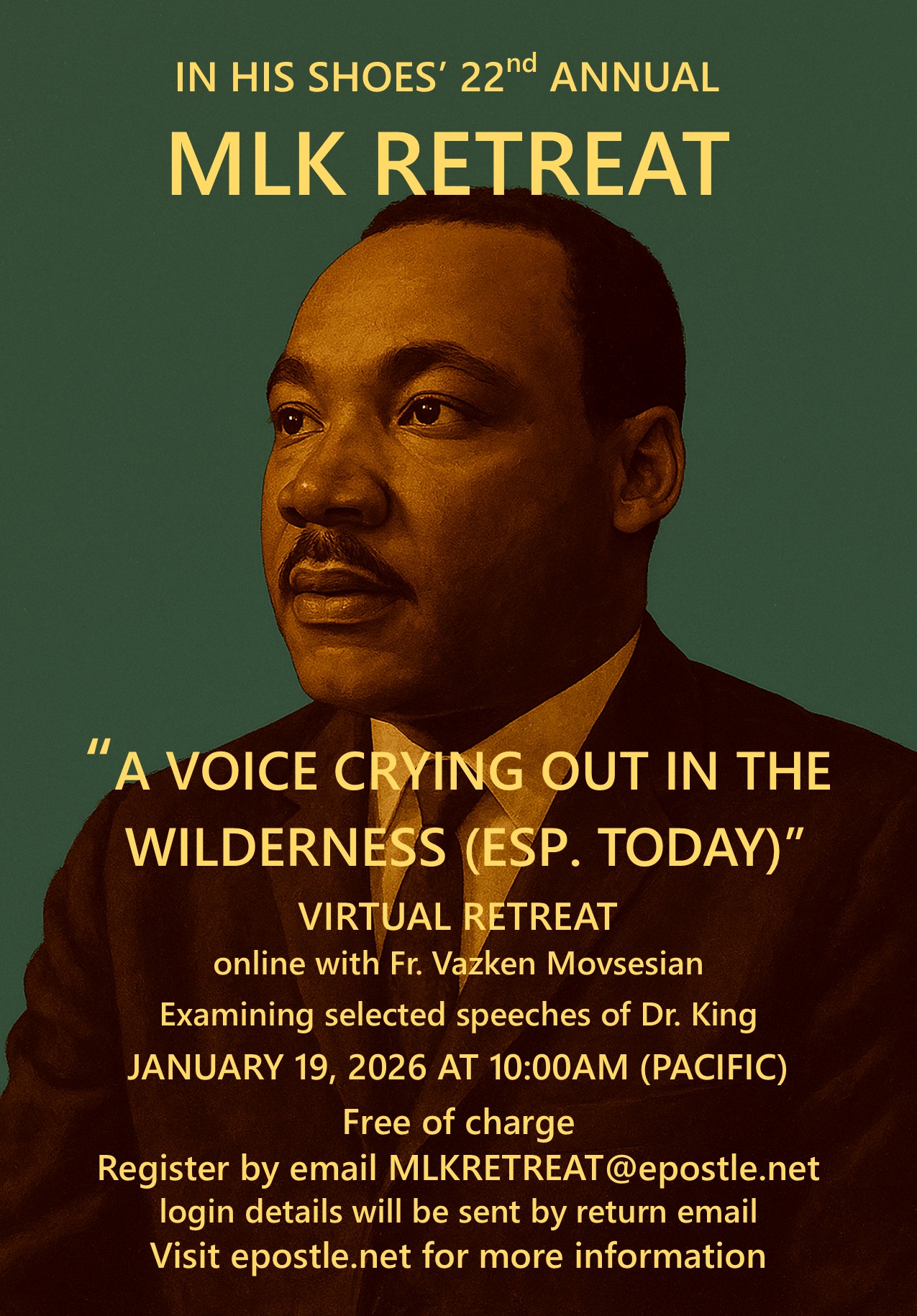

MLK Virtual Retreat 2026

Advent 17-50: Resist Not Evil

Advent Day 17 of 50: Resist Not Evil

On this Advent Journey we reach a major hurdle which will also be a milestone for us. Jesus’ command to not resist evil is one of the most difficult statements to digest because inherently we wish to fight and eliminate evil. For this reason, it is a hurdle, and it is a milestone in our journey because so much rests on our acceptance of this commandment.

Jesus says, “You have heard that it was said, ‘An eye for an eye and a tooth for a tooth.’ But I tell you not to resist an evil person. But whoever slaps you on your right cheek, turn the other to him also. If anyone wants to sue you and take away your tunic, let him have your cloak also. And whoever compels you to go one mile, go with him two. Give to him who asks you, and from him who wants to borrow from you do not turn away.”

Before placing this into the category of weakness, pull out your Advent journals and refer to the lessons on harnessed energy, the discipline that turns our inner strength into focused power. The night that Jesus was born the heavenly hosts proclaimed, “Peace on Earth and goodwill toward men.” (Luke 2:14) The Will of God is proclaimed for all of humanity with the birth of Jesus Christ. For there to be peace, the Prince of Peace advocates for nonviolent resistance to evil. It is the only solution and the only means of bringing about Peace.

The common misconception then, in the time of Jesus, as well as now, is that violence and more evil brings about peace. Mathematically we can formulate this as a + a = -a. It is just as absurd in theory as it is in practice.

Thinkers have pondered these words of Jesus for centuries and have argued pro and con to the subject. Heavyweights like Tolstoy have written volumes on the subject, as well as non-Christians, such as Gandhi have patterned the plan for liberation on nonviolent resistance. Third world countries, liberation theology and of course the Civil Rights movement in America have used Jesus’ teaching as a foundation and model on the path to equality and justice. According to Gandhi, “An eye for an eye makes the whole world blind,” to which Rev. Martin Luther King Jr. added, “If we do an eye for an eye and a tooth for a tooth, we will be a blind and toothless nation.”

We’re not through with the topic. It is the foundation for Jesus’ life and ministry. For today, let us pray a prayer offered by the Rev. Martin Luther King, Jr.: O God, make us willing to do your will, come what may. Increase the number of persons of good will and moral sensitivity. Give us renewed confidence in nonviolence and the way of love as taught by Christ. Amen.

Mindset Change-2

Untold stories from the Armenian Church Youth Ministries Center

Today’s Episode: Changing Mindset 2

As we wind down this series “It was 20 years ago today” before the feast of Ascension (40 days after Easter), we’re taking a look at two of the biggest miracles we experienced changing the mindset of the community, and opening the doors for what is possible in and through the Armenian Church. Yesterday we looked at forgiveness within the community, today we look at the community itself. Both of these mindset changes have to do with the acceptance of reality.

Armenians rightfully take pride in the historic reality that Armenia was the first Christian nation. The operative word for us today is was. The first Christian nation belongs to the 4th Century, while the decedents of that nations, well, ideally, belong to the 21st century, removed by over 1700 years since that nation-changing event. To take claim to that Light of Life that Illuminated Armenia in 301 A.D., the connection has to be justified. The Jews of Jesus’ time tried to justify themselves before him by claiming to be heirs of Abraham, to which Christ responds, “And do not think you can say to yourselves, ‘We have Abraham as our father.’ I tell you that out of these stones God can raise up children for Abraham.”

We can hear the same voice asking Armenians, “And you not suppose that God can create the children of the Armenian nation out of these stones?” In other words, the past is gone, what are you doing to justify your position as children/heirs of the first Christian nation? The challenge we had before ourselves was to change the mindset of pride to a mindset of responsibility.

In 2005, when His Holiness Karekin II, the Catholicos of All Armenians made his pontifical visit to the United States, two of us from the Armenian Church Youth Ministry Center were asked to participate in a symposium held at the University of Southern California. Dr. Dekmejian spoke about the a plan for growth in the Armenian Church utilizing basic ideas of faith-building. My topic was “Globalization and the Armenian Church.” At the end of the conference, His Holiness took both of these plans back to Armenia as a game-plan for the Armenian Church in the 21st century. The idea was simple: we in the Armenian Church have much to offer the world in terms of the being the oldest Christian tradition on earth. At the same time, we have a lot to learn from communities that have adapted to the realities of the day.

One of those communities we looked at was the African American community in the United States. Often we Armenians are compared to the Jewish community primarily because of the connection of Genocide. But a comparison to the African American community has many more parallels. Unlike the Jews who were in Europe leading to the Holocaust, Armenians were residing in their historic homeland. The Nuremberg Trials were held in the 1940s, an international war crimes tribunal which revealed the true extent of German atrocities and held some of the most prominent Nazis accountable for their crimes. Germany accepted responsibility and reparations were made.

Through the years I had read and heard (in recordings) the great Civil Rights leader the Rev. Dr. Martin Luther King, Jr. His words moved and inspired me. In particular his “Letter from Birmingham Jail,” I found to be one of the most eloquent pieces of Christian writing, in any age, and one that reverberated in my heart. It spoke to the plight of the Armenian people and Armenian Church, as much as it did to that of the African American population and the Black church. I must say here, that King would go out of his way to emphasize that in light of all of the accolades, degrees and titles that could be used to identify him, first and foremost he was a minister of the Gospel of Jesus Christ.

Beginning on the first year at the Youth Ministries Center and continuing every year thereafter, we organized Martin Luther King “Retreats” where we would take away groups, mostly young in age/young at heart, to study the works of King, side-by-side to the writings and teachings of Armenian Church leaders such as Khirimian Hayrig, St. Nersess Shnorhali, St. Gregory of Narek and St. Gregory of Datev. We studied and then challenged participants to walk the path forged by Jesus and followed by these most incredible leaders and students of Christianity.

The mindset began to change, ever so slowly, but it did. The majority of our congregation at the church and center were immigrants. They started understanding the huge responsibility they had as children of the Armenian Church. They were hurting from their experiences and were empathetic to others in pain. They would attend rallies in support of Domestic Violence, walking hand-in-hand with survivors, in marches organized on the streets of Glendale and Burbank. They produced a video “Greetings of Hope” as a message to refugees of the Genocide in Darfur. They extended themselves to the poor and the needy. The miracle happened, they saw themselves as representatives of the Resurrection, not as victims of a crucifixion.

The waves of change are not easy to land. There was opposition to these altruistic efforts from Armenian American leadership who could not see beyond their noses. But we were persistent. I used every opportunity that I could to get the message out. From the pulpit, of course, but I also spoke on college campuses, at High School Baccalaureates, at retreats and seminar, and on television and radio interviews. There is a song that the freedom fighters during the Armenian Genocide would sing, Միայն զէնքով կայ հայոց փրկութիւն = Armenian’s salvation is only through the gun. I had the audacity to quote this in interviews and then add that the greatest gun or weapon that we have is our capacity to love and to give. Interviewers didn’t know whether to censor me or pretend I didn’t say it so that it could be dismissed. But we continued. And then we rolled out our greatest weapon, the electronic forum = Epostle dot net.

Join me tomorrow as we tie up “20 Years ago today” with the miracle of apostolic evangelism for an electronic world.

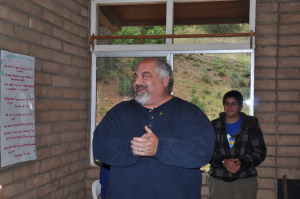
Cover: At the House of Blues – Mike Geragos leads the singing at the IHS MLK Retreat, circa 2010

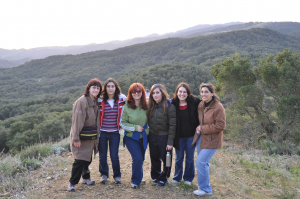
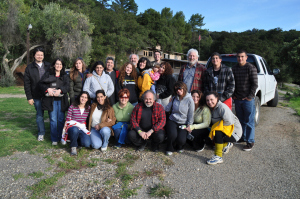
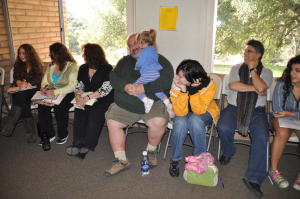
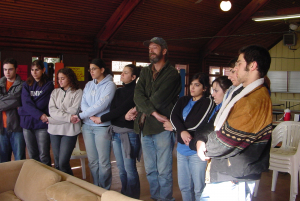
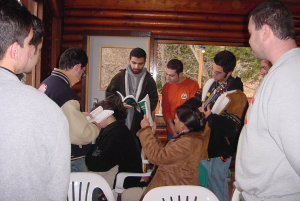
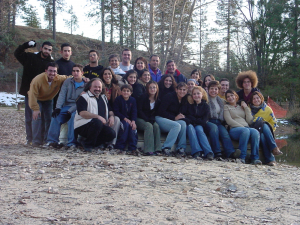
Below: Pictures from various MLK Retreats

Without a life-line

Next Step #658: Fear, anxiety and our worst nightmares are coming true in this age of pandemic. Being alone at the time of death: Faith and the belief that we’re not alone. Lost and disconnected: The challenge to walk in the shoes of others. MLK weekend, upcoming with prayers. Losing control and leaning on crutches: drugs, alcohol and religion.
Reddit: Nightmares
This week’s WD168
MLK Retreat 2021
Virtual Homeblessing
Footprints in the Sand
Luke 4
David Bowie, Space Oddity
George Winston
Cover: IHS at Mt. View by Fr. Vazken 2021
Engineered by Ken Nalik
Produced by Suzie Shatarevyan for InHisShoes.org
Look for The Next Step on blubrry.com
Listen via Stitcher Radio on demand! 

Extreme, Fanatic and the Good

Next Step #606: “Prayers for the President” opens a discussion about fanaticism. The Old Testament and the most severe curses of the Bible: Jesus’ radical approach. Fanaticism – fear and warnings about literalism. Martin Luther King Jr. an “extremest for love” in the footsteps of Jesus.
Epiphany by The Piano Guys
Dr. King interview by Alex Haley in Playboy (1965)
Psalm 109
Kellyanne Conway’s Husband / Trump & Evangelicals
MLK Nobel Peace Prize Speech
MLK and Armodoxy; Armenian Christianity Today #38
Next Step #31 – MLK & John the Baptist
Cover: Arizona Solitude 2012 Fr. Vazken
Engineered by Ken Nalik
Produced by Suzie Shatarevyan for InHisShoes.org
Look for The Next Step on blubrry.com
Listen via Stitcher Radio on demand! 

Bringing Jesus into the Church

Next Step #555: Deflate those balloons and bring Jesus in from the storm – into the church so he can inspire. Martin Luther King: the power of Christ from within the Church. Metaphysical elements of our faith to build on. Lady Gaga: “Do what you want.” Guns in America: Applying the hard concepts of Faith. TED talks filling the void and talking about In His Shoes. Inspired by the Lunar Eclipse – total and the world is a ball!
Udi Hrant
Guns in America: Time Magazine December 2018
TED Radio re: Forgiveness
Total Lunar Eclipse pictures
Lady Gaga & R. Kelly
AC101 on Vestments
Traditional Crossroads
Cover Photo: In from the cold by Fr. Vazken 2018
Technical Director: Ken Nalik
Produced by Suzie Shatarevyan for InHisShoes.org
Subscribe to In His Shoes » Next Step with Fr. Vazken by Email
Look for The Next Step on blubrry.com
Listen via Stitcher Radio on demand!

Singularity In and Out

Next Step #449: Singularity of events from the Big Bang to the Baptism of Christ to the MLK weekend ahead. The power of Love as the “ONLY” transforming power: What are the restrictions and what are the chances for change? Greasing the roads with Dr. King and St. John the Baptist. Sermon on Theophany in Thousand Oaks.
Joni Mitchell, “Love”
MLK on Love
GALAS: http://www.galasla.org/
Theophany Sermon, Thousand Oaks
RECLAIM: Embracing Our Faith in a Changing World www.Embracing-Faith.com
Photo: Sunset over Van, Fr. Vazken 2014
Engineered by Ken Nalik
Produced by Suzie Shatarevyan for InHisShoes.org
Subscribe to In His Shoes » Next Step with Fr. Vazken by Email
Look for The Next Step on blubrry.com
Listen via Stitcher Radio on demand!

Miscalculating the Rev.

Next Step #398: Reflecting on MLK and miscalculating the urgency factor in applying to our needs; David Bowie form and function and the irrelevance of a January 6 comment – Zeus made it here! Some mythology you may not want to hear… sad or funny? In this left handed production we review voice recognition software.
Song: Luys Vocal Quintet www.naregatsi.org
MLK Birmingham letter
Pasadena Independent Celebrating a Dream and a Life of Nonviolence
2006 MLK Retreat Liturgy – Newberry Springs
David Bowie
Engineered by Ken Nalik
Produced by Suzie Shatarevyan for InHisShoes.org
Subscribe to In His Shoes » Next Step with Fr. Vazken by Email
Look for The Next Step on blubrry.com
Listen via Stitcher Radio on demand!