Half Life along side a Full Life
“The half-life of a quantity whose value decreases with time is the interval required for the quantity to decay to half of its initial value. The concept originated in describing how long it takes atoms to undergo radioactive decay, but also applies in a wide variety of other situations.” (Wikipedia, 09/26/08)
Today is my half-life. I’ve spent exactly half of my life as a priest.
My mother has a friend who calls me by my baptismal name, Hovsep, because she claims that’s how she’s known me. Of course, this is an excuse to offer her some skewed sense of personal validation, as someone who knew me “when…”. But as of today, the excuse doesn’t hold much water; I have lived an equal number of days as Vazken and as Hovsep. Tomorrow the scale tips the other way.
People struggle with identity issues all their life. Early on, I would have probably said I struggled between two identities but now I understand them to be the same. A priest’s name-change only marks the pre- and post-ordination periods of his life, but his identity as a priest has been established before his ordination, as we believe his calling predates his taking vows.
I was named after the great patriarch of the Armenian people, Vazken I (Catholicos from 1955-1995). I was honored that my ordaining bishop, Archbishop Vatché Hovsepian, named me after the venerable Catholicos. Vazken I was consecrated as the chief shepherd of the Armenian Church, almost three decades earlier, on that (this) same day. (It also happens to be Gomidas Vartabed’s (Soghomon Soghomonian’s) birthday.)
A couple of weeks ago, a communiqué came to us from the Diocese, instructing a special Hokehankist (Requiem Service) to be conducted on Sunday, September 21, for the late Pontiff, Vazken I. They were marking the 100th anniversary of his birth. Here we go again… I thought. Like, don’t we as the Armenian Church – the LIVING CHURCH of JESUS CHRIST – have ANY OTHER service beside requiem services? Like, isn’t it possible to celebrate instead of mourn? And, to add insult to injury (my mental injury, that is), the day of the requiem was September 21 – Armenian Independence Day! Just 17 years earlier, Armenia, after being locked and squelched by the Soviet communist state for 70 years, proclaimed its independence. Was it asking much to come up with another way of celebrating this man’s life, especially on a joyous day as Independence Day? I know, I know, it’s Einstein’s other theory: “Insanity is doing the same thing over and over again, expecting different results.” It is the same old regime, why am I expecting anything different?
So I’d like to offer some thought on the life of His Holiness Vazken I. As someone who is honored to have received his name, as someone who was certainly touched on several occasions by the presence and soul of this giant among men, I peered at his life from a unique vantage point. Here I am 26 years now, with the name of this man, who really shaped me, and gave me the opportunity to serve our Church.
For us, growing up in America, Vazken I, was an icon. He was bigger than life. Long before simulated worlds dominated electronically enhanced imaginations, there was the concept of a “virtual Armenia.” In the 1950’s, 60’s and 70’s, Armenia was only experienced virtually. My grandmother visited her sisters in Armenia in 1960 and 1967. I remember when she went it was as if she had gone to the North Pole. It was somewhere in our imaginations – there were no travel guides and books. Magazines from Armenia used a very primitive screening process on their pictures making the images very difficult to decipher. There was a Life-magazine-wanna-be called “Soviet Life” but they were as difficult to find here in America as Life magazine was in the Soviet Union. In 1968 “Soviet Life” featured Armenia, and that was our first glimpse at the homeland.
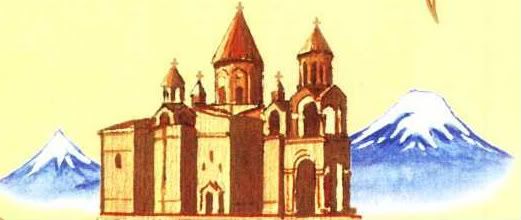
But the main images that defined our virtual Armenia were Mount Ararat and Holy Etchmiadzin. Ararat was always sketched, drawn or photographed with two peaks and snow atop the summits. We had heard that it was in the boundaries of Turkey, but that didn’t mean too much to us. Ararat was the Armenian mountain. Period. Like the genocide, from which we all came, Ararat was not up for debate. It was just accepted as the Armenian mountain. We had t-shirits, signs, posters and all kinds of markings with the double-peaked mountain, and we all identified it as the symbol of Armenia. The other image, Holy Etchmiadzin, was a generic symbol of the Armenian Church. I don’t think we even realized it was the monastery itself, but the image came to mean “Armenian Church.” And put them together – Etchmiadzin against the backdrop of Ararat – and you had instant branding for Armenia! No need to pay anyone on Madison Avenue for this kind of recognition – it was built into us.
Growing up in America, we also had some idea of the Soviets. The adults would speak about them as “bad guys” but it wasn’t until Ronald Reagan’s time, in the 1980s, that he ascribed the term “Evil Empire” to the Union. We just knew that Armenia was locked into the Soviet Union, and as much as we called it “Armenia” for ourselves, to the outside world it was one big blob called the Soviet Union, and often times “Russia.” I remember this would drive me crazy. I knew we weren’t Russian, but it was just too easy for the Americans to paint it all with a broad stroke. If we wanted to write a report for school about Armenia, we’d have to search the indexes of the Encyclopedias or the Almanacs as a sub-category of the Soviet Union. And there it was “Armenia SSR” the smallest republic!
So amidst the cold war, a small nation and a small group of people behind that nation, we had a hero. He became the icon of the Armenian people. He was the Catholicos Vazken I. When he came to America, it was not only the head of the Church visiting, but for us he was the head of the nation. After all, everywhere the post-Genocide generation established itself, they lifted a dome and consecrated their churches. Church and state were intertwined.
In 1960, His Holiness Vazken I became the first Catholicos to visit the United States. He was a man of principle. He was a man who believed in doing right. In Los Angeles, the church community had rented the Shrine Auditorium (of Academy Awards fame) for the Catholicos to celebrate the Divine Liturgy. That day, the Pontiff came out of his car to a waiting crowd of several thousand. He looked up and saw the star and crescent on top of the auditorium and refused to celebrate the Liturgy under the Islamic symbol that was the banner for the murder of 1.5 Million of his people during the 1915 Genocide. He couldn’t justify Armenian churches being empty that day, while he was at this auditorium. And so, the thousands in waiting were moved to the nearby St. James church on Adams Blvd.
I had a chance to meet with Vazken I in 1960, then in 1968 when I was 12 and later when I went to seminary. In the evenings, he’d take a stroll through the grounds of the monastery, and we young seminarians would be on our guard – what if the Catholicos caught us NOT studying?
He came to America for the last time in 1987, and we celebrated the Divine Liturgy at the Hollywood Bowl. It was a memorable occasion, probably because he was older. We met him in San Francisco and he gave a blessing on my son Varoujan. He was the father figure we all understood him to be.
Vazken I was a charismatic individual. I remember at the time he passed away (1994), I was editing a publication called “Window: View of the Armenian Church” along with Hratch Tchilingirian. We were responsible for providing the information for so much of the Armenian Church immediately following the collapse of the communist state. It gave us a very special vantage point to analyze the happenings of the Armenian Church. I remember a conversation off-line with Hratch, where we were discussing the greats of the Armenian Church. It was obvious that the demise of Vazken I was really the end of an era.
I wrote an article for my parish newsletter, “Nakhagoch” immediately following the death of Vazken I. I reprint it here for a few reasons. First, I think its important that we recognize and honor our dead not only with requiems, but with tributes to their legacy. Second, as I write in the article, the greats become great for shaking the world, yes, but because they shake lives. Certainly, Vazken I shook my life. Finally, as I begin my 26th year as Vazken the priest, I want to keep a living tribute to this giant, but living out the ideals that were important to him and overlap my ministry.
Personal Reflections on the Passing of His Holiness Vazken I
by Fr. Vazken Movsesian
September 1994
It was early Thursday morning when I logged onto SAIN. There, with my usual email was a message from Istanbul, Turkey: His Holiness Vazken I Catholicos of All Armenians of beloved memory has entered eternal rest this morning (18 August 1994) in Yerevan.
It wasn’t shocking news, after all the Catholicos had been ill for some time now. Nevertheless, the message sent my mind wandering.
In the quiet morning hours, with the hum of a hard drive twirling, looking at this message on my computer screen, I couldn’t help but contemplate about His Holiness, the Church he represented and the future direction of the Church in our new society. Accelerating my thoughts was the fact that here, a priest of an ancient, conservative orthodox church was learning about the passing of the patriarch via a dynamic and progressive medium.We are standing at a pivotal point in the history of the Armenian Church.
It hasn’t been long since the Armenian Church has been forced to serve its congregation on foreign soils. His Holiness, the late Catholicos, had a difficult challenge before him when he took office. Post World War II Society, Stalinism, McCarthyism here in the States, the Cold War were the outside factors, while schisms among the Armenian people had contributed to assassinations and internal fighting. Yet the 47 year old bishop from Rumania took the helm of our ancient Church and became the 140th successor to the Apostolic throne.
He fought the atheism of the Soviet state with caution and tact. The fact that Armenia enjoyed a religious life and the Kevorkian seminary operated was a testament to His Holiness’ diplomatic style.
I had the good fortune and honor to meet His Holiness on several occasions. His first visit to the United States was in 1960. My parents were ACYO members and met the Catholicos as representatives of the Church youth group. I was four years old and remember him only as a warm and kind father. My mother had sewn him a cross holder and presented it to him that day. This gift he used for many years to come.
The cross holder made our next meeting, in 1968, a possibility. It was more than an opportunity to be off of school that day that made me want to accompany my parents to visit him in Los Angeles. I was 12 years old and going through the usual adolescent struggle to find identity. His Holiness was the embodiment of everything Armenian. After all, he was the “leader” coming from the homeland.
I remember being captivated by his charisma. He was overpowering, yet humble. He allowed this young boy to stay with him for a day and share some precious moments together. You would look at him and know that you were in the presence of a man who took his commitment and position seriously. This meeting had a great impact on my life.
It wasn’t until after I finished college, that I had another opportunity to meet him. This time our meeting was on Armenian soil. Our primate, Archbishop Vatché took me to Etchmiadzin in 1977 where I had the golden opportunity to study at the birthplace of our Faith and under His Holiness’ shadow. We would meet with him, once a week for classes in human psychology. Though the material was outdated by contemporary standards, it was the personal dialogues in which we engaged that made this a true learning experience.
The time I spent in Etchmiadzin is dream-like now. We would see the Catholicos daily when he walked in the garden, at the dinner table or in the church.
In 1982, we met in a more spiritual way. I was ordained to the sacred order of priesthood on September 26, on the anniversary date of His Holiness’ consecration as the Catholicos. On this occasion, Archbishop Vatché named me Vazken, in remembrance of that anniversary.
The last time we met was in 1987 when His Holiness made his last pontifical visit to the States. He was tired and the age and struggle of his people were catching up with him. Nonetheless, he did not cease to inspire us. As faithful of St. Andrew, we greeted him at various functions and services held here in the Bay Area. On the last day of his visit I was honored to accept on behalf of the St. Andrew parishioners, a gold hand cross, which now sits on our altar.In the weeks to come, you will be reading in the Armenian press many biographies about a giant of a man, about a patriarch who held the reigns of the Armenian Church for almost four decades, about the inner struggles and national aspirations of a father.
In these few paragraphs, I’ve briefly outlined his influence in my life. Sometimes we project upon our leaders and ‘heroes’ bigger-than-life images with global influences and impact. Unfortunately we forget that their greatest work is on the human level transforming their concerns to action – hugging a little boy, spending time with a young man, teaching a student and inspiring with form and actions. This is how the late Catholicos touched my life.
As for e-mail and hard drives, we will always have tools. But inspiration is something we can only get from humans who have souls, dreams and love.
I thank God for the opportunity to have known His Holiness Vazken I, as a leader, teacher and father. May God rest his soul and continue to provide us with inspiration.