
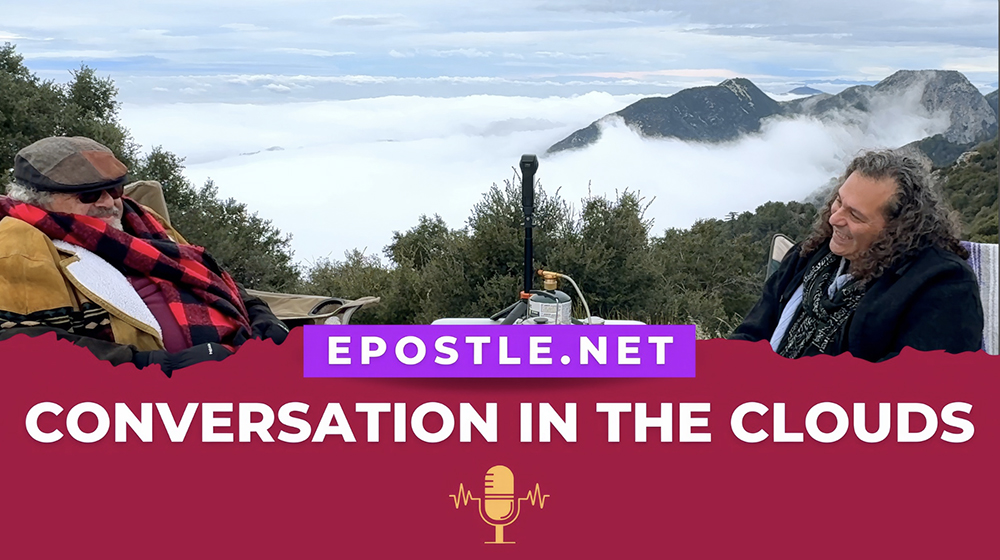
Mountain Talk
A Conversation with Father Vazken Movsesian and Gregory Beylerian on Identity, Creativity, and the Mystery of Being.
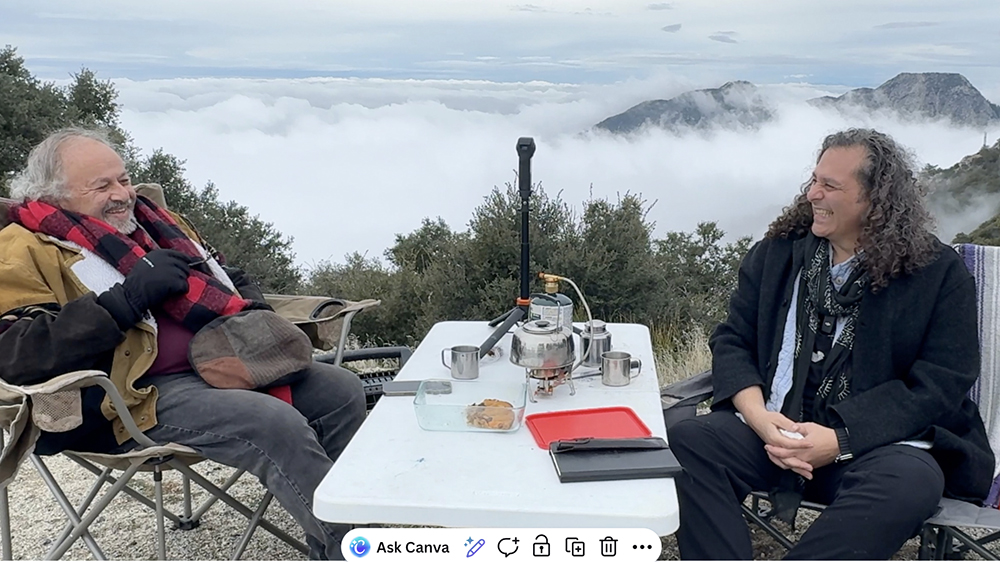
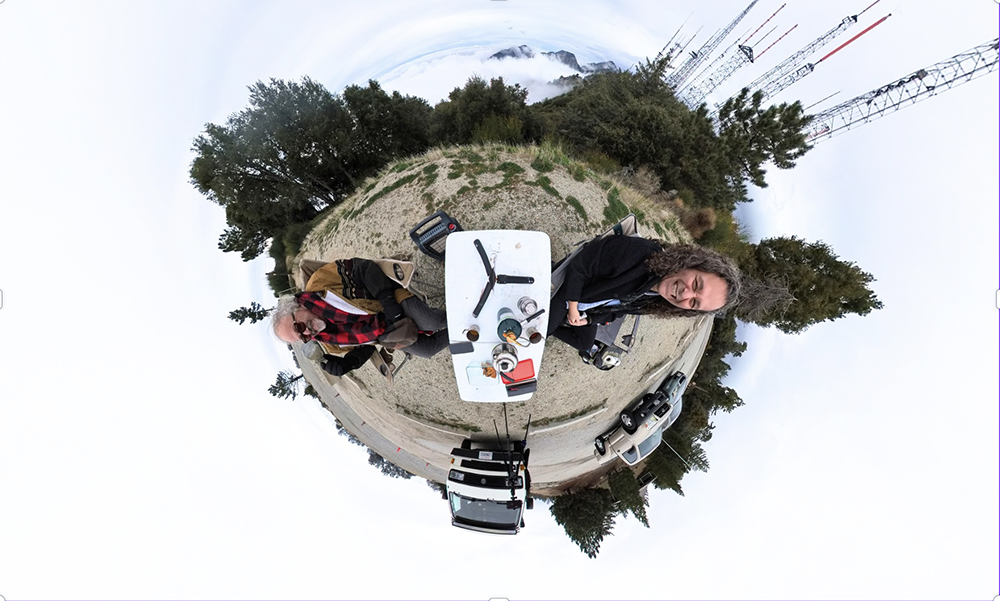
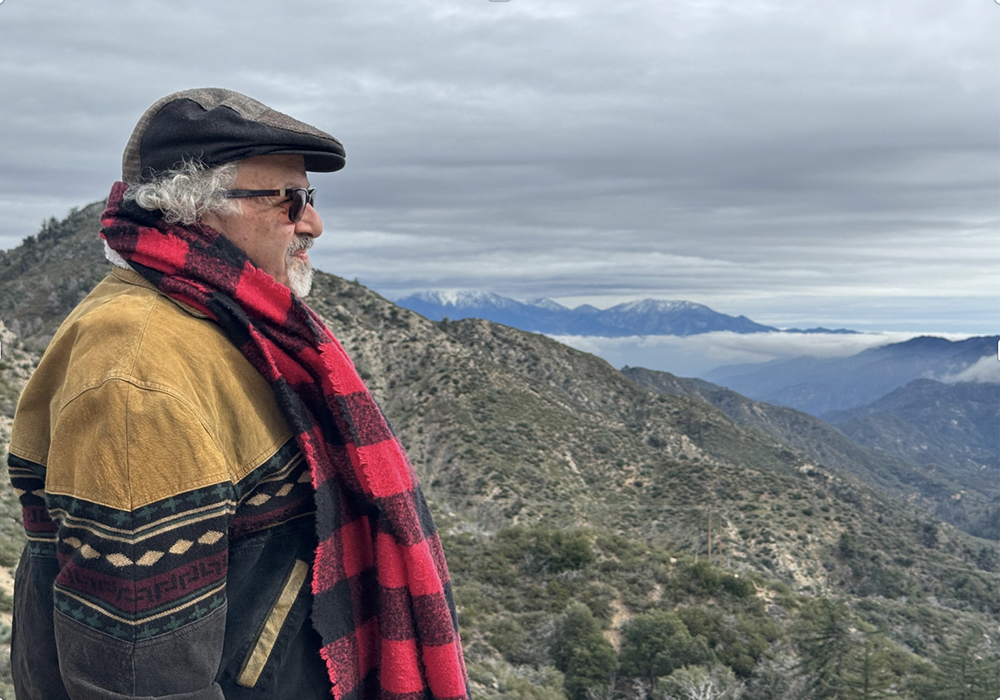
On a quiet mountaintop overlooking the vastness of creation, Father Vazken Movsesian and artist Gregory Beylerian shared tea and reflection, an unscripted exploration of life, identity, spirituality, and the state of humanity. What emerged was a deeply human conversation, rich with humor, humility, and insight into the challenges and beauty of modern existence.
Roots and Identity
Their dialogue began with something simple, homemade rojig, a sweet made from Armenian grapes grown in Pasadena. From there, they explored the meaning of cultural connection and belonging. How does identity shape who we are, and how can it both liberate and limit us?
For both men, identity is not merely ethnicity or history, but a living bridge between past and present. As Father Vazken observed, “It’s not only for yourself, but in defining who you are in the bigger picture.” Gregory expanded the thought, recalling how ancient Indian mystics once taught children to identify first with the cosmos, to root their identity in the whole of creation before nation or tribe. Such a perspective, he said, inspires unity rather than division, compassion instead of competition.
Living in the Now
Father Vazken reflected on how religion often misdirects people’s attention toward “a time to come,” missing the spiritual essence of the present moment. “Jesus wasn’t teaching about something far away,” he said. “He was showing us how to live right now, peace on earth, goodwill toward one another.”
Gregory connected this with the need to evolve beyond survival thinking. Humanity’s progress, he suggested, requires cooperation, mirroring the harmony already present in nature. “Nature doesn’t show survival of the fittest,” he said. “It shows a cooperative relationship. That’s the wisdom we’ve forgotten.”
Education, Creativity, and the Human Spirit
Their conversation naturally turned toward education, how systems built on competition stifle creativity and curiosity. As a teacher and parent, Gregory lamented how children’s innate creativity is often the first thing cut from school budgets. “The art class isn’t just for making Picassos,” he said. “It’s where problem-solving, innovation, and social vision are born.”Father Vazken agreed, describing education not as a means to make money, but a way to connect, understand, and participate in the human story. “Education’s purpose is knowing that you’re not alone here, that you’re part of something bigger.”
Mass Formation and Higher Intelligence
Gregory introduced the concept of mass formation, the way collective consciousness can be manipulated when intellect is disconnected from higher intelligence. Propaganda works not because people lack intelligence, he explained, but because their awareness is confined by identity.
He drew a distinction between intellectual and divine intelligence: “Our intellect can be shaped by the world, but imagination, the higher mind, connects us to creation itself.” Father Vazken reflected that the danger lies in forgetting vision. “Where there is no vision, the people perish,” he said. “Knowledge is important, but that’s not education’s purpose. It’s about learning how to live, connect, and find meaning.”
The World at a Crossroads
Their conversation moved to the state of the world, war, environmental degradation, and political corruption. Both men agreed that humanity has the resources to heal these problems, yet lacks the creativity and moral vision to apply them. Father Vazken spoke passionately: “We fight fire with fire, and that just makes more fire. We’ve convinced ourselves there’s no other way, but there is.” Gregory noted that despite our technological evolution, consciousness has lagged behind. “We’re entering a time when people are waking up,” he said. “Maybe this isn’t a revolution of violence, but a revolution of awareness.”
The Return of Myth and Meaning
Gregory invoked Joseph Campbell’s reminder that societies survive through their myths, living stories that help people understand who they are and where they’re going. “Without vision,” he said, “a culture perishes. We need to retell the old stories in new ways.”
Father Vazken agreed: “Without relevance, even religion loses purpose. These stories were created to help us explain the mystery, to remind us of something beyond ourselves.”
They discussed the vastness of creation, from the first spark of light to the latest discoveries of modern science. “This isn’t just a 2,000-year-old story,” said Father Vazken. “It’s a 13-billion-year-old one. Everything we see, all of it, is part of that same beginning.”
The Hero’s Journey
Gregory reflected on Campbell’s Hero’s Journey as a metaphor for spiritual awakening. “You leave the comfort of your village, your security, and face the unknown,” he said. “The monsters you meet are really your own fears. When you conquer them, you return to your community with wisdom and gifts.”
Father Vazken added that different traditions describe this same journey in different language, “Follow God’s will,” “Listen to the universe.” , Gregoy responded “ ahh, trust the flow”. Each points to the same truth: we are guided when we open to mystery.
Eh, The Presence of Being
Among the most profound moments in their mountaintop dialogue was the exploration of the ancient Armenian letter “Eh” (Է), a symbol carved for centuries above the altars of Armenia’s oldest churches.
Gregory recalled asking Father Vazken what the mysterious sign meant, seeing it over and over in monasteries built atop mountains and inside caves. “It’s Eh,” Father Vazken explained, “the verb to be in the present tense.” In that one syllable lies the heart of Armenian spiritual philosophy: presence. It is not a noun or a static identity, but an active state, being.
Father Vazken described Eh as the essence of reality itself. “It is the ultimate verb, the living now,” he said. “Everything else passes. The past is gone, the future may not come, but this moment, this presence, is real. This is where life is.”
Gregory reflected that this symbol captures what mystics and teachers across traditions have tried to convey for millennia: the invitation to be here now. From the teachings of Jesus to the insights of Eckhart Tolle, the message is universal, the eternal resides in the present.
They both noted how children embody this truth effortlessly. “A child lives in the eternal,” said Father Vazken. “They wake up to a new day without carrying yesterday. What a beautiful way to live.” In this way, the Eh becomes more than a letter, it is a map back to consciousness, a reminder that God, existence, and awareness all meet in the same timeless point: Now.
The Power of Mystery and Presence
Both men concluded that the greatest loss of modern times is our comfort with not knowing. “We’ve forgotten how to live with mystery,” said Father Vazken. “Not everything can be solved or Googled.”
Gregory emphasized the need to remain open, to cultivate a “beginner’s mind,” even after decades of experience. “That’s how discovery continues,” he said. Their conversation ended as it began, simple, grounded, human. They spoke of the wisdom of children, who live fully in the present, unburdened by yesterday or tomorrow.
A Shared Vision
As the sun dipped below the mountain, their tea cooled, and the conversation settled into silence. Two friends, a priest and an artist, had traced the arc of human experience, from cosmic identity to earthly compassion, from intellect to mystery. In their exchange was a quiet reminder: that the way forward for humanity is not through more technology or ideology, but through awakening the heart, nurturing creativity, and remembering our shared belonging in the great cosmic story, in the eternal Eh of being.
Screenshot


 2026 Epostle
 1999 Fr Vazken
Leave a Reply
Want to join the discussion?Feel free to contribute!