
Tag Archive for: Crucifix

The Transformed Cross

Armodoxy for Today: The Transformed Cross

St. Cyril of Jerusalem witnessed to the Apparition of the Holy Cross, which lit the sky in the year 351 from the hill of Golgotha to the Mount of Olives. I shared that witness with you yesterday, which described the rays of light being brighter than the sun.

The cross was an instrument of torture and death. The act of crucifixion took place on a cross, where those who were sentenced to death would slowly die of asphyxiation and exhaustion over the course of several hours. The word “torture” finds its meaning in the Passion of our Lord Jesus Christ, when he was whipped, beaten, physically abused, made to carry his cross up the hill to Golgotha where he was nailed to the cross and mocked as he died a slow death.

Christians celebrate the cross. It’s hard to imagine that anyone would celebrate an instrument of torture and death. Certainly not the rifle from a firing squad, nor an electric chair, gas pellets from the death chamber nor a hypodermic needle delivering deadly toxins to the central nervous system of a prisoner. No. It would be absurd to celebrate these instruments of torture, and certainly we would never hang a replica around our neck, nor adorn our houses and spires with them. However, when we Christian point to a cross with joy, wear it around our necks or lapels, or see it as an ornament, we’re doing exactly that – we are celebrating an instrument of torture, with one major difference! Jesus defeated the cross! He resurrected! He beat evil with good, overcame darkness with light and dismissed hatred with pure love. In other words he turned the Cross into a symbol of holiness and victory. It is there that we Christians find an expression of joy.

The Cross which appeared in the sky was brighter than the sun, of course. It could not be anything but brighter. The Cross symbolizes the ultimate victory of Life over death and Jesus is the one who demonstrated that. But I did promise a connection to a bright cross in our world and in our lives today. Tomorrow, we get closer to that reality as the Cross appears in our lives.

Today we pray, O Christ, Redeemer of the world, You took the wood of shame and made it the Tree of Life. Upon the beams meant for torment, You stretched mercy wide, and turned the nails of cruelty into the keys of salvation. May we lift our eyes to that holy sign, and remember that You have changed its meaning forever: from torture to triumph, from despair to deliverance, from death to the radiant victory of life. Amen.

Memories that Honor

Roots of Armodoxy: Memories that Honor

This week on the Roots of Armodoxy, we are looking at memories – those that honor, those that help us heal and those that keep us from moving forward. We’re looking at memories from different vantage points we’ve discovered in Gyumri, the second largest city in Armenia after Yerevan. This is the third episode of this mini-series of daily messages.

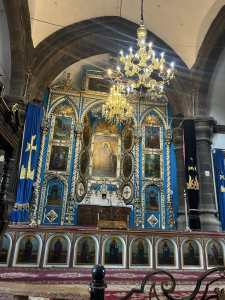
There are a couple appointments in the Church of the Seven Wounds that set it apart from other Armenian churches. The church, as we discovered, is one dedicated to the Holy Asdvadzadzin and points to “seven wounds” inflicted on the Blessed Mother, each annunciated in the Gospel of St. Luke. (See “Memories in Gyumri” for the list.) Aside from the church’s very unique name, inside the sanctuary the altar area is adorned with an iconostasis.  In Eastern Orthodox churches, such as the Greek or Russian Orthodox Churches, the iconostasis is a wall of icons and religious paintings, separating altar area from the nave of the church. In the Armenian Apostolic Church, that separation is demarked by a curtain. Secondly, in one of the side rooms where congregants are invited to light their devotional candles, there is a large crucifix hanging from one of the walls. Crucifixes are not part of the Armenian Church tradition, partly because the symbol of the cross emphasizes resurrection for the Armenian Church, that is, Jesus’ conquering the cross and our ability to do likewise.

These two unusual appointments – to reiterate, they are unusual within the Armenian Church – the iconostasis and the crucifix are reminders of the ecumenic spirit that is often overlooked when people think of the Armenian Church. Gyumri is on the crossroad of the continents and had visitors from different countries. The large Crucifix was left by a Roman Catholic congregation which was granted use of the Church of the Seven Wounds by the Armenians during the World War II, when the Catholics did not have a place to worship.

Ecumenism is the idea that Christians of different Christian denominations should work together to develop closer relationships to promote Christian unity. One of the pioneers of ecumenism was St. Nersess Shnorhali, the 12th century Saint and Patriarch of the Armenian Church. He offered a formula for Christian understanding which has been adopted by many church leaders through the centuries.* Shnorhali says that as Christians we must be united in essentials, approach secondary items of faith with liberty and display charity (love) in all things.

Essential items are the articles of Faith. We are united in our understanding of God as Father, the Son and the Holy Spirit. This is essential. Secondary matters might be practices which differ from place to place, community to community. Is the Crucifix necessary? Should you adopt a vegan diet as a Christian? And finally, we approach all our relationships with one another in a spirit of love, to promote Christ’s Birth announcement: Peace on Earth and Goodwill toward one another.

The Armenian Church has lived and survived by this simple code of ethics as articulated by St. Nersess Shnorhali. In the Church of the Seven Wounds, we find memories, remembrances, that honor the spirit of Christian Unity.

As our prayer today, we remember the words from the Gospel of John, and our Lord, Jesus Christ did say, “I am the good shepherd; and I know My sheep, and am known by My own. As the Father knows Me, even so I know the Father; and I lay down My life for the sheep.  And other sheep I have which are not of this fold; them also I must bring, and they will hear My voice; and there will be one flock and one shepherd.” Amen. (10:14-6)

* There are those who contend that this formula was given developed by Augustine of Hippo, but modern scholarship has shown otherwise.