Tag Archive for: Easter

Jesus in our midst, missed

Armodoxy for Today: Jesus in our midst, missed

Every Sunday, during the Divine Liturgy of the Armenian Church, the celebrant priest, descends from the altar area and processes around the inner circumference of the church.  As he walks by the congregants, he holds a cross in one hand and censes fragrant incense with the other.

There are a variety of reactions to his presence in the congregation. Some lower their head to ask for a blessing, while others kiss the cross in the priest’s hand out of reverence. Others smile and acknowledge his presence. Still, others watch as he goes by, not interested in engaging in any manner. And of course, for those who are not there at that moment, the opportunity to interact is lost because the priest processes through the church and ascends back to the altar area to continue the Liturgy.

This part of the Divine Liturgy, symbolizes Christ’s descent from the comfort of heaven to live, walk and be among us, after which he ascended back to heaven. During Jesus’ life, there were people who sought him for miracles and healings, while others engaged with him for a blessing and merely to touch his garment. And, of course, for many, the opportunity to be made whole was there and they let him pass by.

In life, there are moments that are singular and they demand our interplay at that moment, otherwise, they go by. Sometimes, events demand that we interact.

Today a genocide takes place. Ethnic cleansing is the plot. Hatred raises its head in a variety of places. And love also walks in our midst. What’s your reaction? To stay quiet and/or to ignore the horror, or to allow opportunities of love and healing to pass by are opportunities missed and lost. Unfortunately, they may never come back again. Like Jesus who walked this earth, those who interacted were healed and the made whole. Those who didn’t lost the opportunity.

In the Gospel of John (4) we read of a woman who encounters Jesus at a water well. Jesus asks for a drink of water and she is consumed by the politics of the day –“If you knew the gift of God and who it is that asks you for a drink, you would have asked him and he would have given you living water.”

You never know when that moment of singularity arrives. It is a moment that engages you into action.

Jesus told this woman, “Everyone who drinks this water will be thirsty again, but whoever drinks the water I give them will never thirst. Indeed, the water I give them will become in them a spring of water welling up to eternal life.”

We pray, Heavenly Father, I see pain and suffering in this world. I have walked that path in the past. I said, Never Again. Today, grant me the courage to speak out against evil everywhere, so that I may have the moral authority to voice myself whenever evil confronts me. Give me the strength to accept and carry the love you have put in my heart and for me to be an agent of that love through my actions. Amen.

Cover Photo: Lunabelle Beylerian, 2023

And there’s still much more…

Armodoxy for Today: What More?

Before finishing his Gospel, St. John writes:

And truly Jesus did many other signs in the presence of His disciples, which are not written in this book; but these are written that you may believe that Jesus is the Christ, the Son of God, and that believing you may have life in His name. (chapter 20)

And there are also many other things that Jesus did, which if they were written one by one, I suppose that even the world itself could not contain the books that would be written. (chapter 21)

Armodoxy maintains that we come to know Jesus through the stories we read but also by the Tradition that has been handed down to us through the centuries from the time of Christ, in other words, “all the things that could not be contained in the books.” These verses are important reminders of the vastness of Christianity and the unique place of the Armenian Orthodox Tradition, and Apostolic Tradition, which was there at the time of Christ and represents the most ancient form of Christianity. It is the calling card of Armodoxy.

Let us pray,

O glorious Lord, receive the prayers of your servant; and fulfill my requests that are deemed good. Through the intercession of the Holy Mother of God, and St. John the Baptist, and St. Stephen the first martyr, and St. Gregory our Illuminator, and the Holy Apostles, Prophets, Doctors of the Church, Martyrs, Patriarchs, Hermits, Virgins, and all your saints in heaven and on earth. Unto you, O indivisible Holy Trinity, be glory and worship, forever and ever. Amen. -St. Nersess Shnorhali

The Judas Spot in the Church

The first chapter of the Book of Acts tells us that Judas Iscariot, who betrayed Jesus, took his own life, and the remaining Disciples decided it was necessary to fill the vacancy caused by the death of Judas. They prayed and found two men who had been in their midst, in the company of Christ, from the time of Jesus’ Baptism to his Crucifixion.

They prayed and said, “You, O Lord, who know the hearts of all, show which of these two You have chosen to take part in this ministry and apostleship from which Judas by transgression fell, that he might go to his own place.” And they cast lots, and the lot fell on Matthias. And he was numbered with the eleven apostles.

More than a bit of trivia, I mention the selection of Matthias so that we understand that the Church which Jesus Christ established, the Apostolic Tradition, has order and structure. It is not a haphazard collection of people who gather based on their interpretation of Scripture. The Apostles took the Gospel message to different nations, so that the Church that was established in Rome by Peter or the one in Armenia by Thaddeus, carries the title of One, Universal, Apostolic, Holy Church. It is in this structure that the message of Jesus Christ was transmitted from the generation to generation and reaches us today.

We prayer, from an Orthodox prayer book, Be Mindful, O Lord, of Thy Holy, Universal and Apostolic Church; confirm and strengthen her, increase her and keep her in peace, and preserve her unconquerable forever. Amen.

He’s Not Here

You made it! Fifty Days since Poon Paregentan: 40 days of Lent and today the Easter Message comes to you: Christ has Risen! Blessed is the Resurrection of Christ

A Reading of the Gospel of St. Matthew, chapter 28

To which we can only add: Amen!

Քրիստոս յարեաւ ի Մեռելոց. Օրհնեալ է յարութիւնն Քրիստոսի:

Cover: “Rise” by Gregory Beylerian

“Eh” The Eternal Now: Christ Consciousness Awakens in a World on Fire

Click To Watch.

Ancient Armenian wisdom meets today’s spiritual hunger. Father Vazken reveals why the Kingdom of Heaven isn’t coming later, it’s already here, right now, if we dare to live it.

Los Angeles, CA – April 1, 2026

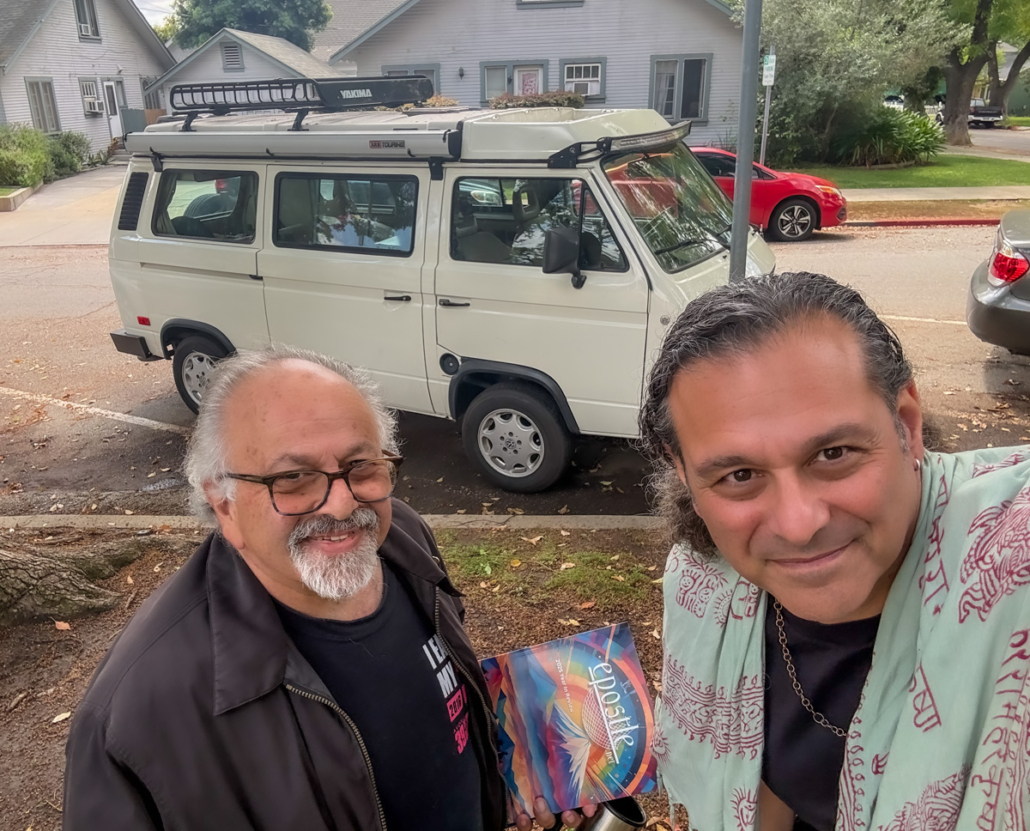
Highlights from a candid, 54-minute conversation recorded in the shadow of the San Gabriel Mountains, Epostle’s Gregory Beylerian and Father Vazken sat in Greg’s restored 1986 VW West camper van for what may be one of the most timely spiritual dialogues of the year. Just days before Easter, in the middle of Holy Week, under the full moon that sets the date for Easter, the two friends unpacked the single most radical idea in Christianity, one the Armenian Church has guarded for 1,700 years: Christ is not a memory. Christ is presence.

The conversation begins with Archbishop Derderian’s prophetic vision from last year: “Epostle is the future of the Church available today.” Father Vazken smiles and says, “We were talking about Christ consciousness centuries before the world gave it that name.”

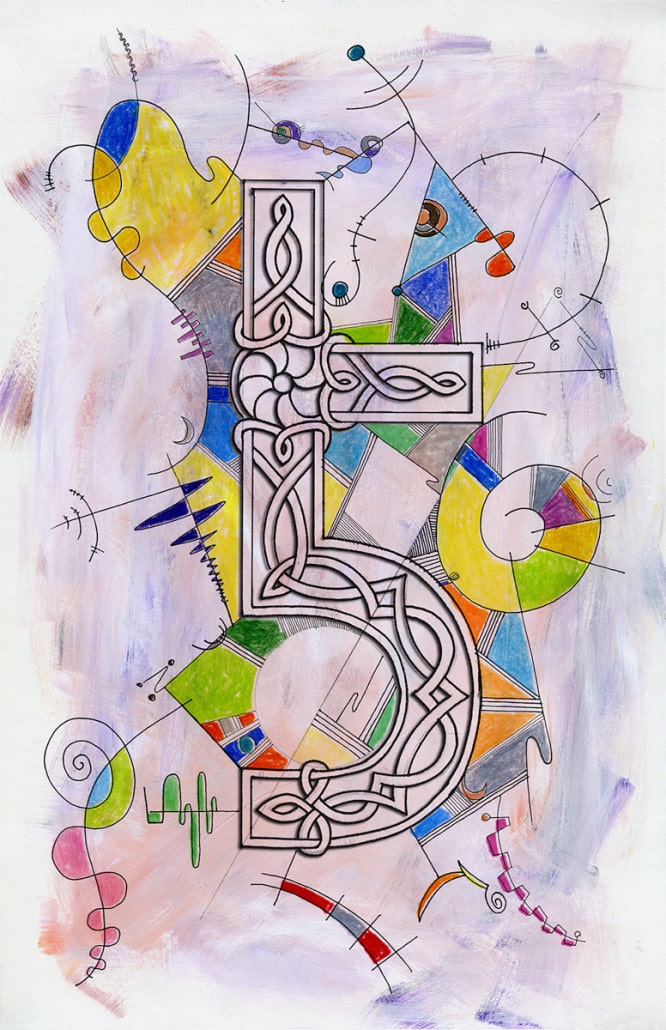
At the center of their exchange is one small, luminous Armenian letter: Է (Eh) the seventh letter of the Armenian alphabet, the verb “to be” in the present tense. “It means ‘is,’” Father Vazken explains. “Not ‘was.’ Not ‘will be.’ Right now. He is. God is. Christ is.”

Greg recalls walking into ancient Armenian churches in Armenia  with Father Vazken. in 2014 and seeing that same symbol glowing above every altar. “I asked Father Vazken what it meant, and when he told me… it was my aha moment. Eckhart Tolle, Ram Dass, Oprah, they were all pointing to the same doorway the Armenian Church had been pointing to since the 5th century.”

From there the dialogue flows like living water:

The Kingdom is now. Jesus didn’t say “the Kingdom is coming.” He said, “The Kingdom of God is in your midst.”

Greg responds, “So no one needs to die first to get there.” The resurrection is not a future event; it is the victory of light over darkness that happens the instant we choose love over fear.

The cross is not a symbol of torture, it is the ultimate symbol of love. Father Vazken shares the story of an Indian Orthodox Catholicos who removed his ring, handed it to him to read the Armenian inscription, and told his people: “These Armenians have never known Christianity without suffering. Listen to them.”

Revolution is not protest with an end time. Jesus rode into Jerusalem on Palm Sunday as a protest against empire. He didn’t go home at 4 p.m. He went to the cross. That is the difference between temporary activism and eternal revolution.

Father Vazken doesn’t shy away from today’s headlines. He calls the absurdity of solving problems with violence “the playground logic of grown men who never grew up.” He challenges the idea that any war can be fought “in the name of Christ.” And he reminds listeners that the Armenian people were invaded, genocided, exiled, never lost the one message that still offers the world hope: Presence.

The conversation crescendos as the two men connect the dots between the full moon that determines Easter, the resurrection that turns the worst Friday into “Good Friday,” and the personal resurrection each of us is invited into right now.

“Suffering is not the end,” Father Vazken says. “It is the a doorway to resurrection. You cannot get to Sunday morning without Friday. But once you see through the lens of resurrection, even Friday becomes good.”

Greg closes the episode with a simple, powerful question that lingers long after the recording ends:

“If fear has brought us this far… what would love do next?”

Watch or listen to the full conversation.

Because the future of the Church is not coming.

It is already here.

Eh.

He is.

We are.

Right now.

“Eh” Artwork by Gregory Beylerian

Lent is Here!

Armodoxy for Today: Lent is Here

GREAT LENT – A Primer

Watch for Daily Messages – Armodoxy for Today – to guide you through this important period of time, or check out the many Lenten program from the vast Epostle library, including 40 days to healing, 40 days to the Divine Liturgy, and 40 days of the Lenten Journey

2026 Lenten Messages begin on Monday, February 16 at Epostle.net

Check out – 40 Recipes – Meatless Vegan Meals by Deacon Varoujan

What is Lent?

The period just before Holy Week is called Lent. It is a time for reflection and self-evaluation. The Church guides the individual believer through this period by offering means of self-discipline and instruction.

When?

Lent begins on the Monday following Poon Paregentan (Day of Great Living) and continues through the Friday before Palm Sunday. This year Great Lent 2026 begins on February 16 and ends on March 27, 2026 just before Holy Week.

The Purpose

During the 40-day period of Lent the believer is called to taper life down to the bare essentials. You should ask yourself what is really necessary to live? You’ll find that much of life is made up of excesses, which clutter our lives and our values. When tempted in the wilderness, our Lord Jesus reminds us that “One does not live by bread alone, but by every word that comes from the mouth of God.”

Dietary Restrictions

Part of the Lenten journey involves “giving up” certain foods. In the Armenian Church you are called to abstain from all foods that come from animals. This includes all animal products, including flesh meats, milk & dairy items, eggs, fowl, poultry, fish, etc. – anything that comes from an animal! Find Lenten Recipes! 40 of them

Diet is only one small part of the Lent. Jesus instructs us, “It is not what goes into the mouth that defiles a person, but it is what comes out of the mouth that defiles.” (Matthew 15:11)   In this spirit, the individual believer is asked to inspect the content of his or her character and act in charity.

The Most Essential

Certainly, LOVE must be at the focus of your Lenten journey because it is the one ingredient of life that gives meaning and purpose to our existence. Love is the necessity of life that needs to be cultivated and nurtured during Lent so that it becomes the main purpose of existence after the Lenten period. While abstinence and restrictions are one part of Lent, the greater task for the believer is to be in love and harmony with his or her family, friends and nature.

Church Services

Even the physical church in the Armenian Church changes in outward appearance during Lent. The curtain is drawn across the altar to remind us that sin prevents us from truly enjoying God. The prayer “Havadov Khosdovanim” (= I Confess with Faith) is offered in particular. St. Nersess Shnorhali, the 12th century Catholicos, wrote this set of 24 prayers and they are considered among the most powerful prayers in the Armenian Church. By following the services, practices and prayer life of the Armenian Church, the believer comes to find the most essential of life’s joys. Peace through God is understood and Lent becomes a prelude to true Christian experience.

Lenten Sundays

Each Sunday of Lent has a unique name along with a unique message:

  • February 15 – Poon Paregentan – A day of good living, to remind us how God wanted us to enjoy life and His blessings. (Read Matt. 5-7)
  • February 22 –Expulsion Sunday reminds us of how sin enters into our lives and prevents us from experiencing the best of life and God’s fullness. (Genesis 1-3)
  • March 1 – Prodigal Sunday – The story of the Prodigal Son instructs us that no matter how much we stray from the good of life, there is always hope to be one with God. His love is unending and unconditional. (Luke 15:11…)
  • March 8 – Steward Sunday – God has given us a life full of responsibilities. How do we manage our lives, our families and ourselves? (Luke 16)
  • March 15 – Judge Sunday – Perseverance and the need to be in constant communion with God is revealed through an unjust and unrighteous judge who is the center of this day’s message. (Luke 18)
  • March 22 – Advent – Christ returns to Earth to judge the living and the dead. How can we be prepared? Listen to the message of his first coming! (Matthew 25)
  • March 29 – Palm Sunday – We enter Holy Week. The triumphant entry into Jerusalem by our Lord also signals the beginning of the holiest days of Christianity. (Matthew 26 & on)

The Bridge and the Air Conditioned Car

The Bridge and the Air Conditioned Car

I shared this story as part of my Easter 2025 sermon. The author is unknown.

Gus was the proud operator of a draw bridge over a busy river.

Each day he’d yank the levers that would elevate the old railroad bridge to allow passage of ships below.

One Saturday several years ago Gus invited his 10-year-old son Peter to spend the day with him at the bridge. Peter whooped with excitement. He’d always marveled at the bridge and its levers and big gears. His dad had the best job in the whole world, he figured.

As an old fishing boat eased up the river toward the bridge, Gus showed his son how the levers performed. With a grinding hum and a few creaks, the old bridge separated and rose toward the autumn sky. Peter gasped and chortled while the boat crept upriver and out of sight.

Gus began watching his gauges and jotting notes in his report book. Then came the unmistakable sound that sent Gus back to his levers. The piercing whistle of the 10:05 southbound train. The 10:05 was a little early and a little late in blowing the warning whistle. Gus knew he must lower the bridge quickly to avoid a tragedy.
Gus’ big gloved hands grasped the shiny levers and pulled. He looked over his shoulder for Peter. Where was the boy? “Peter!” Gus’ stomach knotted as his eyes nervously darted up and down the bridge.

“Peter!!!” The bridge began its descent.

“Daddy! Daddy!” Frantic with worry, Gus peered over the edge and saw his son atop the huge bridge gears. The giant teeth of the rotating machinery had consumed the boy’s jacket. Now his hand and arm were being devoured, slowly pulling his entire body into the grinding gears.

Gus reached for the levers. But there came the 10:05 loaded with passengers, whistle howling, roaring toward the bridge.

“DADDY! HELP ME!” The terror of the boy’s voice seemed to pound within every muscle of his father’s body.

Gus glanced at the train, then at his helpless son. In that split second, Gus was faced with deciding between the life of his son, or the hundreds of lives aboard the rushing train.

Gus held firm on the levers. The bridge continued its bow of mercy for the passengers aboard the train.

Gus wept as the machinery squeezed the life from his son. As the boy’s shrieks melted into echoes, the 10:05 sped across the old bridge. The vacationing passengers had no idea what had just transpired below the bridge.

In air-conditioned comfort, they waved and smiled at Gus as they whizzed past.

Two thousand years ago a similar situation faced a loving Father. Much more was at stake back then. But, confronted with that awesome decision, the Father chose to allow His Son to die so that we could live.

Now we are faced with some haunting questions. How will we demonstrate to God that the life of His Son means more to us than waving and smiling as we go by? Are we willing to step out of our air-conditioned comfort and reflect God’s love to those around us? What will it take to get our attention?


Easter: The News Delivered

John 20:

Now the first day of the week Mary Magdalene went to the tomb early, while it was still dark, and saw that the stone had been taken away from the tomb. Then she ran and came to Simon Peter, and to the other disciple, whom Jesus loved, and said to them, “They have taken away the Lord out of the tomb, and we do not know where they have laid Him.”

Peter therefore went out, and the other disciple, and were going to the tomb… [They both entered the tomb and saw] the linen cloths lying there, and the handkerchief that had been around His head, not lying with the linen cloths, but folded together in a place by itself….  as yet they did not know the Scripture, that He must rise again from the dead. Then the disciples went away again to their own homes.

But Mary stood outside by the tomb weeping, and as she wept she stooped down and looked into the tomb. And she saw two angels in white sitting, one at the head and the other at the feet, where the body of Jesus had lain. Then they said to her, “Woman, why are you weeping?” She said to them, “Because they have taken away my Lord, and I do not know where they have laid Him.”

Now when she had said this, she turned around and saw Jesus standing there, and did not know that it was Jesus. Jesus said to her, “Woman, why are you weeping? Whom are you seeking?” She, supposing Him to be the gardener, said to Him, “Sir, if You have carried Him away, tell me where You have laid Him, and I will take Him away.”

Jesus said to her, “Mary!”

She turned and said to Him, “Vartabed!” (which is to say, Teacher).

Jesus said to her, “Do not cling to Me, for I have not yet ascended to My Father; but go to My brethren and say to them, ‘I am ascending to My Father and your Father, and to My God and your God.’ ”

Mary Magdalene came and told the disciples that she had seen the Lord, and that He had spoken these things to her.


Scriptural excerpts from the New King James Version
Music: The Way, Armenian Sacred Music, Hover Chamber Choir of Armenia 2005
Cover: Rise! by Gregory Beylerian available at Shop – epostle

Holy Saturday – Before the Dawn

Armodoxy for Today: Holy Saturday – Before the Dawn

This Easter Eve we find ourselves in a rather awkward position. We have been through the Lenten journey and walked together during this Holy Week, but today, we find it difficult to really make sense of what we witnessed. Yesterday, we stood at the foot of the Cross of Christ, looking up at our Savior, looking up at a seemingly helpless god, a god who is unable to help himself and protect himself from the perils of humankind.

While Jesus was betrayed and sentenced to death, you and I – all of us – were betrayed to darkness, which is a much a bigger condemnation than death itself. Darkness is our first fear. A room without lights is scary at any age. Darkness holds the unknown. Each step we take in darkness needs to be measured. Imagine a life without Christ – a life without light, a life without love? Imagine a life with no purpose and no meaning. Darkness.

But today, off in the distance, we see light. We see a glimmer of hope, after all, we are children of history, we know how this story is going to end. Unlike the disciples, who were confused and didn’t know what to believe, we have the advantage of knowing that after crucifixion, something incredible will happen, Jesus will resurrect.

Easter Eve is a reminder that it’s always darkest before the dawn.

So off in the distance we see that light, that light of resurrection. In fact, Scripture tells us that before the dawn of the first day, before that Easter morning, the women went to the grave and found it empty. Plant your feet firm in this dawn, on this Easter Eve, you are at the grave. Easter has not come yet, but we know that there’s something great. We know that the journey that we took together over the last seven weeks is about to unfold – not end, but unfold into something greater, which we call life. We are about to confront life, as Christians, as witnesses to the resurrection, as witnesses to the power of love over hate, to the power of light over darkness, to the power of good over evil, to life over death.

All four Evangelists record the details of the first encounter with the Resurrected Lord. It was a small group of women, who had gone to with the intention of anointing Jesus’ Body that first received the news of the Resurrection. Today, you have arrived at the Grave before the dawn. Your anticipation will not be disappointed.

Palm Sunday Addition

Armodoxy for Today: Palm Sunday

Jesus’s triumphant entry into the holy city of Jerusalem is recorded by the evangelists. It is important to read the narrative to understand that in God’s time, all things fall into place.

On Palm Sunday, all the players are moving into their positions. Jesus arrives in Jerusalem. The Pharisees, the Disciples with Judas and Peter, and, of course, the mob, are all there, each one of them, bringing their participation to this passion play.

But there are a few people missing from the story. You and me. We move ourselves into the narrative by picking up the palm branches and adding our voices to the crowd: Hosanna. Blessed is he who comes in the name of the Lord.

Jesus walks by us. He is en route to the temple, the shrine built to praise God. Instead he finds this house of prayer has been converted to a den of thieves. Merchants and moneylenders are doing a robust business under the temple walls. He turns over the tables and one by one, everyone and everything that does not belong in the temple, he throws out in an unusual display of anger. He does not stop until everyone who does not belong in the temple is thrown out and the temple is wiped clean. Needless to say, he has irritated the establishment, the people in power.

We have witnessed this episode and realize that we are part of the story. The holy temple is no further than our heart, at the center of our being. Jesus comes in today to clean the holiest of all temples. He asks that we walk with him through this Holy Week with the simple condition that we remove everything that distorts the truth, whatever prevents us from enjoying all that God offers us.

In the Armenian Church the Palm Sunday Liturgy is followed by a service called “Tur’n batzek” which means “Opening of the Portals.” It is focused on the Coming of Christ and the message is one of preparedness.

We have been through  the Lenten Journey and now at the beginning of Holy Week we pray, Heavenly Father, You sent Your Son, Jesus Christ, for the salvation of the world. He arrived at the appointed time, entered the temple and removed all that did not belong there. I ask that you enter my heart and clean it of all that does not belong there, the hatred, the sickness and disease, the prejudice, the injustice and all that prevents me from seeing the goodness of life. Amen.