Silence is Not Golden

Armodoxy for Today: Silence is not Golden

The negative manner in which commandments are presented in the Old Testament, particularly in the most familiar “Top Ten” commandments, has left the impression that commandments are about restrictions. For instance, we’re familiar with “Thou shall not kill” over “Thou shall revere life.” Or “Thou shall not commit adultery” over “Thou shall be loving and faithful.”

Christ change the negativity tone of the commandments to positive statements promoting action. “Do unto others as you want them to do unto you!” (Matthew 7) “Love the Lord your God with all your heart, mind and soul.” (Mark 12) “Love your enemies and pray for those who persecute you.” (Matthew 5) Do, love, pray, are all action verbs. Jesus sends us – you and me, from the apostles to today, into the world with a positive message of doing, loving and praying.

This a fundamental shift in understanding of relationship with God because it is predicated on our relationship with one another and our world. Hence, sin is not found in doing something, but in not doing what is commanded. Poignantly expressed by the Rev. Martin Luther King, Jr, “In the End, we will remember not the words of our enemies but the silence of our friends.”  (The Trumpet of Conscience)

Do, Love and Pray: Important actions in reaction to a world plagued by war, toxicity, hatred, intolerance and even genocide. Yes, the sin is in not acting. Today we ask, May I do, love and pray more and more, in reaction to the world. Doing what I can, loving without ceasing, and praying through it all. Amen.


Fashion Design in Supporting Vanadzor Sewing Project

Fashion Design Masterclass Fundraiser to Empower Women in Vanadzor, Armenia

Silk Scarf Design and Painting taught by International Fashion Designer, Kevork Shadoyan. To benefit the Vibrantz for Vanadzor Women’s Sewing program.

Date and Time: Sunday, October 12, 3:00-6:00 PM

At: St. Gregory Armenian Church – Mushegan Pavilion 
2215 E. Colorado Blvd., Pasadena, California

Donation: $125/person 

Purchase tickets here

About this Event

Learn the art of silk scarf painting in an intimate workshop with internationally acclaimed fashion designer Kevork Shadoyan. All proceeds support the Vibrantz for Vanadzor Women’s Sewing Project, helping empower women through sewing, design, wellness and entrepreneurship.

Wine and cheese will be served


Learning the Lesson

Armodoxy for Today: Learning the Lesson

Most probably everyone has at one time, or another, brought their hand close enough to an open flame or a hot object to feel the heat, and then quickly retracted their hand before a burn. And sometimes, maybe not quick enough, with blisters betraying the slow withdrawal we feel the pain. Most everyone has come to learn to be cautious of heat because of their near-burn experiences. No matter how many times a child is warned, it’s that close the encounter with the heat source that drives home the point that a flame can burn.

Imagine if we didn’t learn from our mistakes. Imagine if every time we saw an open flame we had to bring our hand close enough to it to feel the heat, retract our hand, and then, only then, realize that it can burn. Yes, experience is the best instructor, provided we learn from our mistakes.

Jesus tells a parable in Matthew 18 about a man who is given a lesson on forgiveness, when his debt is cancelled by his creditor. Yet, when he finds someone who owes him money, he does not show any compassion nor mercy and demands that the debt be paid immediately. While the parable focuses on the act of forgiveness, there is an underlying lesson on the responsibility that comes from learning.

All of life is a learning experience, with events that beg us to make decisions. Those decisions are based on what we have learned, by the many lessons that life teaches us.

Armenians are the people of the Cross, a fact that is celebrated by the Armenian Church through its liturgics and teachings. The Cross is a symbol of suffering and victory, of crucifixion and resurrection, for the Armenian people. They have learned the lessons and the way of the cross from their history as a Christian nation. 1915 records the first Genocide of the 20th Century which took place against the Armenian people living in the Ottoman Empire. A hundred-plus years later, (2023) the campaign of ethnic cleansing took place on Armenian lands again, in Artsakh. The world looked on in 1915 and again in 2023, Another lesson learned – to have genocide and to be isolated in in the world.

Today another campaign of ethnic cleansing takes place and is publicized on media centers all over, to a world deaf and numb to the news. A genocide is taking place in Gaza. It is not a political issue, but a humanitarian one. The Armenian Church is a witness to the crucifixion – a witness to the Cross – and cannot remain quiet while professing the Gospel of Resurrection. Herein we understand that necessity for Armodoxy, the Armenian Church in action in our world today. To apply what we learn to life today is what is demanded of us as humans. It is the underlying lesson of the parable Jesus uses to teach us to learn from our past.

There are many lessons that are more painful and more severe than a burn from an open flame. The soul of humanity is lost when we ignore the most fundamental lessons of speaking out in the silence for justice and life.

We pray for courage to stand up for what is right, even when it is difficult. Help us to be instruments of Your peace and justice, reflecting Your love in all we do. Amen.

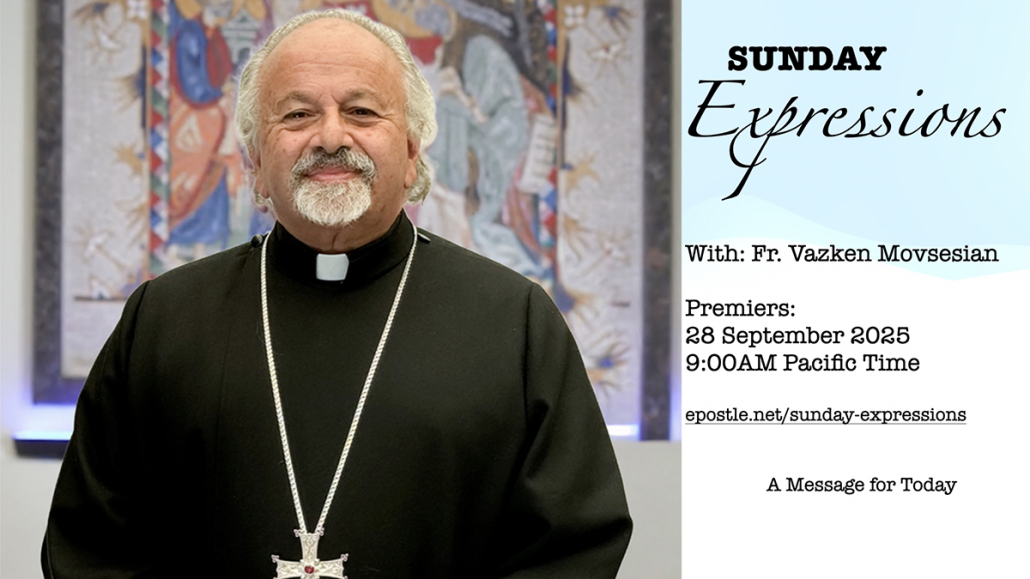
Sunday Expressions Premiered

A Message for Today. Every Sunday at 9AM Pacific, 12Noon Eastern, 6PM Europe, 8PM Armenia. A collaboration of the Western Diocese Media Department and ePostle.net.
https://epostle.net/sunday-expressions and on the Epostle YouTube channel.

Varak Dialect of Khatchkar

Armodoxy for Today: The Khatchkar dialect of Varak

As Jesus entered Jerusalem on that first “Palm Sunday” the people went to the streets with joy, singing in loud voices, “Hosanna. Blessed is the King who comes in the name of the Lord! Peace in heaven and glory in the highest!”

In the Gospel of Luke (19) we read that the religious elite of the day called Jesus from the crowd and ordered him to rebuke the crowd, but Jesus answer, “I tell you that if these [people] should keep silent, the stones themselves would immediately cry out.”

There is a small little village just off the shore of Lake Van in Western Armenia called Varak. In the third century the nun Hripsime, escaping persecution for her Christian beliefs hid in the hills of Varak. In her possession was a piece of the Cross of Christ. She hid the fragment on the mountain where it lay for over three hundred years until a hermit named Totig found it in the seventh century. This Sunday marks the celebration of this event, the Cross of Varak.

I had a chance to visit Varak. Today the town as well as all of Western Armenia is occupied by Turkey. The once beautiful and spiritually active monastery of Varak is now in shambles. Among the ruins you can make out the markings of the interior of the church. Small niches where candles once lit the interior are now exposed to the elements with the roof and huge dome in piles of rubble.

Next to the foundation stones which act as a footprint of the Varak Monastery are houses of the villagers. Kids were playing on the unpaved streets and we struck up a conversation with some of the villagers. One of them invited us into their house. The walls were stones stuck together with a dry pack type of mortar. Stones of different colors and different shapes indicating a variety of sources and suggested they were gathered from different time periods. And… there were khatchkars – cross stones – taken from the monastery and stuck on the wall to protect the inhabitants of the house from outside weather conditions.

The destroyed monasteries and ruined churches, are part of a campaign to erase history and are the final act of destruction following Genocide. Michael Arlen, in his book Passage to Ararat, (1975) searches his roots in Armenia and in Western Armenia. Speaking to the erasure of history, Arlen writes, “What was it except hatred to say that a people did not exist?”

The khatchkar answers back. Khatchkars speak to us in a distinct language, or perhaps, it is a different dialect, because if you listen carefully, you can always understand the message. Khatchkars are the stones that counter the hatred by proclaiming peace of heaven on earth. Even in destructed form, in the ruins, the khatchkars are sharing the Divine message of hope and love as an antidote to the hate.

We pray this prayer for peace, Lord Jesus Christ, who are called the Prince of Peace, please grant us peace. Make all men and women witnesses of truth, justice, and brotherly love. Amen.

Khatchkar Messages


Armodoxy for Today: Khatchkar messages of Christ

Khatchkars decorate Armenian Church, monasteries and the landscape of Armenia. They are tall. They are telling. Many of them can be read like a map pointing to the heavens and eternity.

khatchkar, literally means “cross stone.” On a large stone, usually rectangular in shape, about six or seven feet tall and three feet wide, engravings reflecting the faith and determination of a person dedicated to the Gospel of Jesus Christ. These stones have survived and have been sharing a message for hundreds and even a thousand years.

The central carving is of a cross, ornate with swirls and designs that depict different theological concepts or ecclesiastical symbols. One khatchkar which is found at the Monastery at Gōsh is especially telling. Gōsh was a seat of education in Armenia as such, the khatchkar there stands tall to tell a story of heaven-earth relations. It may not seem very unusual to see earth depicted as a large sphere in this carving, until you learn that this stone was carved in the 6th century, some 600 years before the Inquisition in Europe, Armenians had already understood the earth to be round and rejected the flat-earth concept.

The messages on the khatchkars are many and in different varieties. However, the greatest story that is often  forgotten is that the khatchkar depicts resurrection and victory. Every cross, without exception, and especially every khatchkar is the story of Jesus Christ. Without Christ, the khatchkar has no meaning, in fact, without Jesus Christ, a cross is merely two perpendicular lines.

We stand between two feasts of the Cross – the elevation and the Cross of Varak. The Cross is defined by Jesus Christ, as the instrument of torture, now turned into a symbol of victory.

Yes, the khatchkar decorates the Armenian landscape, and in that decorative form it has been a constant reminder to the people of the power of love over hate, and good over evil. The khatchkar stoically standing on the sidelines of history as the ever-present messenger of hope is a nonstop witness to the reality that has been central to the survival of a people.

Imagine that, a people who have turned around in their journey, and everywhere they have looked, they have been reminded of the hope in the eternal and aligned themselves with the Divine through Christ. “If God be for us, who can be against us?” (Romans 8:31)

Tomorrow, we’ll look at one special khatchkar, decorating a village house, in Varak. Today we pray, from the 13th hour of St. Nersess Shnorhali’s “I Confess with Faith”: Heavenly King, grant me your kingdom, which you have promised to Your beloved; and strengthen my heart to hate sin, to love you alone, and to do Your will. Have mercy on all Your creatures and on me. Amen

Cover photo: Luna & Gregory Beylerian, 2023

Fig Leaf Censorship?

Armodoxy for Today: Censorship

Censorship pops up as a topic in the news regularly. It rises to a prominent news position here in the United States, primarily because constitutional guarantees forbid forbidding free speech. Censorship is understood as a central authority – read, a government – decides what should and should not be read, heard, seen, written or said. This decision is made based on someone’s, or some group’s values.

As far as central authorities go, you can’t get more central or more authority than God and God does not censor. Nor does he ask that we make aprons out of fig leaves. (cf. Genesis 3) In Jesus’ teachings, he calls us to personal responsibility. Over and over again, he insists that we are responsible for the actions we take, hence censorship – a decree to prohibit access to certain words or content is not part of Christianity. You are free to act as you wish, understanding that there are consequences, even ultimate judgement, for your actions. The entire concept of a final judgement, to be judged on your life’s sum-total, is based on the premise that you are free to choose to do or choose to do otherwise.

Often, in their zeal to keep things orderly and not to violate norms and decency, people come up with rules and regulations to protect a society, and most definitely those who are unable to protect themselves, such as children.

So what is the answer to censorship? How do you prevent bad ideas from spreading?

Think of how you get your news, or receive entertainment, ponder art and experience music. Think of how you participate in your faith, and stay away from belief systems that are offensive to you. You have the ability to walk away! You have the ability to turn off a television, swipe up on a page to make it disappear, unplug a device, unsubscribe to media, or just plain turn the channel. Just as right now – you have the option to tune in or to tune out to this message. In other words, you can make those decisions. Pray, engage in dialogue, share your thoughts and then act. It’s your decision. This is Jesus’ call to responsible living.

The Bonds of Sisterhood

Armodoxy for Today: Sacred Bond of Sisterhood

The remembrance of saints is an important and essential part of Armenian Church Tradition. Saints are not God or gods, far from it. They are people – flesh and blood, like you and me, with the freedom to exercise their will according to their conscience. They are the ones who opt for the difficult path of life with faith. We commemorate them because as humans, with all the frailties that come with being human, they demonstrated godly expressions of living.

Saints days are interspersed on the calendar throughout the year. Today, the Armenian Church remembers St. Peprone (or Phebronia), Mariana, and Shoushan, the daughter of Vartan the Great. Each of these saints has a story in which they rose from their human condition and demonstrated an extra ordinary love for God and people.

In remembering the saintly stories from yesteryears, we can’t ignore the stories of today. A few days ago, at a nationally televised funeral of Charlie Kirk, his wife, Erika in reflecting on their life together and the faith they shared, went on to forgive her husband’s assassin.

In tears she said, “…on the cross, our Savior said, “I forgive them for they know not what they do.” That man, that young man, I forgive him. I forgive him for they know not what they do. I forgive him because it was what Christ did and is what Charlie would do. The answer to hate is not hate. The answer we know from the Gospel is love and always love. Love for our enemies and love for those who persecute us.”

In a country that is divided, in an atmosphere of volitivity, amid the incomprehensible acts of violence, and against the backdrop of an ignored genocide on the other side of the globe, these words were a welcome and needed expression for the world. If only we have ears to hear.

For all we do and say at Epostle, and for every sermon and advice I have given, had I not remembered this small expression from this weekend, the saints and lives of the past would not shine.

Forgiveness. It is the hallmark of Christianity. It is the higher and divine grace that saves us from our past and from ourselves. Forgive us our trespasses as we forgive those who trespass against us. Amen.

Autumn is Here

Armodoxy for Today: Autumn is Here

Today is the Autumn Equinox, meaning that there is an equal number of hours of sunlight and sunless time during the day, if you happen to be residing on the equator. For the rest of us, and particularly those in the Northern Hemisphere of our planet, it is the first day of autumn or simply Fall.

New Years, and particularly New Year’s Day, has taken a first place spot for resolutions. It’s a convenient time to change – put off old habits and take on healthier and better habits. But the first day of Fall is even a better opportunity. First of all, there’s not all the hoopla of New Years, but even more the entire season is based on change. The color of the leaves turn, trees lose their leaves, while others go dormant to survive the winter months. It’s a perfect day to cycle through life and begin anew.

St. Paul writes to the Ephesians, “You were taught, with regard to your former way of life, to put off your old self, which is being corrupted by its deceitful desires; to be made new in the attitude of your minds; and to put on the new self, created to be like God in true righteousness and holiness.” (4:22-24)

We pray, Lord our God, You create everything with wisdom. The seasons take shape according to your order and coordination with the Sun and our Earth. At this beautiful time of year, let the habits of old fall off, like the leaves of summer and prepare me for the days ahead that are full of life. Amen.

The Turn-it-off Solution

Next Step with Fr. Vazken, The Turn-it-off Solution, #806 – September 21, 2025
Freedom, Independence and Speech in America on the anniversary of Armenian Independence. Step-by-step instructions on how to turn off what you reject. Checks and balances. Aftermath of Charlie Kirk’s death, Palestinian death. Editorial perogative. Varakakhatch coming up: The Stones will speak, they did and do in Varak. Rallying around the Shnorhali formula of Unity in Essentials.
Epostle.net – for all of our programs and announcements
Fast & Pray App
Music to share: Skating Away on the Thin Ice of a New Day
Produced by Suzie Shatarevyan for Epostle.net
Subscribe and listen on demand on better pod-catchers everywhere.
We’re on PandoraSpotify and Apple Podcasts
Remember to sign up for our Newsletter at Epostle.net