Styrofoam, a Green Valley and Recycling Junk
|
|

|
|
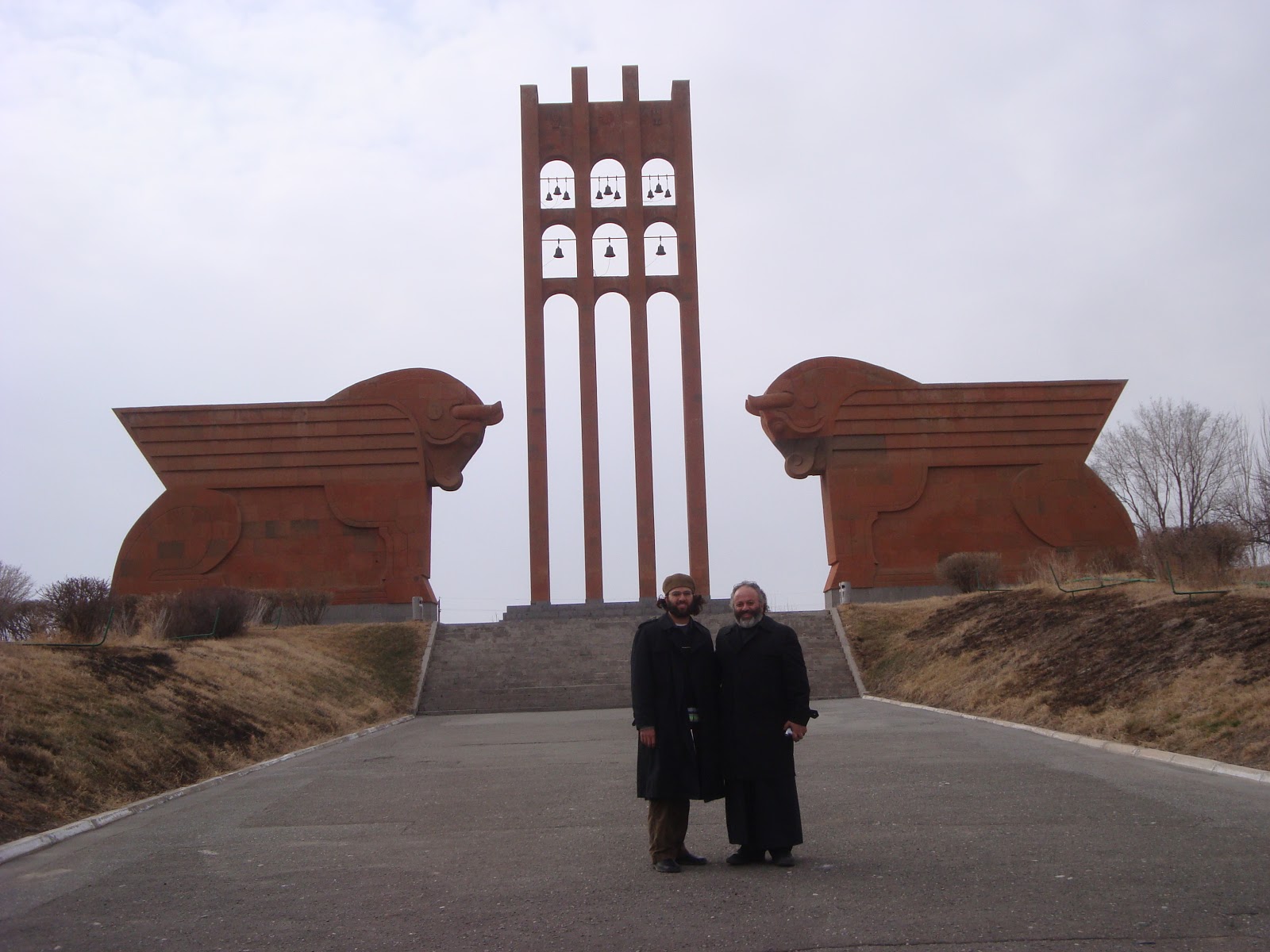
I love the song “Sardarabad.” I love the first lines… “Yerp chi munoom yelk noo jar, khenteru en kdnoom hunar…” [roughly translated = When there exist NO means of resolution or no remedy, the crazy ones find the means!] These words have been a guiding riff for me, challenging me to look beyond the limits. In fact, it probably goes hand-in-hand with my policy that it’s always easier to ask for forgiveness than permission.
So what’s an alternative? How about a celebration of resurrection, instead of the requiem? How about explaining to our people that the Holy Eucharist holds within it the power to go beyond the grave? How about a party, where bishops and priests dance with the people in a celebration of victory? Did you hear/read Sara Miles’ experience with the Eucharist? http://www.prx.org/pieces/25794-this-i-believe-sara-miles
A few years back I decided to have my left lobe poked. It was interesting to see the reaction of the people to a priest with an earring. I wrote a small piece in the church newsletter “Nakhagoch” at the time. In its entirety –http://armodoxy.blogspot.com/1993/06/guns-earrings.html – but the portion that I direct you to:
I have never hidden the fact that I don’t care to live up to these misdirected stereotypes we have of priests. A priest, as a servant of God, must celebrate life; after all it is the greatest gift God has given us. A priest must live with a zeal and excitement for life. He must be a listener of music, a singer of songs, a orator of poetry and a dreamer for the romantic. Life is here to be lived, not to be hidden away in the recesses of darkness.
The purpose of religion is to bear witness to that celebration. There is a genuine beauty in life which demands us to partake and celebrate. Christ tells us, “I came that they may have life, and have it abundantly.” (John 10:10) Sure, life has its share of difficulties and problems, but our religion gives us an opportunity to rise above those pains.
At the Requiem Service in the Armenian Orthodox Church, the Holy Gospel according to St. John, is read.
THE TRUE LOSSES OF THE CHURCH
The 1915 Church in Turkey was well established by virtue of Her existence within the Armenian communities for centuries. The Armenian Church in the diaspora has only a living history of 75-100 years. The Church today is built upon the ruins of 1915. The losses of the Armenian Church were far greater than the decrease in the number of clergy. The Church lost Her impact over Armenians and lost Her place as a necessity among Her people. Her preoccupation with survival in the post-Genocide years moved Her from the sacred realm to the secular. The objective of the Church was compromised by the necessity to build. The devastation of the Genocide was too great upon Church leadership so there was no one “manning the ship.”
Golgotha of the Armenian Clergy is full of horror stories page after page, all tied together by a common thread of suffering and martyrdom. Teotig interviewed and compiled data from a variety of sources, many were first hand witnesses and clergy who escaped the atrocities one way or another. To understand the scope of his work, he confesses that the massacres were so precisely orchestrated that often villagers did not know of the destruction in a neighboring village a mile away. Yet he was able to compile and document the witness of 1252 of these clergy and their flocks.
The register includes among the most notable victims, Gomidas Vartabed Soghomonian to the most seemingly obscure, such as Krikor Kahana Zartarian, a priest of Sepastia whose finger nails were pulled, horse shoes nailed to his feet and then his skin was butchered off his body, because of his refusal to deny his faith.It is more than evident that the Armenian Church suffered immensely in numbers alone.
Several years ago (around the early 90’s) the infamous arms dealer Sarkis Soghanalian was making headlines in the Armenian press by donating to Armenian organizations and churches.
He had appeared on CBS-60 Minutes at the time and was internationally known for his sale of arms and weapons to a variety of different clients.
When there was talk that Soghanalian might donate to the churches, one of our overly righteous, self-appointed defenders of the ethical virtues of the church (a priest, no less) cried foul. How dare we, the church, take “tainted” money from this man? Ill-gotten gains, he claimed.
On the surface, this reasoning sounded good. After all, the church is an agent of peace and there’s a definite incongruity in peace efforts being funded by money coming from the sale of weapons of war. But, what got me thinking deeper on the subject was that the priest who raised the issue was serving in California’s Central Valley. In other words, his congregation made its money by working the land. And so, you have to wonder, how much of the money that came into his church’s plate was from farmers and land-owners who had exploited migrant farm workers? (Yes. Coincidence that tomorrow is Caesar Chavez day?)
And so, we have a double standard here: somehow money from guns is dirtier than money produced at the expense of people who might not rate a spot on the 6 O’clock News? Mexicans risking their lives, crossing the border for a chance to make a few bucks. They live in sub-standard conditions, and because they will, they work for very little wages. And if someone exploits these people they are called shrewd and good businessmen – after all, they are turning over a buck for less than what it would ordinarily cost. How is this any less ill-gotten or tainted than the money from the arms dealer?
So my question – isn’t money, money? If you go far enough, isn’t there some factor that will always put the money in the tainted category?
I bring this up now because I’m concerned about the role of money in our efforts. I have always insisted that we have a product that is worth funding. (Check out the “Miller Interviews” on the In His Shoes area of YouTube.) In other words, we have to stand by our product and believe in it to the point that we can (and should) ask for money for the product. If we are engaged in a ministry, we should ask people for money for the ministry. If we are engaged in helping children of war, we should ask people for money to help children of war. And so on…
What would you think of a store which sold light bulbs, but every time you walked into that store they kept handing you oranges and insisted that those oranges were good oranges? Well, for a while you’d be confused and then you’d get use to it. You’d start coming to the light bulb store to do your shopping for oranges. And eventually, the employees themselves would be convinced that their job was to promote and sell oranges. But, the savvy shopper will figure out that there are better oranges at the produce store and since you’re unsure of your main product – light bulbs – then certainly the better light bulbs must be elsewhere as well.
This is what has happened in our church. We’re selling all the wrong things. We have a product called Armenian Orthodoxy, and instead we’re selling Debutante Balls, Fashion Shows, and basketball games. So what happens – people come to our church searching for the ancient truth that they can ONLY get from the Armenian Orthodox church. They walk in, like they do to the light bulb store, and we tell them, here, have a debutant ball: this is the mission of the church. Or our children come looking for identity and we say “Join our team! We belong to a great basketball league!” Well – what do you suppose will happen? At first, people will be confused but eventually we will have a steady clientele ready to consume the products we offer. Some people will come thinking this is the Debutante store. Others will come thinking it’s the basketball store. Many of the employees will forget what the product is. BUT the savvy shopper, will figure out there are better basketball courts at the YMCA and there is certainly better places to learn about faith than a place that doesn’t want to give it to you.
In your own experience – I know we can all relate to this – you tell non-Armenians that you belong to the Armenian Church and what do they tell you? “You have some great food.” “I love the bakalava… or is that the Greeks?” In fact, just in the Los Angeles area I can tell you if people want the best pilaf it’s at one of the churches, the other has the market on kufta, and still, the other is known for its topig!
Which are the successful ministries? The ones that offer a product they believe in. Does that mean they don’t sell anything else? Certainly not. We’re all realists and we know that money is the necessary tool to get work done. But there are certain ratios that need to be agreed upon from the beginning. Albeit, these ratios may be arbitrarily established, still they are there to guide us. For instance, I have set up an arbitrary ratio in my own ministry between outreach and time allocated to admin. The same can be put in place for funding. If we can raise 80% of our funds from donations directly to our ministry then we can justify 20% of the money coming from non-ministry functions. I think this is reasonable and we’re doing it in our small corner of the world.
In His Shoes and the St. Peter Youth Ministries has been funded primarily by people who believe in the mission we’re engaged in. Even the occasional dinner dance, or concert is supported primarily by people who are supporters of the ministry, so that the events don’t come off as fund-raisers, as much as opportunities for the community to get together and enjoy fellowship and each other’s company.
Now we are engaged in raising money for poverty. Our annual Famine, raised awareness and money for world hunger. Most of the money comes from direct donations – people giving to the cause, that is, to aid world hunger. A percentage of the money comes from indirect solicitations, for instance, the sale of lemonade on the street corner – with proceeds benefitting the Famine. We have to admit that the person buying a glass is more interested in quenching his own thirst than hydrating the dehydrated children of Africa, still, in a small way awareness for the big cause is heightened.
This balance between direct and indirect solicitation is important. It will be the difference between a sincere effort to do our mission and selling oranges, just because we don’t believe in our light bulbs.
A few months ago, we saw a raffle ticket that was being sold by an Armenian organization to bring aid to the Refugees of Iraq. This was a hard one for me – because behind each of those words is a mass suffering. It’s another one of those incongruent situations where people vying for a chance to go to vacation in Hawaii might also be saving a life in the war zone. As I read the raffle ticket I wondered if the Jewish Diaspora during World War II was selling raffle tickets to vacation in New York, with proceeds benefitting displaced persons in Europe? Or even worse, if we had a large enough Diaspora in 1915, would we have raffled off a Ford Model-T so that proceeds could be sent to aid Genocide victim families and survivors?
Obviously, there are many for whom these issues – poverty, ecology, torture, violence, environment, immigration – are not important. And there are many in these categories that have money. And I would even venture to say, once that money is not used to bring aid and comforted, it falls into the earlier tainted category. AND, so the challenge is on us – the Robin Hood challenge – to take from the rich and distribute to the poor. It’s a challenge. It’s also ethically challenging because we ourselves don’t want to be tainted in the process of doing this. So it’s important that we hold our mission always in front of us and not lose sight about what we’re doing and the reason why we’re doing it. And along the way, we need to police ourselves, in case it does get out of hand. I think this is an area that we need to develop as we grow and as we expand. Certainly, if nothing else, I think the addition of these blogs and the dialogue that follows either on line or in our Questions in Faith discussion, is a step in this direction. We don’t want to be like the light-bulb store employees, who have gotten so use to the idea of selling oranges that we’ve forgotten that we have a product that is worth pushing, promoting and selling.
Sunday mornings, I place my cell phone on my desk before entering the church. I figure those couple of hours in the church can be spent without being wirelessly tethered to the world.
But not last Sunday. It was an early Daylight Savings Time – March 9, to be exact. And ever since AT&T fired or shot the Time lady, I’ve been using my cell phone’s clock to coordinate myself with my calendar. So this Sunday, my phone was in my pocket throughout the liturgy. It was a good thing because it was a few minutes after services were over that my phone rang. It was my close friend, telling me his mother-in-law was on her way out. She had been battling cancer for several years and now she was in the hospital.
It was also a day that we had gone to church in only one car. So I asked Susan and Christaphor to join me out to Woodland Hills. At the hospital I found Arlene with her family huddled around her in the Intensive Care unit. One of the last times I had seen Arlene was at the TV studio – I was doing my weekly show and she was doing a promo for the Armenian Bone Registry. We discussed her cancer. We discuss her faith. It’s very interesting how God makes these meetings possible – sometimes using the most unlikely places where we can share and exchange matters of great importance. I walked away from that meeting so impressed by her attitude. She had too much to live for. She wasn’t going to let this dreaded disease get in the way. She approached life in a very big way – with much zest and love: a small lady that filled up the room with her smile and charm.
And so, in this Intensive Care unit, this small body was taking a very rough and hard beating.
It didn’t look like she was awake, but I’ve learned in all these years that it’s not our call to figure out if a patient can hear or not. So I went up to her and said, “It’s me, Der Hayr. Your Der Hayr.” I’m not really sure what gave me that extra bit of confidence to personalize myself to her life, but I felt it was right.
We all stood around the bed, holding hands. I began the Lord’s prayer and then the Gospel passage. I read from John 14:
The emotions in the room were running high. A lot of tears, you wouldn’t expect anything less: a life was being cut short. I followed Arlene’s daughter and her husband into the waiting room. We began talking about the twist of life and fate. We were hitting on some of the big issue of life when a cousin came up to us and said, “You’ve got to come.”
We walked back into the room and there was Arlene, at peace. She wasn’t breathing. The breath had left her body exactly a minute since hearing the Gospel message. Her suffering had ended. She was at peace.
I know we were all moved and stunned. “Do not let your hearts be troubled” says God and certainly, the trouble had left the room. Her peace was touching each of us.
There are times in our lives when things just work. This was one of those. Arlene was leaving an incredible message to all of us. She was waiting for this final blessing – she was squaring things with her Maker and at the same time letting everyone know that at the end of the day, this was the ultimate reconciliation one needs to make in life.
As her motionless body lay there, I thought about the last words she heard, “I go to prepare a place for you… I am the way, the truth and the life…” She heard these words with her most treasured possessions standing all around her. She left this world at peace, leaving behind the pain, the suffering and the disease. She received a blessing sure, but at the same time each of us in that room knew that there was something greater happening here. We were blessed by this experience.
As a priest, I find a very profound point of equilibrium – where we give and it comes back to us in many different forms. In all of these variations we find the presence of God peaking at us through the thin veils of human experience, touching us – almost shaking us up – to reconnect to our humanity.
Today was the funeral. I went wantingly. I wanted to be there because it was a miracle that touched me. In the filth and disgust of something called cancer, a beautiful expression was blossoming.
I spoke about the angel Arlene. An angel is a messenger and Arlene was that angel that brought us the message: love never dies. She loved, she was loved and in her relatively short life of 59 years, she lead a very full existence. Her life was one which touched others.
At times like this we use some thoughtless terms such as paying our “last respects.” Or she “succumbed” to the disease. Or she “lost the battle” to cancer. With people like this, there cannot be a “last respect.” Honoring a person like Arlene is to live the example of the life she lived – more than a positive attitude, she had an attitude of love. She cared for and touched others. How dare we end it for her by saying she lost or succumbed to anything? Arlene was a victor, not a victim. Anyone who loves is a winner, because in return she’s gained all of eternity. She has reconciled with the ultimate force of the universe. She is one with God.
We all have a certain number of years – some get only a few, others many and still others get an over abundance. 10, 50, 80 or 100, its really doesn’t matter how many – sure life is sweet and nice, but the real measure is in how and in what way those years are filled. It’s something we all know, but when a life like Arlene’s touches us, it’s just one more opportunity for us to fortify our understanding of the power of love in our lives.
May God rest her soul. I stand today in thanksgiving for having known this very special woman.
Matt. 15: 22 Just then a Canaanite woman from that region came out and started shouting, “Have mercy on me, Lord, Son of David; my daughter is tormented by a demon.” 23But he did not answer her at all. And his disciples came and urged him, saying, “Send her away, for she keeps shouting after us.” 24He answered, “I was sent only to the lost sheep of the house of Israel.” 25But she came and knelt before him, saying, “Lord, help me.” 26He answered, “It is not fair to take the children’s food and throw it to the dogs.” 27She said, “Yes, Lord, yet even the dogs eat the crumbs that fall from their masters’ table.” 28Then Jesus answered her, “Woman, great is your faith! Let it be done for you as you wish.” And her daughter was healed instantly.
Thoughts on the passing of Arlene Titizian (1948-2008)
One of the many clergyman that had his impact on my life and my becoming a priest was Archbishop Asoghig Ghazarian. He served in United States in the 1950’s. Later, he became the Primate of the Diocese of Iraq.
I met Bishop Asoghig on the few occasions when he visited America and he’d come over to our house. He was the priest that blessed my parent’s wedding engagement and through the years they had corresponded with him, staying in-touch enough so that when he would come from Iraq we’d have a chance to visit with him at our home. One day back in 1974 we even had the chance to take him to Disneyland. Though I don’t remember him on the Matterhorn, the image of him on the It’s-a-Small-World boat is still in my head.
In 1977 he passed away. His last wish was to die in Armenia. They brought over the ill prelate on a special plane from Bagdad to Yerevan. I was a student at the Seminary of Etchmiadzin that year. I remember that the venerable Catholicos Vazken I was truly heartbroken and saddened by his colleague’s passing. As a young seminarian, I participated in his funeral. Even more, along with two priests at the ancient monastery of Gayane, I prepared his body through a ritual bath provided for the clergy. I mention this here because his body was a bit different from others, and especially other priests.
You see, Bishop Asoghig had served in China. There he was persecuted and tortured. The same hands and forehead that had once absorbed the sacred Holy Miuron, were bound and beaten by communists and thugs. It was his private hell and, though we met on a few occasions, he didn’t share his stories or experiences with us. Back then I was too young to know, but now looking at his pictures, you can see the blank stare of abuse in his eyes.
I bring this up today because the persecution continues today in China. This week, the Newspress Question for us clergy was about the new religious freedom in China and what is says about our faith. (http://inhisshoes.com/In_Theory/China%20Freedom.htm) Imagine that… China and the Armenian Church? What’s the connection? Well, Bishop Asoghig for one. But Bishop Asoghig was and today China’s violation of human rights and support of regimes supporting Genocide viz. Sudan, is.
China is one of Sudan’s largest suppliers of arms, and in return Sudan is China’s largest overseas oil project. Official data shows that China now takes 40% of Sudan’s oil output. China can and must play a role in bringing an end to the genocide in Darfur.Being descendants of genocide survivors ourselves, there is a moral imperative, no less dictated by our faith that we stand in the shoes of others who are going through the sufferings we’ve endured. And our motivation to do so comes from the possibility of, what might have happened had the world disarmed Turkey at the time of the Armenian Genocide (1915)?
With religious freedom in China, I’m hoping that the same Christian mandate that moves us to search and work for peace will lean heavily on the government to end the Darfur genocide. George Bernard Shaw reminds us, “Liberty means responsibility. That is why most men dread it.”
The people who make a difference in our lives, like Bishop Asoghig, are the people who dared to take the responsibility for their lives. They were the ones who cared enough to put it all on the line. As a follower of Armenian Orthodoxy, he was a follower of Christ, taking up the cross no matter where it was planted – in Iraq, China, Armenia or on Calvary. Our responsibility is the same, but the way we can express it is much easier – it means standing up for what is right and being ever-vigilant.
Today, we were very happy and encouraged to learn that US filmmaker Steven Spielberg abandoned his role in the Beijing Olympics, as a host of prominent figures accused China of not doing enough to press its ally Sudan to end devastating violence in Darfur. Read more: http://news.yahoo.com/s/afp/20080213/ts_afp/uschinasudanunrestdarfuroly_080213040036
The turn is really ours. As a Christian Church, as the Armenian Church – as the one Church which traces its roots to Jesus Christ himself, do we have any other choice but to rise to the occasion and take this responsibility? We need to walk the walk of Christ, and certainly at this point, talk the talk of Christ. In other words, the Armenian Church is definitely concerned about China, as it should be about everything else in the world. Armenian Orthodoxy is our belief system. Christ cared and his Body follows the directions of its Head.
At our first Husgoom* service on Wednesday evening, when we prayed the prayer of St. Gregory of Nareg (Naregatzi), between the priests, deacons and people we had a nice rhythm going. (There are few occasions when this happens naturally. Most recognizably during the “kohootiun” portion of the Badarak – when a percussion section with high-hat and tom-toms would fit perfectly.)
The words of Naregatzi are intense, to say the least. The words are simple, yet complex. They seem like compound words but lack bridges. They delicately express some of the most basic emotions of the the human soul. His words come from the spirit and speak to the soul.
This week as we were singing, I got caught up in the tempo and beat. It was hypnotic and at the same time made me pay attention to the detail. I saw the punctuation marks and how they split the flow of the words. And then it hit me that those punctuations are so critical to the understanding of St. Nareg’s prayer and lament.
Like most of the liturgies of our Armenian Church, there is a tendency to “perform” rather than experience the prayers and song. That is, we understand the services as part of a prescription for our spiritual well-being – take a two Naregs, one Shnorhali, top it off with a Badarak once a week and call me in the morning. In the event of difficulty breathing, extinguish incense and use flavored candles instead.
Our work toward defining “Armenian Orthodoxy” is exactly the opposite. The words are not there to be taken (swallowed) but to challenge and motivate us to be one with Christ. Each word of Naregatzi stands as a koan waiting to be explored. Each word can become a key to your heart. Each word can be a door to the Kingdom.
Naregatzi – as well as all of our services and prayers – are not meant to be ingredients in a prescription, nor should they be part of formulas that solve spiritual dilemmas. They are the means for us to take the responsibility of our human condition and find peace.
Below, I’ve placed the prayer of St. Nareg that we sang during Husgoom. Read it through. Then, cut and paste it in a word-processor and split it up at each of the commas or semi-colons. If you have a bulleting function on your word-processor, bullet each of these. You will find small meditations that will perhaps haunt or perhaps calm you. Read one bullet and let it take hold of your thoughts and your soul. This is easier said than done, but don’t try to “solve” a word, rather, let it guide your prayer life.
For instance, one of the verses is, “abolish my pleasures of a deceiver, O ever victorious.” Don’t follow the natural tendency to ask “How am I a deceiver? What do I need abolished? How is God victorious?” etc. Because we already know those things! Think about it, you wouldn’t be in a “Lenten Journey” if you didn’t already realize that you had some issues to work out and the solution to those problems are from a source greater than you!” Instead, take this one sentence and let it soak in your heart as you pray, as you worship, as you live, as you love. Let it be a part of your life, so that when you pay for gas at the gas station or when you are stirring the soup (thinking of somethings mundane), the words “abolish my pleasures of a deceiver, O ever victorious” don’t stand out as words, but are nestled inside of you. Don’t rush anything to “Look for an answer.” Instead, pray with this one line in your heart for a week or two. You’ll find that the words begin to have more of an impact on the things you do, your relationships, your movements, your life. Then move on to the next line – to the next bullet.
This is the way of Armenian Orthodoxy. You’ll find the prayer will stimulate you to move toward God.
Prayer of St. Gregory of Nareg
Receive with tenderness, O might Lord God, the supplications of mine embittered self!
Approach me with compassion, I who am in deep disgrace; dissipate my sadness filled with shame, O thou most generous with gifts; remove mine unbearable burden, O merciful one; sever mine unbearable burden, O merciful one; sever my mortal habits from me, O thou inventor; abolish my pleasures of a deceiver, O ever victorious; disperse my demoniacal mist, O lofty one; arrest my course of perdition, O redeemer; destroy the evil devices of the captor, O thou seer of the concealed; scatter the assaults of the warrior, O inscrutable one!
Inscribe thy name with the sign of the cross upon the skylight of mine abode; encompass with thine hand the roof of my temple; mark with thy blood the side posts and the upper door-posts of my cell; imprint thy sign upon the trail of the footsteps of thy supplicants; fortify with thy right hand my couch of repose; free from snares the covering of my bed; protect with thy will my tormented soul; purify the breath of life with which thou endowest my body; surround me with troops of thy celestial army; array them against the battalion of demons.
Grant soothing rest like death unto the slumber in the deep of this night, through the mediatory supplication of the holy Mother and all the elect ones.
Closely envelop the windows of the visual senses of my mind, placing its dauntless against turbulent troubles, worldly anxieties, fantastic dreams, foolish hallucinations, that, through the memory of thy hope, it may remain protected beyond all harm; and that, roused anew with full wakefulness from the profundity of my slumber, standing erect before thee filled with soul renovating joy, I may forward this cry of supplication scented with faith, unto thee in heaven, O most hallowed king of ineffable glories, in unison with the hymns of praise sung by the celestial bands; for thou are glorified by all beings, forever and ever. Amen.
(For St. Nareg’s “Lamentations” check out Prof. Tom Samuelian’s website: http://www.stgregoryofnarek.am/)
* Husgoom = literally means “vigil”. The Armenian Church has seven hours of worship. Two of those hours are the “Peace” and “Rest” hour. At our parish we pray the prayers of these two hours and refer to it as the Lenten Vigil, i.e., “Husgoom.”
I received an ad from Office Depot just in time for the start of Lent: 40% off USB Flash drives; 2GB or more, it said in the fine print. I looked through the drives and sure enough, the 4GB and 8GB are within price reach. And I suspect, by year’s end we will see standards of 64GB or even 128GB.
What does this mean? Well basically, everything that you’ve been storing on your laptop’s hard drive can now be conveniently placed on an electronic stick and toted on your key chain, around your neck or in your pocket.
I remember when those small (3.5”) floppies were marketed for their size. Before those, my first hard drive – a 5MB Apple drive – was the size of two large Yellow Pages books put together. By today’s standards, it held only the equivalent of two photographs taken on a nice pocket digital camera. But back then, I never imagined I’d fill up that hard drive. But I did. And later, I filled my 20MB drive. Then came the ads for the Zip Drive, “Store more stuff!” and I did. And along the way, with each subsequent generation of technology, I was relieved that my excesses didn’t have to be jettisoned during the migration to a new computer or new hard drive; rather, I could take along and store them safely in folders buried in folders. And I know I’m not alone in my feelings of relief. Google, Yahoo and Microsoft have all developed search utilities just for this purpose: to find those bits and pieces from our past that we refuse to clean up or throw out.
So now today – thank God – we can store more, save more and protect more. We really don’t have to deal with cleaning or clearing up. Wouldn’t life be great if we could do the same with all of our “stuff?” But like the poor fool in Luke 12:13-21* discovered, you only get one chance at life. So you better make sure you prioritize your lists and keep those things that are necessary.
Lent is a proactive experience. You have a chance to clear out your memory and your baggage. It’s a time to really bring life down to the bare essentials. What does it really take to live? You know how the questions go… If you had a fire in your home – what would you take with you? If you were stranded on a desert island, what 10 CD’s would you want there to comfort you? If your hard drive crashed, and you had a chance to recover only 10 files, what would they be? These questions are reactive.
Lent is proactive: before things get bad, slow down, lighten up and live. What are the 10 files that are most important to you? Which relationships move you closer to your humanity? What are the things that you would want to present to God at the final check out? What is necessary to exist? What is necessary to survive? What is necessary to live be happy, i.e., live?
Lent is the time to inventory your inner drive. It’s a time to move some of the bones and garbage to the trash bin. Some files don’t even open up with today’s software, you know? Let’s start with those, at the very least.
Ultimately, you have to do your own inventorying. No one else can do it for you. That’s the way we begin the Lenten journey. What a great time we’ve been given.
* Luke 12:13 And one out of the multitude said unto him, Teacher, bid my brother divide the inheritance with me. 12:14 But he said unto him, Man, who made me a judge or a divider over you? 12:15 And he said unto them, Take heed, and keep yourselves from all covetousness: for a man’s life consisteth not in the abundance of the things which he possesseth. 12:16 And he spake a parable unto them, saying, The ground of a certain rich man brought forth plentifully: 12:17 and he reasoned within himself, saying, What shall I do, because I have not where to bestow my fruits? 12:18 And he said, This will I do: I will pull down my barns, and build greater; and there will I bestow all my grain and my goods. 12:19 And I will say to my soul, Soul, thou hast much goods laid up for many years; take thine ease, eat, drink, be merry. 12:20 But God said unto him, Thou foolish one, this night is thy soul required of thee; and the things which thou hast prepared, whose shall they be? 12:21 So is he that layeth up treasure for himself, and is not rich toward God. Luke 12:13-21 ASV
Archbishop Vatché introduced me to the congregation for the first time as Fr. Vazken and explained that a Christian is not “merely a follower of Christ. A Christian is a restless person… He will endure hardships, criticisms and danger because of his faith.” He went on to explain that the Catholicos Vazken was that type of man and that the name was fitting for me.
It is in this context that I was ordained. I never understood the priesthood as something easy. In fact, while most kids move toward adulthood there’s a period of rebellion and mine came in a different context. It was rebellion against the establishment. I left everything in knew in the United States to go to Armenia to study at the Seminary of Etchmiadzin. The year was 1977, during the cold-war era. I was in Brezhnev’s Soviet Union, studying. Away from family and friends – a hardship brought upon myself by virtue of the profession I had selected.
It was kind of freaky, now that I think about it. It just didn’t make sense, by the standards that people have for the Armenian priest. Why would I get a degree from USC and not pursue some type of business/profession that had some obvious social and monetary rewards attached to it? Why would anyone leave the comforts of the US and go to a country which had so many question marks attached to it? Where mail didn’t get to us for a month and that, only after it had been searched and censured? Where phones didn’t connect within the city, and definitely not across trans-Atlantic lines? Where, in case of an emergency, a ride home might take days, if not weeks? And the guilt of leaving two grandmas that were reaching the end of their lives? Where there would be no movie theaters to go to, because there were no girlfriends to take? It just wasn’t the thing a 21 year old USC graduate would do.
And on top of it all, for what? To be a member of a brotherhood that was as mysterious as the language I didn’t speak? An ancient faith inside the shell of antiquity, looking for definition. A people in the aftermath of the Genocide, searching for meaning and turning to this ancient church, which had no apparent answer to her people’s prayers. Nevertheless the church was the last of the hold-outs. There was no where else to turn. I saw it and see it today as the salvation of our people as a people. It is within this nationalistic framework that I defined the church, but not as the end of all of our woes. In other words, if we were to find salvation for the Armenian nation, we needed to first and foremost find salvation for the people that made up the nation. A nation (the collective) can only be as good as its people (the parts), correct?
He gave me the chalice and the right to consecrate the Holy and Pure Body and Blood of our Lord Jesus Christ, for the living and the dead. He tied the belt around me and passed along the apostolic authority to tie or loose sins here so that they may be tied or loosed in heaven.
It has been 25 years since that date. Since the day I came on my knees and proclaimed my fidelity to the Armenian Church and her Orthodox teaching I was joined always in spirit and in body by my soul mate, Susan. My ministry quickly became ours.
Every anniversary of my ordination I listen to the tapes from my ordination. In particular I am fascinated by the sounds and prayers of the service on calling, on the night prior to the ordination. There I am “grilled” by the ordaining bishop with questions about my sincerity and willingness to take on the difficulties of the priesthood. “Do you promise,” he asks, “to take on the challenges of being a servant of Christ and not trade them for the comforts of this world?” He asks my sponsors, Fr. Arshag Khatchadourian and Fr. Levon Apelian –both monks of the church at the time (dzayrakoyn vartabed)- if I had the training and the upbringing to be a priest? I always wondered what secrets they knew that would allow them to answer in the affirmative, but they each would qualify their answers by saying, “to the best of my knowledge.”
I am brought to tears many times while listening to the tape, because of the language of that particular service. It is so simple and compelling. The archbishop goes through a list of 159 heretics who would otherwise be long-forgotten by us, if not for us! In other words, the only people who remember these heretics is us, ironically, as we recount their heresy and then pronounce them as anathema. I think to myself, how wonderful if others could understand this beautiful language. How often we find the excuse of language for not understanding our service, when in reality it is our unwillingness to listen with our hearts that is the problem.
In that group, I knew and watched so many priests and bishops who were all ‘larger than life.’ The priests who were my pastors (no particular order): Fr. Dirayr Dervishian*, Bishop Aris Shirvanian*, Fr. Sam Aghoyan*, Bishop Yeghishe Simonian, Abp. Torkom Manoogian, and Fr. Torkom Saraydarian, Abp. Yeghishe Derderian, Abp. Tiran Nersoyan, who invited me to New York to take on the task of the editing the St. Nersess Theological Journal, Abp. Shnork Kaloustian, Catholicos Vazken I, Abp. Asoghig Ghazarian, Fr. Isahag Ghazarian*, Fr. Shahe Semerdjian*, Fr. Shahe Altounian* and of course, Archbishop Vatché (*attended my ordination). There is a generation among these priests that is no longer there – no longer accessible. It is sad when you look around among the ranks of the clergy, the brains and intellect may be there, but the spirit is missing. There was a generation of powerhouses that we’re missing today.
And so… the Next Step…
There has to be a Next Step, otherwise we will rust. The next step is just as dangerous as the first step, but it was for this that I was ordained, it is the restlessness that burns inside of me that pushes me to the “Next Step.”
|
G
|

 ENVELOPES IN ARMENIA


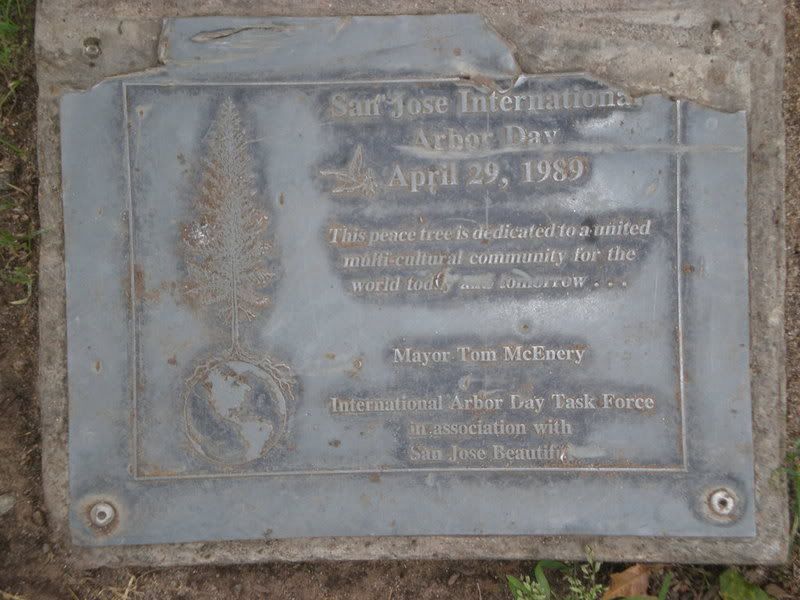 Outside the Armenian Church community, the larger area was transitioning as the leader of technology and innovation for the world. It would be known as Silicon Valley. Gates, Jobs, Wozniak, Allen, all names that sound big today – but just regular boys around town then. There was a granary, a couple of blocks from our home in Cupertino – it became the home of Apple Computer. We watched apricot orchards get cut down to make way for technology and egg-carton housing. Garage start-ups became the HP’s and Sun Microsystems of the Valley. For me, a small Timex computer opened the door to electronics for God’s work. I attended user-group meetings with electronic eggheads who would become the pioneers of technology within their fields. I remember another computer along the way – something called a Coleco system with tape drives. Then in 1985 Susan surprised me with an Apple IIc and I got hooked on programming.