
“Eh” The Eternal Now: Christ Consciousness Awakens in a World on Fire

Click To Watch.

Ancient Armenian wisdom meets today’s spiritual hunger. Father Vazken reveals why the Kingdom of Heaven isn’t coming later, it’s already here, right now, if we dare to live it.

Los Angeles, CA – April 1, 2026

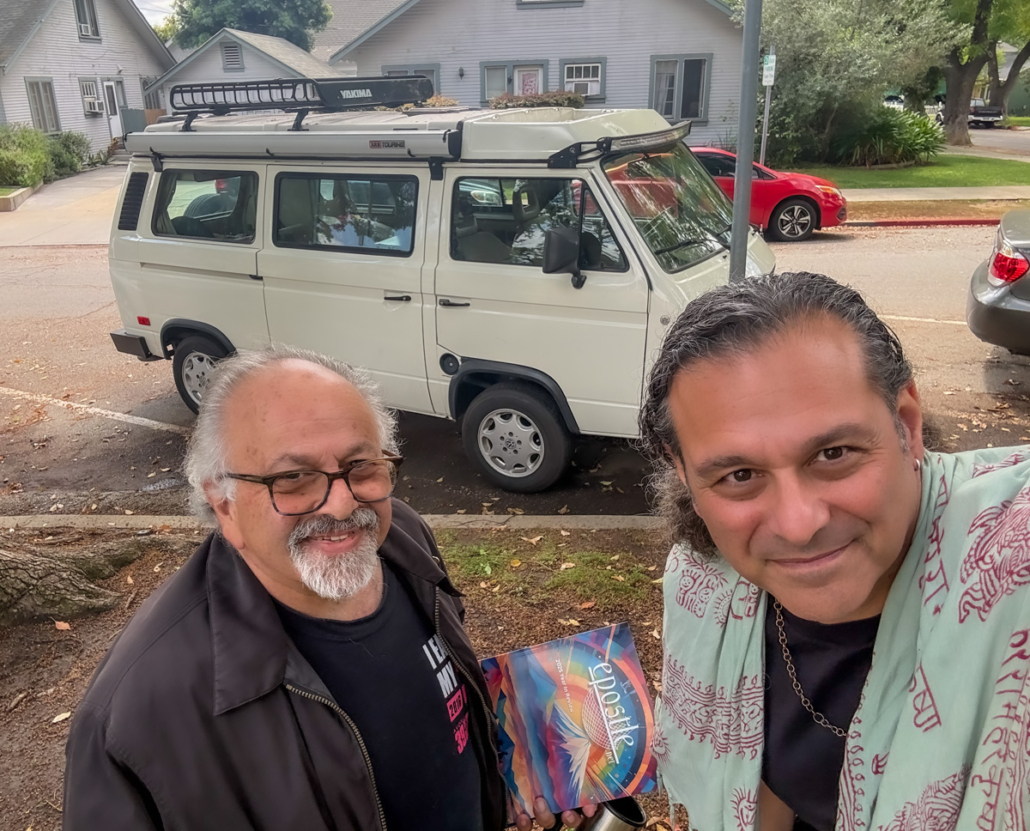
Highlights from a candid, 54-minute conversation recorded in the shadow of the San Gabriel Mountains, Epostle’s Gregory Beylerian and Father Vazken sat in Greg’s restored 1986 VW West camper van for what may be one of the most timely spiritual dialogues of the year. Just days before Easter, in the middle of Holy Week, under the full moon that sets the date for Easter, the two friends unpacked the single most radical idea in Christianity, one the Armenian Church has guarded for 1,700 years: Christ is not a memory. Christ is presence.

The conversation begins with Archbishop Derderian’s prophetic vision from last year: “Epostle is the future of the Church available today.” Father Vazken smiles and says, “We were talking about Christ consciousness centuries before the world gave it that name.”

At the center of their exchange is one small, luminous Armenian letter: Է (Eh) the seventh letter of the Armenian alphabet, the verb “to be” in the present tense. “It means ‘is,’” Father Vazken explains. “Not ‘was.’ Not ‘will be.’ Right now. He is. God is. Christ is.”

Greg recalls walking into ancient Armenian churches in Armenia  with Father Vazken. in 2014 and seeing that same symbol glowing above every altar. “I asked Father Vazken what it meant, and when he told me… it was my aha moment. Eckhart Tolle, Ram Dass, Oprah, they were all pointing to the same doorway the Armenian Church had been pointing to since the 5th century.”
From there the dialogue flows like living water:

The Kingdom is now. Jesus didn’t say “the Kingdom is coming.” He said, “The Kingdom of God is in your midst.”

Greg responds, “So no one needs to die first to get there.” The resurrection is not a future event; it is the victory of light over darkness that happens the instant we choose love over fear.

The cross is not a symbol of torture, it is the ultimate symbol of love. Father Vazken shares the story of an Indian Orthodox Catholicos who removed his ring, handed it to him to read the Armenian inscription, and told his people: “These Armenians have never known Christianity without suffering. Listen to them.”

Revolution is not protest with an end time. Jesus rode into Jerusalem on Palm Sunday as a protest against empire. He didn’t go home at 4 p.m. He went to the cross. That is the difference between temporary activism and eternal revolution.

Father Vazken doesn’t shy away from today’s headlines. He calls the absurdity of solving problems with violence “the playground logic of grown men who never grew up.” He challenges the idea that any war can be fought “in the name of Christ.” And he reminds listeners that the Armenian people were invaded, genocided, exiled, never lost the one message that still offers the world hope: Presence.

The conversation crescendos as the two men connect the dots between the full moon that determines Easter, the resurrection that turns the worst Friday into “Good Friday,” and the personal resurrection each of us is invited into right now.

“Suffering is not the end,” Father Vazken says. “It is the a doorway to resurrection. You cannot get to Sunday morning without Friday. But once you see through the lens of resurrection, even Friday becomes good.”

Greg closes the episode with a simple, powerful question that lingers long after the recording ends:

“If fear has brought us this far… what would love do next?”

Watch or listen to the full conversation.

Because the future of the Church is not coming.

It is already here.

Eh.

He is.

We are.

Right now.
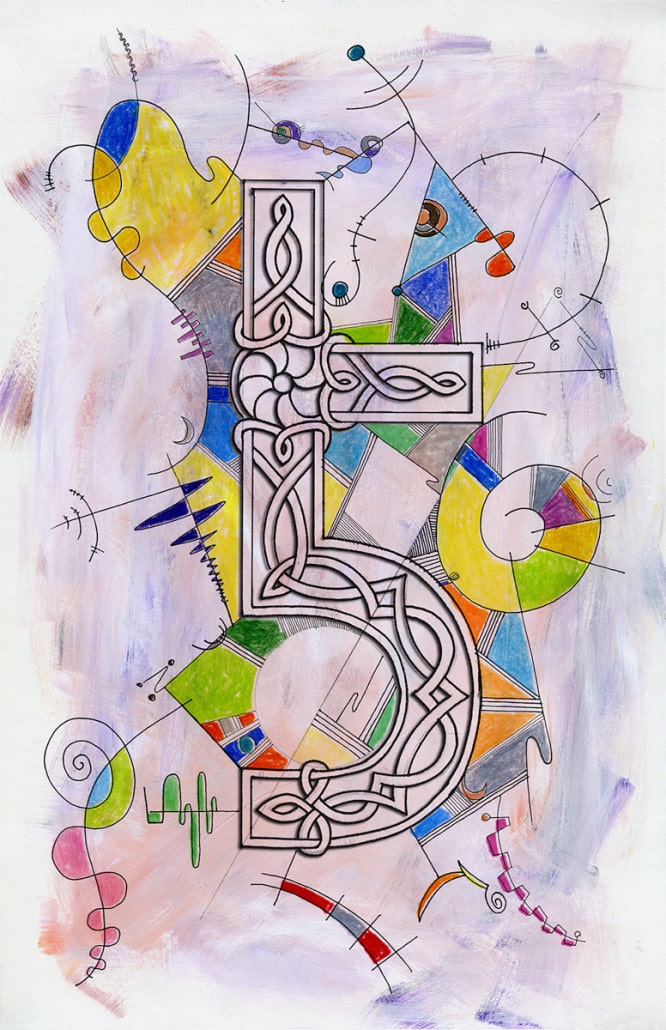
“Eh” Artwork by Gregory Beylerian

Presence of Christ

Armodoxy for Today: Presence of Christ

On this Great Wednesday of Holy Week we focus on the Presence of Christ. During his ministry Jesus continually referred to the little children as the pure, innocent, uncorrupt ones who are in tune with God.

“Let the little children come to me,” says Jesus, “and do not forbid them; for of such is the kingdom of heaven.” (Matthew 19:14) The children, being pure of heart, have access to God, and therefore, the Presence of Christ.

Before He was betrayed, before his trial and crucifixion, Jesus ate one last meal with his loved ones. Known as the “Last Supper,” this is where Jesus gave his instruction to disciples. Addressing them by using the same descriptive phrase, “Little children,” Jesus tells them, “A new commandment I give to you, that you love one another; as I have loved you, that you also love one another. By this all will know that you are My disciples, if you have love for one another.” (John 13) He placed love as the highest standard for identification as a follower of Christ.

As they were eating, Jesus took bread, blessed and broke it, and gave it to the disciples and said, “Take, eat; this is My body.” Then He took the cup, and gave thanks, and gave it to them, saying, “Drink from it, all of you. For this is My blood of the new covenant, which is shed for many for the remission of sins.” (Matthew 26) These words of Institution established the ritual of Communion.  It is a sacred and a holy act by which we literally and completely absorb Christ as the energy source by which we live the expression of love. The Christ Presences is not outside of you, but, in the words of Jesus, “Indeed, the kingdom of God is within you.”  (Luke 17)

As we move through Holy Week, today we must answer a simple, and fundamental question: Where is the Christ Presence in your life?

Hint: Look at your acts of Love.

Archaic Terms? Try your profession…

Armodoxy for Today: Holy Tuesday – 10 Professionals

On the Tuesday before Easter, known as Great Tuesday, the Armenian Church remembers the Parable of the 10 Virgins. From the Gospel according to St. Matthew, we find a parable whereby Jesus teaches us the importance of always being ready. Five maidens who were prepared for an event are referred to as wise virgins, while five who were not ready are referred to as foolish maiden. Read the parable in Matthew 25

First of all, these archaic terms, virgin and maiden can be distracting and may deflect our attention from the real message of the story. So go ahead and change the characters. Substitute yourself and your profession for the characters in the story. Make this about the 10 dancers, the 10 accountants, the 10 doctors, the 10 architects, or the 10 dish washers. Make the story about 10 of your profession who are anticipating an event that comes up in your line of work. For instance, the 10 dishwashers are waiting for the plumber to fix the sink so they can finish their duties. Be creative and try it.

I will take the lead and talk about the 10 priests, five of them were wise and five of them were foolish. They were waiting for their bishop to arrive, a bishop who was going to come and celebrate the Liturgy. And while waiting, five foolish priests used up the candles and the incense that they had prepared to celebrate the bishop’s arrival. At the same time the five wise priests had kept their candles and their incense, anticipating the arrival of the bishop and were prepared. When the bishop arrived, he looked around and he said, I am ready to be escorted into the sanctuary. Light your candles, light your incense, and let us process into the sanctuary. The five foolish priests had used up their resources, they were not ready. And turned to the five wise priests and said, let us borrow some of your incense, some of your candles. But those priests said, we cannot give it to you. We’re escorting the bishop into the sanctuary, and the people are waiting. The crowds have arrived. We cannot let them wait. And so they entered into the sanctuary, and the five foolish priests were left out.

So you see, this story is not about priests just as the original was not about virgins. This is a story of preparedness and readiness. When God shares His kingdom with us, it’s not for us to be saying, Wait! Even with a Pretty please, on our words. Ours is to always be ready to interact with God. The stakes are greater than a plumber or a candle. This is the Holy Tuesday meditation that comes across Armodoxy on this Tuesday of Holy Week. Amen.

Cover Photo: Gregory Beylerian

Epostle Releases Its 2025 Year in Review

Epostle Releases Its 2025 Year in Review

Now in its third year, Epostle.net proudly presents its 2025 Year in Review, a reflection of growth, purpose, and inspired service. What began as a small, grassroots initiative has quickly evolved into a dynamic creative force, rooted in the faith and living tradition of the Armenian Church.

The Epostle team introduces the 2025 Year in Review as a thoughtfully designed, magazine-style publication, created to honor and document the collective efforts of a passionate community working in alignment with a shared vision. Under the guidance of His Eminence Archbishop Hovnan Derderian, who formally recognized Epostle as the digital ministry of the Western Diocese of the Armenian Church of North America, the initiative has continued to expand its reach and impact. Upon reviewing the inaugural edition, he described Epostle as “the future of the Armenian Church today.”

Epostle’s mission is grounded in three core pillars: education, outreach, and heritage preservation. Each annual review serves not only as a record of accomplishments, but as a tangible expression of gratitude, offering supporters a clear and beautifully presented view of the impact their contributions make.

Blending creativity, technology, and faith, Epostle seeks to illuminate the depth and beauty of Armenian spiritual heritage, one of the world’s oldest monastic traditions, while engaging the needs of the present moment. It stands as a bridge between origins and the modern world, from the sacred symbolism of Mount Ararat, long held as the resting place of Noah’s Ark, to a global audience seeking meaning, connection, and service.

The 2025 Year in Review is more than a publication; it is a beacon, an offering of light, inspired by the teachings of Christ, intended to uplift, inform, and activate. Within its pages is an invitation: to be inspired, to open the heart, and to take part in meaningful action.

Epostle extends its gratitude to all who have supported this journey and welcomes all who feel called to participate.

Support Epostle. Support humanity. Let us move forward—together.

Click To View The 2025 Year In Review.

Heart Hearing

Armodoxy for Today: Holy Monday – Hearing with your heart

A post on social media asks, “Jesus crucified 1.5 million Armenians with him. He never saved anyone. Why praise him!?!” The large number is in reference to the martyrs of the  Armenian Genocide of 1915. Social media is only a new medium for an age-old question. This question is asked because the bigger question pertaining to this Week is even more puzzling. Indeed, the Passion of our Lord Jesus Christ does not make sense on human terms for even more reasons. How do we explain a person who gives love, who is sacrificial in every aspect of his giving, who heals the sick, raises the dead, and in return, receives a death sentence. At this point, many will dismiss the Christian experience by identifying it as nonsense, literally, that is, that which does not make sense.

In a final farewell discourse, Jesus shares words of comfort with his disciples, to make sense out of the seemingly nonsensical. He speaks of God’s love.

The Disciples had been in the presence of Christ for three years when he spoke to their heart. You have been through the Lenten journey, 40 days of preparation for this week. I ask you to sit with the Disciples today. With the teachings and exercises of the last several weeks, listen with your hearts to these words coming from your teacher, your brother and your friend. And believe.

A reading from John chapter 14:

Jesus says, “Let not your heart be troubled; you believe in God, believe also in Me.  In My Father’s house are many mansions; if it were not so, I would have told you. I go to prepare a place for you.  And if I go and prepare a place for you, I will come again and receive you to Myself; that where I am, there you may be also. And where I go you know, and the way you know.”

 Thomas [one of the Disciples] said to Him, “Lord, we do not know where You are going, and how can we know the way?”

 Jesus said to him, “I am the way, the truth, and the life. No one comes to the Father except through Me.

“If you had known Me, you would have known My Father also; and from now on you know Him and have seen Him.”

 Philip [another of His Disciples] said to Him, “Lord, show us the Father, and it is sufficient for us.”

Jesus said to him, “Have I been with you so long, and yet you have not known Me, Philip? He who has seen Me has seen the Father; so how can you say, ‘Show us the Father’?  Do you not believe that I am in the Father, and the Father in Me? The words that I speak to you I do not speak on My own authority; but the Father who dwells in Me does the works.  Believe Me that I am in the Father and the Father in Me, or else believe Me for the sake of the works themselves.

 “Most assuredly, I say to you, he who believes in Me, the works that I do he will do also; and greater works than these he will do, because I go to My Father. And whatever you ask in My name, that I will do, that the Father may be glorified in the Son.  If you ask anything in My name, I will do it.

Palm Sunday Stones

Stones: Palm Sunday (Question 2 of 9 Questions to Resurrection, an Armodox journey through Holy Week)

“Do you believe this?” is the simple question posed to us by Jesus, with which we began Holy Week. Each of the days of Holy Week leading to the Resurrection presents us with a question which only you, and you alone can answer.

On the Sunday before Easter, Scripture tells us that Jesus entered into Jerusalem, humbly, but was quickly elevated by the people to the status of king, a savior who had come to liberate them from the political bonds that enslaved them.

In the Gospel of John (12) we read, “…When they heard that Jesus was coming to Jerusalem, they took branches of palm trees and went out to meet Him, and cried out: “Hosanna! ‘Blessed is He who comes in the name of the Lord!’”

The religious establishment fearing the possibility of a religious rebellion told Jesus to stifle the crowd – to rebuke them, to which Jesus says, “I tell you that if these [people] should keep silent, the stones would immediately cry out.” (Luke 19)

What is it that you fear that would make you silence voices of praise? is the second question of this Holy Week.

Tomorrow: Cleansing

Resurrecting Lazarus

Armodoxy for Today: Do you believe this? – Lazarus Saturday

The Lenten season is over, and now begins the holiest of all days and journeys, as we prepare to greet the Empty Tomb, that is Easter Sunday. This preparation is an actual walk with Christ, walking with him as he enters the holy city of Jerusalem on Palm Sunday, through his passion, through His crucifixion, even His burial, and ultimately finding ourselves at the Resurrection as a witness to life beyond the grave.

Welcome to Holy Week.

The first day of Holy Week is called Lazarus Saturday. The story comes to us from the Gospel of Saint John chapter 11, where we learn of the death of Jesus’ close friend Lazarus. When Jesus arrives at his friend’s home, Lazarus’ sisters, Mary and Martha, turn to Jesus and say, If you had been here, our brother would not have died, an acknowledgment of Jesus’s Lordship and power even over death. Jesus turns to them and says, Your brother will rise again. Martha agrees and says, I know he will rise in the resurrection of the last day. But Jesus says to her, I am the resurrection and the life. He who believes in me will live even though he dies, and whoever lives and believes in me will never die.

Having proclaimed this truth, Jesus turns to Martha and says, Do you believe this?

I invite you to read the entire story of Lazarus resurrection (John 11). For today, I’d like to focus on the words that Jesus speaks to the sisters, Do you believe this? Because it is the same question that he asks us. We can recognize Jesus at many levels. We can even proclaim His Lordship. We can call him the Son of God, the question that he asks to the sisters he asks now of us, Do you believe this? Do you believe that I am the resurrection and the life. Do you believe that I am love incarnate? If you believe that, then you must believe that love is the resurrection and the life. You must believe that it is love that prevents any of us from dying, that love is the one factor that allows us to live forever.

As we begin this Holy Week, ask yourself this very personal question: Do I believe this? The road in front of us is a tough one. We’re going to go all the way to the cross and then to the tomb. Love is the one thing that cannot be killed. It is the resurrection and the life. It’s only with this commitment and with this confession on our part that the rest of the week will make any sense that the rest of the week will rise from the pages of history and become a living testament to what faith means today in our lives, how that faith will actually allow us to be participants in the Resurrection.

We pray, Lord Jesus Christ, who are Resurrection and the Life, fill my heart with your Love so I may forgive my enemies and care for others, and share that Love in my life. I await the travel before me, to accompany you to the Cross. Amen.

Cover photo: 2023 Luna & Gregory Beylerian, St. Gregory Armenian Cathedral, Narthex, Yerevan, Armenia

And in the End…

Armodoxy for Today: And in the End…

A week spent on the theme of the Second Coming of Christ, culminates today with this message, one which I only preface with the note that I needed to undo so much misconception and misunderstanding about the Second Coming of Christ be before I could share this with you. Indeed, today’s message was given to us by Jesus Christ but is often run over and/or forgotten because of the appeal that sensationalized and dramatized readings of the Book of Revelation or Old Testament mythology that accentuates end-of-world disaster.

If you’d listened to the last daily messages of the last four days – those dedicated to the Second Coming of Christ – then you are ready to hear truth about the end by Jesus Christ himself. This will only make sense if you have followed the Armodoxy manual of eschatology as presented over the last few days, so if you have not read or heard those messages please do so before proceeding.

This, then, is the description of the Second Coming according to Jesus Christ, offered to you here on this 40th day of Lent as a fitting culmination of our Lenten Journey as we engage in the life that is before us. And Jesus says,

“When the Son of man comes in his glory, and all the angels with him, then he will sit on his glorious throne.  Before him will be gathered all the nations, and he will separate them one from another as a shepherd separates the sheep from the goats,  and he will place the sheep at his right hand, but the goats at the left. Then the King will say to those at his right hand, ‘Come, O blessed of my Father, inherit the kingdom prepared for you from the foundation of the world; for I was hungry and you gave me food, I was thirsty and you gave me drink, I was a stranger and you welcomed me, I was naked and you clothed me, I was sick and you visited me, I was in prison and you came to me.’ Then the righteous will answer him, ‘Lord, when did we see thee hungry and feed thee, or thirsty and give thee drink? And when did we see thee a stranger and welcome thee, or naked and clothe thee? And when did we see thee sick or in prison and visit thee?’ And the King will answer them, ‘Truly, I say to you, as you did it to one of the least of these my brethren, you did it to me.’ Then he will say to those at his left hand, ‘Depart from me, you cursed, into the eternal fire prepared for the devil and his angels; for I was hungry and you gave me no food, I was thirsty and you gave me no drink, I was a stranger and you did not welcome me, naked and you did not clothe me, sick and in prison and you did not visit me.’ Then they also will answer, ‘Lord, when did we see thee hungry or thirsty or a stranger or naked or sick or in prison, and did not minister to thee?’ Then he will answer them, ‘Truly, I say to you, as you did it not to one of the least of these, you did it not to me.’ And they will go away into eternal punishment, but the righteous into eternal life.”

In Space and Time

Armodoxy for Today: In Space and Time

All things are affected by their environments. Few things exist in vacuums, and those that do are not organic, obviously they die of suffocation. Even religion is a product of its environment. And so begins today’s examination of yet another aspect of this week’s study of the Second Coming of Christ.

The Book of Revelation seems to be a favorite among people who want to decipher dates and times about the Second Coming, despite the fact that Jesus says it is not for us to know the dates and times and instructs us to live for the day. We discussed this over the last few days explaining that life is the gift that God to us, meant to be lived and not wasted with worry about tomorrow. And the best way to be prepared for the Second Coming is to accept the teachings of the first coming.

Furthermore, the Book of Revelation comes with a warning,  “Everyone who hears the words of the prophecy of this book: if any one adds to them, God will add to him the plagues described in this book,  and if any one takes away from the words of the book of this prophecy, God will take away his share in the tree of life and in the holy city, which are described in this book.” You’ll find this at the end of the Book, chapter 22, verses 18-19. A book of prophesy, demands interpretation, and those who interpret – in the words of the warning, are adding and subtracting to the prophesy.

The Book of Revelation was written by St. John, the same one who wrote the fourth Gospel, from the island of Patmos toward the end of the first century. He was talking to the Christian community of that time in a code that they would understand. The Christians for the first century were under tremendous persecution and gist of the Book is to let them that in the end, God will prevail.

Revelation was the last book to be accepted in the Biblical Canon by the Church in the fifth century. It was written in a time and place far from us. Revelation, as anything else, must be understood in context of space and time.

If I wrote in my journal, today, that I was facing some challenges and I decided to bite the bullet we would all understand that with courage and decisiveness I did something that was difficult and unpleasant. Yet, 2000 years from now, if someone found my journal they would certainly pity me thinking that in the face of my challenges began chewing on live ammunition!

In Armodoxy we allow God to be God and we live the day as best we can according to the guidelines given to us by Jesus Christ.

Today we pray a prayer from the Armenian Church’s Book of Hours, Jamakirk, Lord our God, we give thanks to You, for You have granted us to pass this day in peace. Grant us, O Lord, to pass this evening and the night before us without sin and stumbling, and to stand firm and abide steadfastly in faith, in hope and in love and in the observance of Your commandments. Give peace to the world and stability to Your holy Church and salvation to our souls. For to You is befitting glory, dominion, and honor, now and forever and ever. Amen.

Prelude to the Second Coming, Love

Armodoxy for Today: Prelude to Second Coming, Love

This final week of the Lenten Season is dedicated to the Second Coming of Christ. As I’ve shared over the last couple of days, the Church talks about preparedness for the Second Coming in terms of living a life based on Christ’s first coming, namely, living in harmony with God and your fellow man. We read that the leaders of the religious community tried to trick Jesus by asking which is the greatest commandment, thinking that he might choose the Do not murder, or perhaps, Do not make false oaths and in return they would argue the merits of another commandment. But Jesus gives them an answer that cannot be disputed: Love God and love neighbor and he seals this commandment by saying, “On these two commandments depend all the law and the prophets.”

Today we meditate on the simplicity of Christ’s call to love God and our neighbor. If you love God you cannot murder, you cannot lie, you honor your parents, you cannot be apathetic about life. Every commandment hinge on these two essentials.

We hear the reports from war daily. There is a vocabular of war with phrases such as targeting innocent people, friendly fire and war-crimes, in other words, there are certain crimes inside of war confrontations that are criminal, as if war itself is not a crime?  Think of it for a moment, if you love God how can you possibly drop a bomb on another human being? Whether military or the civilian target, aren’t they all innocent? Aren’t they all children of God?

The 17th century French archbishop François Fénelon expressed it eloquently: All wars are civil wars because all men are brothers… Each one owes infinitely more to the human race than to the particular country in which he was born.”

Christ’s path is the higher road to take. In the context of the Second Coming, if fear of a final judgment stops people from hurting and killing one another, then let us promote that day. But let us promote it with the terms by which Jesus promoted it: Love God and love your neighbor! Everything is built on these two commandments. Love is an action that must be demonstrated not with words but with deeds.

Today I leave you to meditate this simple parable offered to us by our Lord Jesus Christ.

A man had two sons; and he went to the first and said, ‘Son, go and work in the vineyard today.’  And he answered, ‘I will not’; but afterward he repented and went.  And he went to the second and said the same; and he answered, ‘I go, sir,’ but did not go. Which of the two did the will of his father?” They said, “The first.” Jesus said to them, “Truly, I say to you, the tax collectors and the harlots go into the kingdom of God before you. For John came to you in the way of righteousness, and you did not believe him, but the tax collectors and the harlots believed him; and even when you saw it, you did not afterward repent and believe him. (Matthew 21)