
Bearing Fruits with St. John

Armodoxy for today: Bearing Fruits with St. John

Yesterday I shared with you an introduction to St. John the Baptist. He is also known as St. John the “Forerunner” or Garabed, the one who prepared the road for Christ’s Revolution. I specifically and intentionally used the word Revolution, because Jesus’ message was so fresh and new that it was like hitting a RESET button on an electronic device. It was a revolution and, it still is.

In the Scriptural passage that introduces St. John to us (Matthew chapter 3), St. John has a confrontation with the religious elite of the time, namely the Pharisees. These were people the one who knew Scripture backwards and forwards. They followed the law, and yet, Jesus, the lowly son of a carpenter, had the audacity to challenge them on the grounds of practicing what they preached.

In his confrontation with the Pharisees, Jesus says, “Bear fruit worthy of repentance.  Do not presume to say to yourselves, ‘We have Abraham as our ancestor’; for I tell you, God is able from these stones to raise up children to Abraham.”  (vs.8-9) It was not enough that they followed the laws and the prophets. It wasn’t even enough that they repented. “Bearing fruits,” that is, backing up words with actions, is a necessary component of Christian living.

The idea that Faith is passed along genetically or through osmosis, is rejected by Jesus. God can create people of Faith from the stones. Faith is understood through the works you do.

Christianity is a faith that calls people to personal responsibility for their actions. “Bear fruit worthy of repentance,” is exactly that: the call to personal responsibility.

You live and you labor. You make mistakes along the way. You are forgiven by God – the RESET button has been pushed; however, the words of Jesus are heard every time he forgives, “Go, and sin no more.” Repenting means to turn from your ways.

Once turned away, we are called to produce the fruit worthy of that repentance. If you have hurt someone, ask for forgiveness, repent, go and sin no more, but now… produce fruits worthy of that repentance. Find ways to help, to love, to care for those in need. The fruits that John the Forerunner speaks about are the introductory remarks to the revolution of love, that Jesus’ ushers in. Throughout the Gospels, over and over again, Jesus calls on us to live a life of love and care, one which builds and strengthens life for all.

Think of today as an opportunity to hit the RESET button, a time of introspection and the outreach. Make it a pattern of and for your life and wellbeing.

We pray, O St. John the Forerunner, may your message reverberate in my life today, so that my repentance, my faith, my belief may all point to the actions of love and care that I share in this world. Amen.

John the Forerunner: First Steps of Revolution

Armodoxy for Today: John the Baptist & Forerunner

The third person in the Nativity narratives is St. John the Baptist. In the Armenian Church he is celebrated as the one who baptized Jesus, (=M’grdich) and as the forerunner (=nakha-garabed). About a week after the Theophany, the Armenian Church celebrates the birth of St. John the Baptist and Forerunner to Jesus Christ.

“John the Baptist came preaching in the wilderness of Judea,” writes the evangelist St. Matthew (chapter 3). John’s message was simply, “‘Repent, for the kingdom of heaven is at hand!’ For this is he who was spoken of by the prophet Isaiah, saying: “The voice of one crying in the wilderness: ‘Prepare the way of the Lord; make His paths straight.’”

The forerunner prepares the road for the one who is to come, and so John the Baptist, was actively preparing the people for the Revolution that was soon to come, that is, for Jesus Christ. I use the word “Revolution” intentionally, to draw attention to the uniqueness and newness/freshness of Jesus’ message. It was about to explode the society and all the conventions of the religious community. If it were not revolutionary, there would be no need for a forerunner. There is no need to prepare people to maintain the status quo.

The evangelist further describes John’s appearance as being “Clothed in camel’s hair, with a leather belt around his waist; and his food was locusts and wild honey.” It is important to note that this is one of the rare occasions in the Gospels that someone’s appearance is described. John was being compared to the Prophet Elijah who was, “A hairy man wearing a leather belt around his waist.” (2Kings 1:8) According to the tradition, Elijah was a forerunner to the coming of the Lord (See Malachi 4:5) and the connection between John and Elijah is made in several instances in the New Testament.

John the Baptist was the first to recognize Jesus, while still in the womb. His mother Elizabeth was a kinsman to Jesus’ mother Mary. When the two pregnant cousins met, John “Leapt in his mother’s womb” (Luke 1:41), thus he became the first to recognize Jesus, while still in utero.

This is our take-away from the Forerunner John: he knew where he stood in the salvific process. He was in complete acceptance of his position as forerunner to the Lord. In today’s terms, he knew he was the opening act to the main event. He did not try to overshadow Jesus, instead backed off and said, “A man can receive nothing unless it has been given to him from heaven. You yourselves bear me witness, that I said, ‘I am not the Christ,’ but, ‘I have been sent before Him.’ He who has the bride is the bridegroom; but the friend of the bridegroom, who stands and hears him, rejoices greatly because of the bridegroom’s voice. Therefore, this joy of mine is fulfilled. He must increase, but I must decrease.” (Luke 1)

Let us pray, “Lord our God, Jesus Christ, who came to the River Jordan to be baptize by John. May my soul be humbled as I stand in your presence. May I find my calling in your service. May the example of John the Forerunner remind me to always seek the Glory of God and not my own. Amen.

Accepting in Love

Armodoxy for Today: Mary’s Yes

Mary, the mother of Jesus, is the first among all the saints in the Church. In the Armenian Church she is referred to the Asdvadzadzin (= Bearer of God) or Asdvadzamayr (= Mother of God). These titles tell us more about the primacy of Jesus Christ in our Faith, than they do about Mary, but they point to the reverence with which we approach the Blessed Mother.

Unique in the Christian story, Mary is chosen by God to bear the Christ Child. We encounter Mary in the Scriptures at the Conception, the Birth, in the adolescent period of Jesus and finally at the Crucifixion, at the foot of the Cross watching as her child is beaten, tortured and killed by the same humanity for which he came to save. Mary is the only witness, according to Scripture, of Jesus’ life from “cradle to grave.” Though it may be possible that Joseph lived as long, there are no details of his life beyond the story of Jesus at age 12. (Luke 2:41-49).

While much has been said and written throughout the centuries about Mother Mary, her story is a simple one which takes place in the first two chapters of the Gospels of St. Matthew and St. Luke. Even more, the simplicity of Mary’s story can be summarized in one word: Yes! Mary, the Holy Mother of God, is revered and set apart from all the saints because of a simple and courageous “Yes” that she said to God’s invitation.

The story of that “Yes” cannot be more eloquently expressed than it is in the Gospel of St. Luke (chapter 1), when an angel reveals to her that she will conceive a child, the “Son of the Highest.” Mary responds to the angel, “How can this be, since I do not know a man?”

And the angel answered and said to her, “The Holy Spirit will come upon you, and the power of the Highest will overshadow you…” Then Mary positive response is heard, “Behold the maidservant of the Lord! Let it be to me according to your word.” And the angel departed from her.

Mary’s “Yes” to the angel is simple, yet powerful. It seems to have flowed off of her tongue, yet took the courage of a lifetime to utter. Mind you, we’re talking about 2000 years ago, in the Middle East. This story is not in 21st century USA. The sentence for unwedded pregnancy was death, not to mention the humiliation, dishonor and stigma it cast on your family. The pressure, both real and psychological to say “No” was great, and so the value of that “Yes” was beyond measure. And so it was that her “Yes” changed the course of human history, for unto her a child was born who is the Son of God.

Now, invite Mary’s action to your 21st century. Every day and every moment we are asked to bring Christ into this world. Christ is the incarnation of love. By loving, caring, being empathetic to the needs of others, we are bringing Christ into this world, we are saying “Yes” to God. It’s as simple as that. And the level of difficulty to do so, is up to us. Armodoxy is a testament to a people who have chosen to bear Christ to the world. It has not been easy, but the reward has been great. Every Armenian Church altar bears the image of St. Mary presenting, offering, Jesus Christ, Love to the world. Every altar is a reminder that this “Yes” changes human history.

We pray, “Lord, Jesus Christ, your holy mother said yes to the invitation to bear you and present you to the world. You came into a world of darkness and brought light, into a world of hate and preached love. I say Yes today, to bring light and love to a hurting world. Shine in my life, move me in the paths of your love, always. Amen.”

His Name is Jesus

Armodoxy for Today: His Name is Jesus

Eight days after the Nativity, Jesus is named. The Gospel passage that is read today, is the shortest one of the entire year consisting of only one verse, Luke 2:21. Here, the Gospel describes the Christ Child is named “Jesus,” which was the name the angel of the Lord revealed to Joseph and Mary, saying, “You shall call His name Jesus, for He will save His people from their sins.’” (Matthew 1)

The name Jesus means exactly that, “God is salvation.” The name Jesus is a title reflecting Christ’s divine mission of rescuing people from their sins. Sin is the one, and arguably the only, thing that prevents people from living full and meaningful lives.

In this post-Theophany season of the Church, the name of Jesus comes to us as a simple reminder that the fullness of life can enjoyed through the teachings of Christ. St. Nersess Shnorhali, the 12th century theologian took the act of salvation one step further by proclaiming, “The name of Love is Jesus” thereby pronouncing the formula of Armodoxy: Through love we find the fulness of life and unite with our Maker and all of Eternity.

We pray today, O Lord God, we celebrate the Sacred name of Jesus today. May this celebration be a turning point in my life where I understand that it is only through Love – the name of Jesus – that I can find salvation and eternity. Amen.

Welcome Epostle’s Latest Team Members.

Epostle’s Social Media & Marketing Team: 

Bridging Humanity Through Faith, Technology, and Service

In a historic proclamation, His Eminence Archbishop Hovnan Derderian affirmed Epostle as a global mission of the Armenian Apostolic Church, an initiative devoted to carrying the original Gospel message of Jesus Christ into the modern world. Rooted in ancient faith and empowered by contemporary tools, Epostle stands at the intersection of sacred tradition, technological innovation, and compassionate service.

For over two millennia, the Armenian Church has safeguarded the integrity of Christ’s original teachings, preserving a spiritual lineage that began when Armenia became the first nation to adopt Christianity. These teachings, endured through persecution, displacement, and cultural upheaval, were never preserved for history alone, but for humanity’s present moment. Today, Epostle exists so that anyone, anywhere in the world, can access these treasures of the heart.

At its core, Epostle is a mission of service. Its vision extends far beyond geographic boundaries, beyond Armenia, Glendale, the United States, and Europe, reaching toward a truly global community. With the guidance of advisory board member Jim Kaplan, retired Chief Engineer at Lockheed Martin, Epostle has embraced data-driven insight to better understand today’s spiritual landscape. Through analytics and research, the organization identified a growing population of the “unchurched”: individuals seeking a connection to Apostolic Christianity without access to a physical church, or those separated by language, culture, or circumstance.

Epostle’s response has been clear and courageous, to become a bridge. A bridge between tradition and innovation. Between ancient wisdom and modern life. Between humanity and the divine, no longer limited by geography, language, or culture. With little more than a phone in one’s pocket, the teachings, voice, and presence of the Church can now travel instantly across oceans and time zones.

Epostle is not afraid of technology. It understands technology not as a replacement for human connection, but as a tool, one that, when guided by integrity and love, can amplify human potential. Just as Christ once traveled by donkey, today we travel by digital pathways, carrying the same message through new means. Technology itself is neutral; its impact is shaped by intention. At Epostle, these tools are used in service of unity, compassion, and the guiding light of Jesus Christ.

This understanding is where social media becomes essential, not as marketing alone, but as ministry, outreach, and presence. As Epostle’s global initiatives continue to expand, from the United States and Armenia to regions such as Darfur and beyond, the need for thoughtful, values-aligned communication has never been greater.

In 2025, Epostle proudly expanded its Social Media and Marketing Department with the addition of Lilit Avdalyan and Gohar Voskanyan. They are bachelor and master’s-level university students in Armenia, specializing in social media strategy and marketing, and both bring a rare combination of technical skill, creative vision, and heartfelt devotion to service.

Working remotely through a virtual office, Lilit and Gohar have helped build a living digital bridge between Los Angeles and Yerevan. Their youthful perspective, innovative thinking, and enthusiasm have brought tremendous value to the organization. Deeply rooted in love for their country, culture, and church, yet globally minded and service-oriented, they embody the spirit Epostle seeks in its team members.

At Epostle, attitude matters. An open heart. A willingness to explore, experiment, and innovate. The courage to try new ideas while holding firm to integrity. This is the essence of creativity, an intangible yet sacred asset that fuels meaningful innovation and real solutions for humanity’s needs. When this spirit is found in working relationships, it is something to be honored and celebrated.

We are honored to officially welcome Lilit Avdalyan and Gohar Voskanyan as leaders of Epostle’s Social Media and Marketing Department. Their work stands as a living testament to what is possible when technology is guided by aligned hearts and a shared mission.

Weekly meetings across continents, collaboration across time zones, and unity across cultures, this is the power of technology when used in service of love. From Mount Ararat to Los Angeles, and onward to the world, Epostle continues to bridge humanity through faith, creativity, and innovation, carrying light through fiber-optic cables and wireless transmissions, and into the hearts of people everywhere.

Joseph’s Courage to Raise the Child

Armodoxy for Today: Joseph’s Courage to Raise the Child

In the days and weeks that follow the Theophany, we learn more of the background – foundational – story to the Nativity. Do not suppose that these stories as history lessons, rather find in them the strength to meet your challenges – physical, spiritual or within your relationships with others. In these stories we are to understand how to live our lives fully.

Last time I shared with you some highlights about St. Joseph’s life. As mentioned, very little is written about him in Holy Scriptures, but from that little we know that he was a devout and God-fearing man. We know his strength was not only by his physical prowess as a carpenter, but in his moral fortitude. He was unwilling to discredit his wife. Being obedient to the messenger of God, even when all the facts gave him reason to doubt, he took on the responsibility of being the adoptive father of Jesus. In that act of compassion, Joseph did not allow Jesus to be referred to as “illegitimate,” or as an “orphan.” Nor did he allow Jesus to be treated as anything less than his own son. In Gospels, people question Jesus’ authority by asking, “Is he not the son of the carpenter?” (Matthew 13:55)  From this statement, it’s obvious that Jesus was accepted and regarded Joseph’s true son.

In learning about Joseph, we are given an example for living. We see true strength. We understand what it means to be obedient to God’s word. Joseph prayed, believing that “Thy Will be done” would take place when he, Joseph, agreed to take part in God’s will. In fact, his actions allowed God’s will to be done here on earth as it was in heaven.

As the adoptive father of Jesus, Joseph displayed courage and immense love for his wife and her child. Former president Barak Obama, in commenting about responsible fatherhood in working on the Strong Communities initiative, said, “What makes you a man is not the ability to make a child, but the courage to raise one.” Joseph teaches us the true virtues of parenthood – it is the courage to give, sacrifice and to love another human being as your own. He raised Jesus Christ from infancy to adulthood and gave him the necessary support in preparation for the Divine ministry and to ultimately rise to the Cross and conquer it.

This example drove the Armenian Church to be, in a sense, the adoptive parent of the Armenian people, never allowing the people to be orphaned or feel “illegitimate” in the absence of a state, or country. When you plug into Armodoxy, you’re plugging into the other parent that connects you to the bigger family of God.

We pray, Lord our God, as we accept the challenges of the day and days before us, may the example of Jospeh’s integrity, perseverance and clarity of focus inspire within me the opportunity to share in God’s Kingdom. May Your Kingdom come, may Your Will be done and may I find the courage to love and sacrifice for others. Amen.

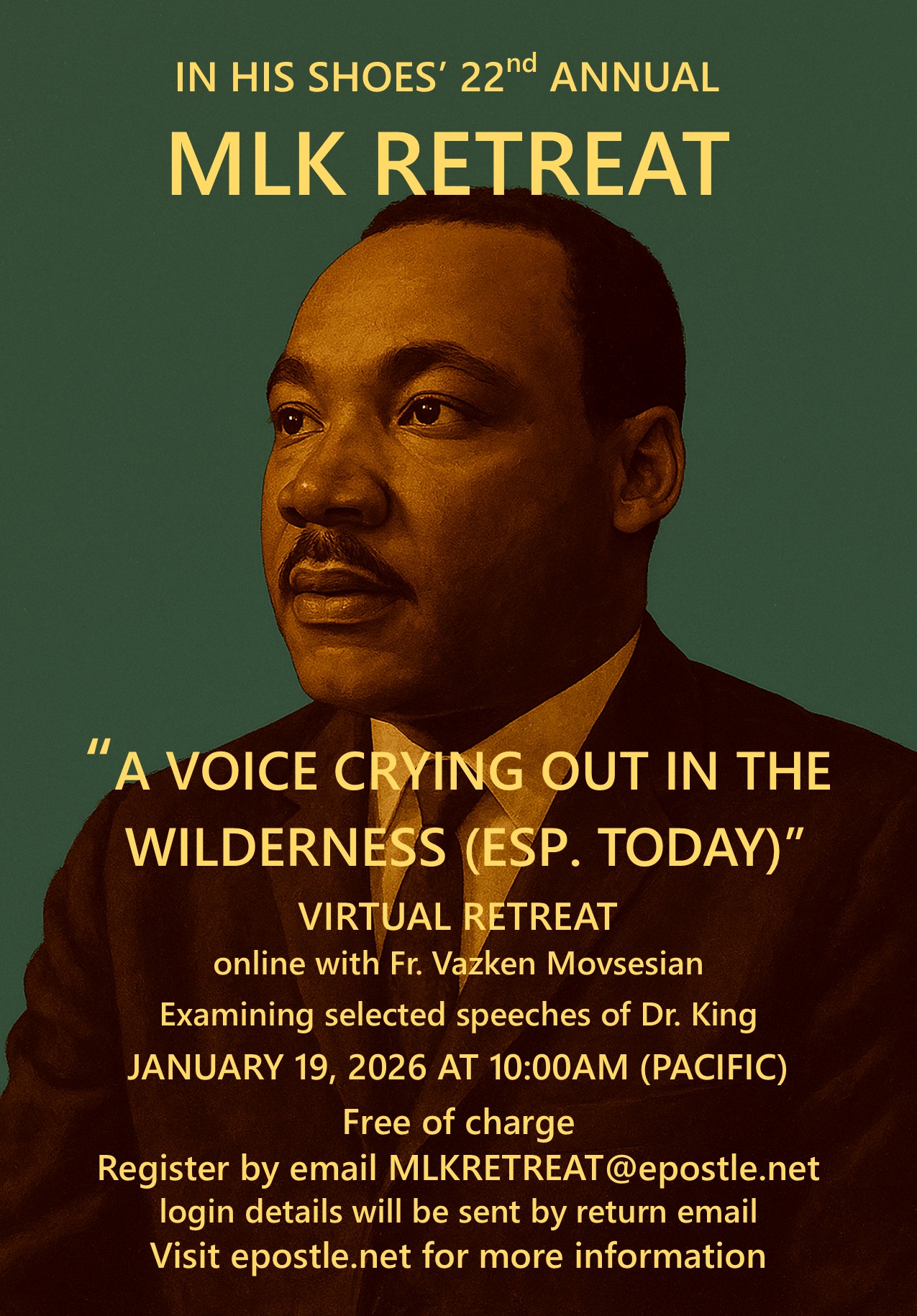
MLK Virtual Retreat 2026

Thy Will: Joseph’s Example

Armodoxy for Today: The Example of Joseph

Of all the characters in the Nativity narratives, Joseph, the husband of Mary, the Mother of Jesus, is often the least discussed. Sometimes he’s even forgotten. According to the Gospel record, “After … Mary was betrothed to Joseph, before they came together, she was found with child of the Holy Spirit.  Then Joseph her husband, being a just man, and not wanting to make her a public example, was minded to put her away secretly. But while he thought about these things, behold, an angel of the Lord appeared to him in a dream, saying, ‘Joseph, son of David, do not be afraid to take to you Mary your wife, for that which is conceived in her is of the Holy Spirit. And she will bring forth a Son, and you shall call His name Jesus, for He will save His people from their sins.’” (Matthew 1)

According to the Scriptures and Church Tradition, Joseph was a carpenter by trade and lived in Nazareth in Galilee. He is described as a righteous man, and a devout man of faith, as is evidence by his obedience to God’s command. St. Matthew continues, “Then Joseph, being aroused from sleep, did as the angel of the Lord commanded him and took to him his wife, and did not know her till she had brought forth her firstborn Son. And he called His name Jesus.”

Joseph was the adoptive father of Jesus, who raised the child Jesus as his own. In the Western Church, he is regarded as the patron saint of adoptions.

Joseph gives us a very unique example by which to guide our lives. When we pray, we articulate, “Thy Kingdom come, Thy Will be done on earth as it is in heaven.” We ask that God’s Will be evident in our lives, here on earth. Jesus instructs us to pray these words because God’s Will is manifested here on earth through our participation. We pray and articulate it as such to remind us that we are participants in the Kingdom. Joseph understood that if God’s Kingdom was to come, his participation was essential. And so against all the odds, against the conventions and norms of the day, against the possibilities and improbability of a virgin birth, against the put downs of gossiping mouth, and humiliation by members of his own community, Joseph says, “Thy Will be Done” and obediently follows the order to take Mary as his wife.

Some of the hardest solutions in this world begin by us simply accepting the responsibility to be a participant in God’s Kingdom. Joseph gives up his comfort and his dreams to ensure the Kingdom in enacted, “on Earth as it is in Heaven.”

Let us pray, from a traditional prayer dedicated to the Blessed husband, “Oh, St. Joseph, whose protection is so great, so strong, so prompt before the throne of God. I place in you all my interests and desires. Oh, St. Joseph, do assist me by your powerful intercession, and obtain for me from your divine Son all spiritual blessings, through Jesus Christ, our Lord. Amen.

On the cover: Statue of St. Joseph and Young Jesus, at the Cathedral of Our Lady of the Angel, Los Angeles, California

Cozy: Mangers in Our Lives

Armodoxy for Today: Structure

The Armenian Church has unique readings for every day of the calendar year. These are daily prescriptions for the soul and mind, to be taken with plenty of fresh air and fresh thoughts. The fact that the Nativity stories of Jesus Christ as prescribed after the Theophany, and not before, is enough to tell us that Scripture is not meant as a history lesson, or a chronology, rather it is a means of bringing structure to our lives.

Structures are built upon foundations that are multifaceted. The fresh air blows and you start understanding in new ways that your spiritual side is living, it is evolving, it is being challenged and at the same time it is challenging to you.

Jesus was born in Bethlehem, and Mary, his mother, “Wrapped Him in swaddling cloths, and laid Him in a manger, because there was no room for them in the inn.” (Luke 2:6) A manger is a feeding trough for animals. It is small enough for an infant baby and secure enough to make for a cozy crib. The fact that mangers are found in barns and stables, makes us believe that the first witnesses to the Birth of Christ were barn animals. These assumptions and deductions are nice ways of developing a story and contributing to a history. These are only one of the foundations found in Christianity, but not enough to sustain the structure of our spiritual life. The structure will crumble on only this foundation.

The fresh air that blows gives us fresh thoughts. For most, January 6 is referred to as “Armenian Christmas” because the Armenians are the only ones who continue to celebrate the Nativity on January 6. A spiritual life cannot be sustained on this alone. As we learned during our meditations throughout the Advent season, the feast of Theophany is an overwhelming, life-changing and life-building event. It is the acknowledgment that the God of the Universe is revealed to humanity. Thus, the foundation for our spiritual life is much deeper and sounder than a birthday celebration.

The understanding of Theophany juxtaposed next to the narrative of “no-vacancy at the inn,” now challenges us to think beyond the historical facts. Where are the mangers located in our lives? Where can God rest comfortably and cozily? Can our lives – our hearts – function as mangers and if so, how do we anticipate God growing with our lives? What kind (manner) of power would we possess? In a personal manger, where God is snuggly and cozily situated can there be room for hatred, intolerance, bigotry or racism? And thus the hear Armodoxy difference, it’s our responsibility to prepare the room, the manger, the heart, so that God can reside within.

Let us pray, O Lord our God, you are the Way, the Truth and the Life. Today, I invite you into the coziest spot in my life, dwell in me as you dwelt in the saints and keep me from temptation so I may be delivered from evil. Amen.

Post-Theophany: Fast Forward to the Background

The Universe is an ordered system of bodies, forces and interactions. The Armenian Church organizes its liturgies and events according to a calendar. The post-Theophany period counts of 40 days to the event of “Dyaruntarch” or the Presentation, described in Luke chapter 2. It may seem a bit odd and backward, but during this post Theophany period, the events leading up to the Theophany are examine in Holy Scripture.

Often the Nativity of Christ, commonly referred to as Christmas, is considered as the first of all celebrations of Jesus Christ’s life. In fact, the Nativity, as well as every other celebration, is defined by the Resurrection, that is, the Easter celebration. In Jesus’ resurrection, death was conquered. “Christ has risen from the grave” was the first “gospel” of the Christian Church. Gospel means, the “Good News.” You might imagine that after the Resurrection, the early Christian community was completely baffled and in shock. They had witnessed the violent death of Jesus, an execution so heinously delivered that nobody would have believed that anyone could have possibly survived that death. And there was no reason to even consider Jesus’ survival because they removed his breathless body from the Cross and placed his body in a tomb. Resurrection was not even considered. But early that morning, Holy Scripture tells us, the visitors to the grave were surprised to find Jesus’ tomb empty.

The Christian Community, which became the Church, was defined by the Resurrection of Christ. “God so loved the world that He gave His only begotten Son” (John 3:16) finds its meaning because of the Crucifixion and Resurrection. It was because of the Resurrection that people began to inquire about Jesus and his history, that is, who is he? Where did he come from? Who are his parents? And so on…

The Gospel narratives were written to share the Good News. The Good News was contained in the person of Jesus Christ. The Nativity narratives in St. Matthew and St. Luke’s Gospels were presented to answers questions people had about Jesus’ background: What were the circumstances surrounding his birth? Where was he from? What was the connection with Joseph the Carpenter?

As you recall, in preparation for the Theophany (the Advent period we just concluded) we focused on our spiritual growth to accept the power of the Theophany. Now, we too, like the early Christians, will look a back at the stories that come from Jesus’ childhood. For this reason, the Armenian Church assigns the Nativity narratives to the days following Theophany. The stories we are all familiar with peripherally, will be the focus of our next journey on the road to the Presentation or Diaruntarch.

Let us pray, Lord Jesus Christ, we are in the joy celebrating your Nativity and Revelation. We stand in awe of your presence in our life. Open our hearts and our minds to all that is You, as we begin in our Scriptural study of the Nativity narratives. May your holy name be glorified today and always. Amen.