Western Diocese Hosts Special Livestream for Armenian Christmas

Western Diocese Hosts Special Livestream for Armenian Christmas at St. Leon Cathedral

Burbank, CA.  January 8, 2026

During the Theophany service, Archbishop Derderian proclaims Epostle as a global Missionary of the Armenian Church.

On January 6, 2026, the Western Diocese of the Armenian Apostolic Church hosted a meaningful live event and livestream from St. Leon Cathedral in Burbank, titled “Christ is born and revealed”. The celebration marked the Feast of the Holy Nativity and Theophany of Our Lord Jesus Christ, a cherished tradition for Armenians worldwide.

This unique feast combines the commemoration of Jesus Christ’s birth in Bethlehem with His baptism in the Jordan River. In Armenian tradition, the day is known as Astvadzahaydnootyoon (“Revelation of God”), emphasizing the manifestation of the divine in both the Incarnation and the appearance of the Holy Trinity at Christ’s baptism, where the Father’s voice proclaimed Him as the beloved Son, and the Holy Spirit descended like a dove.

The Divine Liturgy (Badarak), sermons, and the traditional Blessing of Water ceremony highlighted themes of spiritual renewal, light overcoming darkness, and God’s revelation to humanity. Faithful gathered to exchange the joyful greeting: “Christ is born and revealed!” (Krisdos dznav yev haydnetsav!), with the response “Blessed is the revelation of Christ!” (Orhnyal eh haydnootyunun Krisdosee!).

Why January 6th instead of December 25th?

Unlike most Western Christian traditions that celebrate Christmas on December 25, the Armenian Apostolic Church observes the Nativity on January 6. This practice preserves one of the oldest Christian traditions: in the early centuries of Christianity, all churches celebrated Christ’s birth and baptism together on January 6 as a single feast of Epiphany/Theophany (“revelation of God”).

By the fourth century, the Western Church (particularly Rome) shifted the Nativity to December 25 to coincide with, and Christianize, existing pagan festivals, such as the birth of the sun god. Most Eastern churches eventually adopted this change. However, the Armenian Church, which was not under Roman influence and had no such pagan observances to counter, faithfully retained the ancient unified celebration on January 6. This enduring tradition reflects the Armenian Church’s deep commitment to early Christian liturgical roots.

The January 6 event at St. James Cathedral served as a beautiful reminder of this heritage, bringing together the community in prayer, reflection, and joy. Many parishes across the Western Diocese and beyond continue this sacred observance each year, keeping alive a timeless expression of faith.

Click To Watch Recorded Livestream.

Here are some glimpses from Armenian Theophany celebrations, capturing the liturgy:


Theophany: God Revealed

Armodoxy for Today: The Theophany – Christ is born and revealed!

We have arrived at the Theophany. Advent has prepared us to accept with clarity and purpose, the great news: Christ is Born and Revealed. More than a “Christmas Celebration” we now understand the great Revelation: “For God so love the world that he gave his only begotten Son…” (John 3:16) Most have learned or memorized this passage by heart. Following Advent, and this Advent Journey, I trust that these words resonate deep in your spiritual consciousness.

It is not by accident that we have not spoken about the virgin birth, the obedience of Joseph, the visit of the Magi or the shepherds’ vigil thus far. No worries, we will. But today we move to the Baptism of Jesus, the starting point of his ministry. The Baptism is recorded by all the evangelists – Matthew, Mark, Luke and John – in their Gospels. In a very real sense, his baptism was the “birth” of him ministry. Reading the account of St. Matthew (chapter 3) we find, “When He had been baptized, Jesus came up immediately from the water; and behold, the heavens were opened to Him, and He saw the Spirit of God descending like a dove and alighting upon Him. And suddenly a voice came from heaven, saying, ‘This is My beloved Son, in whom I am well pleased.’”

At this one moment in history, God is revealed as the Holy Trinity. The Son of God stands in the River Jorden, the Holy Spirit descends on Jesus in a dovelike manner and the voice of God the Father is heard. The Revelation of all three Persons of the Holy Trinity gives definition to the Feast of “Theophany.” Asdvadzahaydnoutiun

In the Armenian Church the Feast of Theophany encompasses all of the events in the life of our Lord Jesus from his Birth to his Baptism. At the conclusion of the Divine Liturgy, water is blessed to symbolize the Baptism of Jesus. Into the water is poured Holy Miuron, that is chrism or “Holy Oil” which comes from the time of Christ and is preserved and renewed in the Armenian Church every seven years.

Today is a new beginning. It is a new day of celebration. In modern terms, you can think of it as a hard reset, it is like hitting the reset button on your device and coming back to the original form. In this case, were back – reset – life as it was meant to be. Today, the Light shines bright, for the Author of Light is shining in our hearts.

Now that you have arrived at Theophany after this intense period of Advent, I invite you to follow along the daily podcasts, “Armodoxy for Today” where we will explore the intricacies of the Armenian Church and her faith. The OG – original Gospel message as presented by the Armenian Church. If you have missed any of the Advent series, you’ll find the lessons archived on Epostle.net. Moving forward, we’ll learn where the Christmas narratives of shepherds, wisemen and stars fit into our Faith? What is the mystical and magical quality of Holy Miuron? What is the strength of the Holy Divine Liturgy that is repeated every week? Because Armodoxy for Today connects the dots between the ancient and the current, the sacred and the secular, our relationships today with the beauty of God’s Kingdom and His Love and Kindness for each of us.

On this special day, our prayer is the prayer of the Angels, let there be peace on earth and good will toward all. I leave you today with a special hymn, Aysor Hayragan, Today the Voice of the Father, is heard at the River Jordon and in our lives today. It is meditative and I invite you to be swept away by the melody and this celebratory rendition by the Vem Radio Choir.  (Visit the Vem website for broadcasts and information.)

Christ is Born and Revealed! Blessed is the Revelation of Christ.

Before Mangers and Flashing Stars

Armodoxy for Today: Revelation (Eve of Theophany)

It is the eve of Theophany. You might expect a message about a babe in a mangers or a star in the sky flashing, but instead we take a detour on the final day of Advent and grab

Revelation story from the Book of Daniel.

On the Eve of Theophany, in all Armenian churches, this story, referred to as the “Song of the Three” is chanted from Daniel chapter 3 and responded to with a rebellious song against the powers of the world, pledging loyalty to God.

Many stories from the Old Testament feature royalty, and this one doesn’t disappoint. This about King Nebuchadnezzar. As the story is read, he has constructed a huge gold statue celebrating himself and his magnificent prowess. He has sent out an order for everyone in his kingdom to come forward, pay homage and worship before the statue. Should anyone refuse to do so, the penalty was death by means of a fiery furnace. Three men, Shadrach, Meshach, and Abed-Nego, refuse the order of the King. The orders for punishment are carried out and Shadrah, Meshach and Abed-Nego are thrown into the fiery furnace. They go in singing the praises of God and survive the heat and flames.

Their song, “The Song of the Three,”* says, “O Nebuchadnezzar, our God whom we serve is able to deliver us from the burning fiery furnace, and He will deliver us from your hand… But if not, let it be known to you… that we do not serve your gods, nor will we worship the gold image which you have set up.”


Nebuchadnezzar is furious at their contempt and their rebellious attitude. He has the heat turned up seven-fold. The three men continue to sing the praise of God.

The narrator continues to describe the intensity of the heat being so great that the guards who took the men into the furnace were killed in the flames, but Shadrach, Meshach, and Abed-Nego went unhurt, and continued to sing the praise of God. The King, looks into the furnace and out of astonishment yells out, “Did we not cast three men bound into the midst of the fire? … Look! I see four men loose, walking in the midst of the fire; and they are not hurt, and the form of the fourth is like the Son of God.”

On the Eve of Theophany, the Eve of the Celebration of Jesus Christ being born and revealed, this Scriptural passage is read in all the Armenian churches as a reminder that during our worst moments, when the heat is on and even exceeding normal expectations of survival, our salvation is in God. God is revealed in our midst. He never abandons us. The story of the three men, Shadrach, Meshach, and Abed-Nego is retold as a prelude to the greatest story ever told, a prelude to the Birth of the Savior, who stands with us during our most difficult moments and we find a loving and caring Father who never abandons us.

Tonight, we greet one another with the great news: Christ is born and revealed, blessed be the revelation of Christ!

Let us pray, “O Lord and Savior, Jesus Christ, Son of the Father, on this evening You entered the world. The Word was made flesh. Keep the freshness of this story ever present in my life. Tonight, we finish this preparatory period of Advent, and I am ready to fully engage with You and Your Revelation, tomorrow at the Theophany. May I never turn away from this connection to Life and this Truth. In all things I praise you along with the Father and Holy Spirit. Amen.”


*Note: The story of King Nebuchadnezzar and the three men can be found in Daniel 3 and I strongly urge that you read it in its entirety. The Song of the Three is part of the Armenian canon, that is, it is in the Traditional Orthodox and Roman Catholic Bible. Unfortunately, the Protestants (including the Armenian evangelical churches), have removed the Song of the Three from the Holy Scriptures along with several other books, and placed them in a group of books labeled as “Apocrypha (that is, “Hidden”). For the Armenian Church, Holy Scripture cannot be discarded.

Nativity: Part of Theophany

Armodoxy for Today: And Now the Nativity

When we first began to journey through Advent I mentioned that there are three Gospel narratives concerning the birth of Jesus Christ. We are all familiar with St. Matthew’s account of the Nativity, with the virgin birth, to the visit of the Magi. Likewise we know that St. Luke presents the Nativity in the context of the census and with Joseph and Mary finding a birthing area in a barn because there was “no room at the inn.” The angels herald the Good News with the words “Peace on Earth and good will among men.”

The third Nativity story does not read like the other two. It is recorded by the Evangelist St. John in His Gospel. The time referenced is not two thousand years ago, rather it at the beginning of all time. It reads as follows:

“In the beginning was the Word, and the Word was with God, and the Word was God. He was in the beginning with God. All things were made through Him, and without Him nothing was made that was made. In Him was life, and the life was the light of men. And the light shines in the darkness, and the darkness did not comprehend it.”

The final narrative, the one according to St. John, is about the eternal presence of the Christ. The holy words of scripture point to the Eternal One, the Creator and the Source of Light. And now, “The Word became flesh” and “Dwelt among us, and we beheld His glory, the glory as of the only begotten of the Father, full of grace and truth.” (14)

We refer to this event as the Theophany, that is, the Revelation of God. In Armenian, the word is descriptive of the event, Asdvadzahaydnutiun. In Jesus Christ, God is revealed to humanity. The Nativity is part of the Theophany. He that was at the beginning, the One that took nothing and created the stars and the sky, the sea and scenery, is now in our midst. Advent has prepared us for this moment and we now understand that no matter how long we prepare, we can never be prepared enough to stand in His presence. It is only by His grace that we can find the expression of awe that lifts up from our inner being.

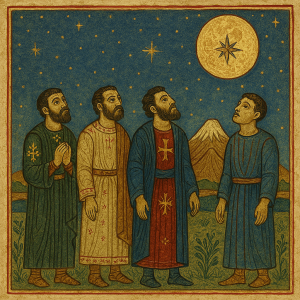
January 6 is the feast of Theophany, Asdvadzahaydnutiun. It arrives in two days. The 50 days of Advent have been filled with lessons from Holy Scriptures and the teachings of Jesus Christ. We are ready to view the Theophany through the lens of Armodoxy. That means, with awe we await to witness the Nativity from Bethlehem to our homes. We look up to the heavens and see the shining star guiding us to the stable where the Child Jesus is wrapped in swaddling clothe and lays in a manger. And the spot under the star is in our neighborhood, close to home. Armodoxy asks us to understand that the star shines above Artsakh, Ukraine, the Congo, Ecuador, and San Salvador, Moscow, Ethiopia, Bangladesh, Darfur, and even under Wall Street, and the seemingly glowing hubs on the world, because most of all, we understand that Jesus Christ is revealed where humanity struggles, whether physically, emotionally or spiritually. The Theophany will be here and we are ready to greet one another with a message of hope, love and faith.

Let us pray, Lord God, on this Holy Day you came into a world in the most lowly of all conditions. You came to share Your Divine message with us. Fill us with the power of the Holy Spirit. Give us strength to marvel at the wonders of this Day and to stand in awe. Give us the perception to see the star of Bethlehem everywhere where you are born to those in need, to us and those who hurt. Amen.

Advent’s Last Stop: Service

Armodoxy for Today: Service, Advent’s Last Stop

We started this journey at the direction of the Church almost 50 days ago. Advent, meaning coming. We have prepared ourselves for the coming of Christ – the Nativity, or in more distinct terms, the Theophany. Preparation has been emotional, spiritual and even physical with the scriptural passages and the exercises prescribed to us by the Church.

The last stop on the Advent Journey is directed by the passage that comes to us from the Gospel of St. Luke and is read during the last Sunday worship before Theophany. It reads as follows:

Now there was also a dispute among [the Disciples], as to which of them should be considered the greatest. And He said to them, “The kings of the Gentiles exercise lordship over them, and those who exercise authority over them are called ‘benefactors.’ But not so among you; on the contrary, he who is greatest among you, let him be as the younger, and he who governs as he who serves. For who is greater, he who sits at the table, or he who serves? Is it not he who sits at the table? Yet I am among you as the One who serves.” (22:24-28)

This is the “last station stop,” so to speak, before the celebration of the Theophany. Having learned the lessons of the last six weeks, today we move on to service. Jesus tells us, in no uncertain terms, that he comes to us to serve, presenting himself as an example for all of us to do the same: to serve one another. And he articulated this idea of the greatness through service, with his actions at the Last Supper by washing the feet of the disciples (John 13).

This is the last station stop because in order to serve you must first be spiritually and emotionally ready. This means you must be rid of egotism that will restrict or forbid you from serving others. Christian service is selfless, in other words, it demands that the self be put on hold while you tend to the needs of others. Without the training of the last fifty days, service would be extremely difficult because emotionally you were not ready to cast aside selfish pleasures, in service to someone else. Service comes from an empathetic heart. Empathy is the result of understanding the pain of others, or walking in their shoes.

The path of Armodoxy is simple and interconnected to everything, that is, every lesson is connected to every other lesson, to build upon and to give momentum and meaning to Faith. Today you are one step closer to the great news that Christ is in our Midst. Tomorrow, Theophany will be explained.

Let us pray, O Lord, Jesus Christ, you have given us an example of loving and serving. May we be worthy to be called your Living Body, the Church by loving and caring for others. Allow me to see the hurting world and the pain of people, and answer with my ability to serve others. Give me the strength and courage to express my love to all. Amen.

New Year Lesson: Never on a Sunday

Armodoxy for Today: Lessons from Pasadena

Today’s lesson comes not from the Church but from the City of Pasadena. Ten miles northeast of downtown Los Angeles, at the base of the San Gabriel Mountains, lies the City of Pasadena. The town has the distinct honor of ushering in the new year, every January 1st with the Tournament of Roses Parade. It is estimated that about one-million tourists enter the city to watch the five-and-a-half mile parade which features floats, bands, horses with riders, celebrities and football champions. Another 50 million people watch the television broadcast.

The Pasadena Tournament of Roses parade began in 1893. The floats are constructed of all natural herbs and plants, with over 18 million flowers used annually to construct the displays, taking 80,000 hours of human power.

But of all the remarkable statistics that I can rattle off about the parade there is one that sets it apart from all others. Pasadena has a “Never on a Sunday” rule! The parade takes place on January 1stunless January 1st falls on a Sunday, in which case the parade is moved to the following day, on Monday January 2nd.  The rule was put in place when Pasadena started having parades in the 1890s to avoid interference with church services. It is a simple rule and an overt expression of the city’s priority.

The new year begins a few days before the Theophany. January 1st is a convenient time to access our life directions and make necessary changes to our course. It is a time to set goals and priorities. Jesus instructs us with the words, “No one sews a piece of unshrunk cloth on an old garment; or else the new piece pulls away from the old, and the tear is made worse.” The new year doesn’t need to be patched and if it does, not with old habits. You don’t want to carry old baggage into the new year. Begin by a simple assessment of your life and what are the priorities you would like to implement. Think of the lesson of Pasadena’s Rose Parade. Are you ready to implement policies that will prioritize God in your life?

Let us pray. A prayer for the New Year by Rev. Marcy Sheremetta

As the dawn breaks on a new year, let us give thanks for all we hold dear: our health, our family and our friends. Let us release our grudges, our anger and our pains, for these are nothing but binding chains. Let us live each day in the most loving ways, the God-conscious way. Let us serve all who are in need, regardless of race, color or creed. Let us keep God of our own understanding in our hearts and to chant God’s name each day. Let us lead the world from darkness to light, from falsehood to truth and from wrong to right. Let us remember that we are all one, embracing all, discriminating against none.

May your year be filled with peace, prosperity and love. May God’s blessings shower upon you and bestow upon each of you a bright, healthy and peaceful new year.