Mountain Talk

A Conversation with Father Vazken Movsesian and Gregory Beylerian on Identity, Creativity, and the Mystery of Being.

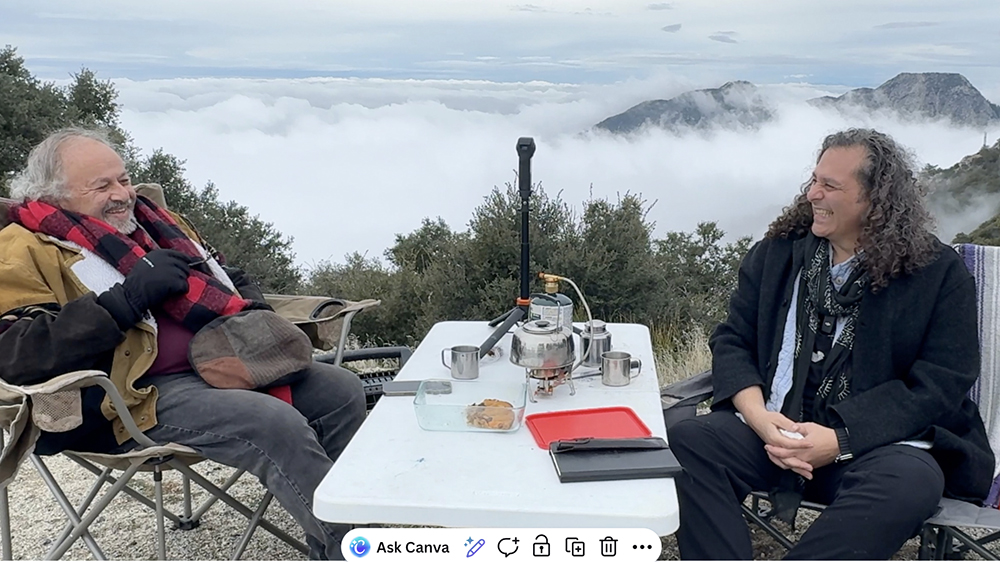
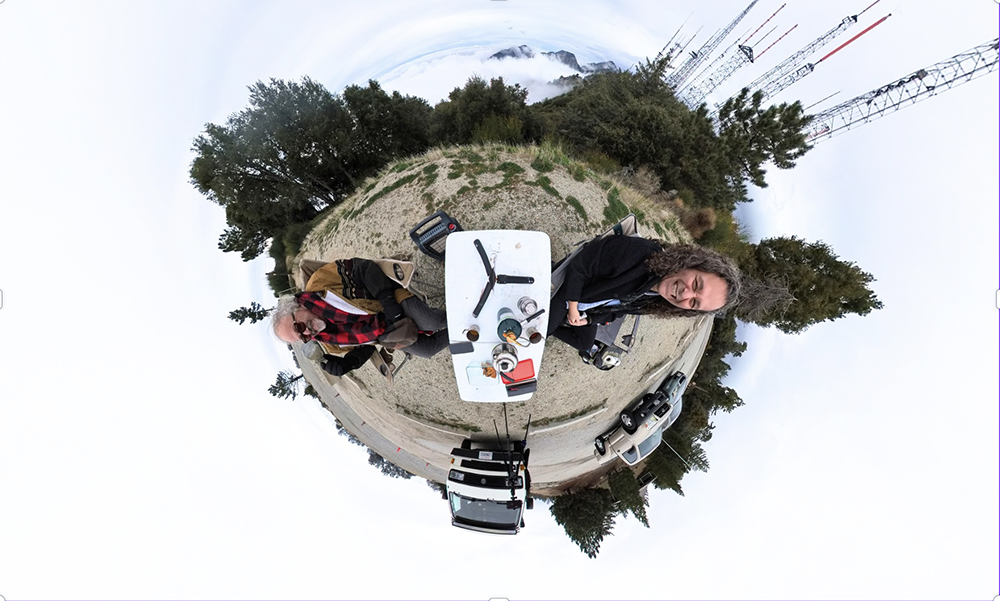
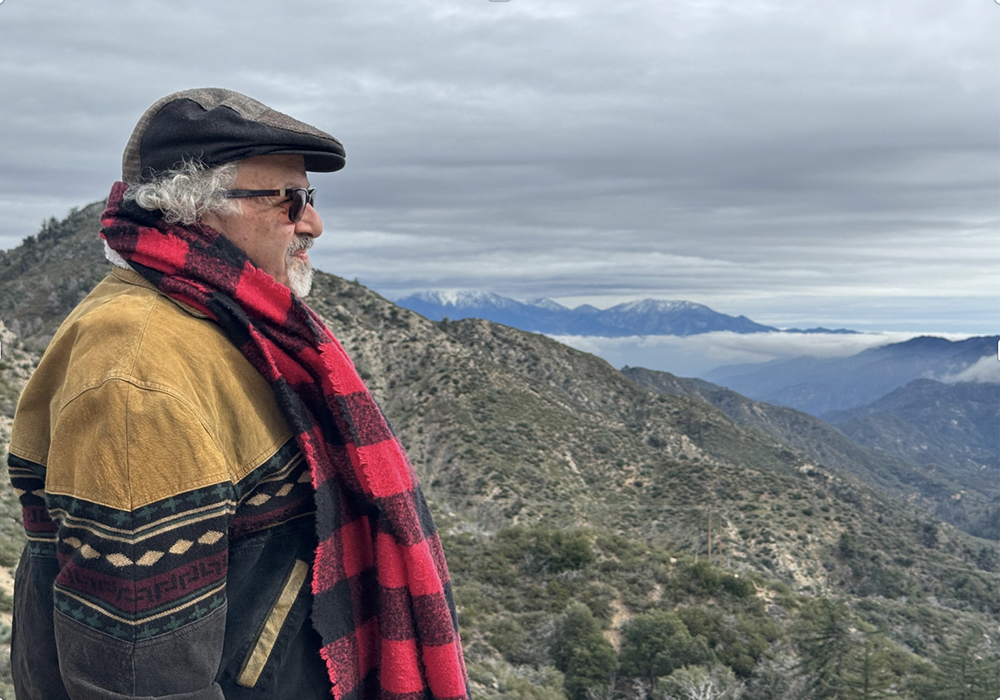
On a quiet mountaintop overlooking the vastness of creation, Father Vazken Movsesian and artist Gregory Beylerian shared tea and reflection, an unscripted exploration of life, identity, spirituality, and the state of humanity. What emerged was a deeply human conversation, rich with humor, humility, and insight into the challenges and beauty of modern existence.

Roots and Identity

Their dialogue began with something simple, homemade rojig, a sweet made from Armenian grapes grown in Pasadena. From there, they explored the meaning of cultural connection and belonging. How does identity shape who we are, and how can it both liberate and limit us?

For both men, identity is not merely ethnicity or history, but a living bridge between past and present. As Father Vazken observed, “It’s not only for yourself, but in defining who you are in the bigger picture.” Gregory expanded the thought, recalling how ancient Indian mystics once taught children to identify first with the cosmos, to root their identity in the whole of creation before nation or tribe. Such a perspective, he said, inspires unity rather than division, compassion instead of competition.
Living in the Now

Father Vazken reflected on how religion often misdirects people’s attention toward “a time to come,” missing the spiritual essence of the present moment. “Jesus wasn’t teaching about something far away,” he said. “He was showing us how to live right now, peace on earth, goodwill toward one another.”

Gregory connected this with the need to evolve beyond survival thinking. Humanity’s progress, he suggested, requires cooperation, mirroring the harmony already present in nature. “Nature doesn’t show survival of the fittest,” he said. “It shows a cooperative relationship. That’s the wisdom we’ve forgotten.”

Education, Creativity, and the Human Spirit

Their conversation naturally turned toward education, how systems built on competition stifle creativity and curiosity. As a teacher and parent, Gregory lamented how children’s innate creativity is often the first thing cut from school budgets. “The art class isn’t just for making Picassos,” he said. “It’s where problem-solving, innovation, and social vision are born.”Father Vazken agreed, describing education not as a means to make money, but a way to connect, understand, and participate in the human story. “Education’s purpose is knowing that you’re not alone here, that you’re part of something bigger.”

Mass Formation and Higher Intelligence

Gregory introduced the concept of mass formation, the way collective consciousness can be manipulated when intellect is disconnected from higher intelligence. Propaganda works not because people lack intelligence, he explained, but because their awareness is confined by identity.

He drew a distinction between intellectual and divine intelligence: “Our intellect can be shaped by the world, but imagination, the higher mind, connects us to creation itself.” Father Vazken reflected that the danger lies in forgetting vision. “Where there is no vision, the people perish,” he said. “Knowledge is important, but that’s not education’s purpose. It’s about learning how to live, connect, and find meaning.”

The World at a Crossroads

Their conversation moved to the state of the world, war, environmental degradation, and political corruption. Both men agreed that humanity has the resources to heal these problems, yet lacks the creativity and moral vision to apply them. Father Vazken spoke passionately: “We fight fire with fire, and that just makes more fire. We’ve convinced ourselves there’s no other way, but there is.” Gregory noted that despite our technological evolution, consciousness has lagged behind. “We’re entering a time when people are waking up,” he said. “Maybe this isn’t a revolution of violence, but a revolution of awareness.”

The Return of Myth and Meaning

Gregory invoked Joseph Campbell’s reminder that societies survive through their myths, living stories that help people understand who they are and where they’re going. “Without vision,” he said, “a culture perishes. We need to retell the old stories in new ways.”

Father Vazken agreed: “Without relevance, even religion loses purpose. These stories were created to help us explain the mystery, to remind us of something beyond ourselves.”

They discussed the vastness of creation, from the first spark of light to the latest discoveries of modern science. “This isn’t just a 2,000-year-old story,” said Father Vazken. “It’s a 13-billion-year-old one. Everything we see, all of it, is part of that same beginning.”

The Hero’s Journey

Gregory reflected on Campbell’s Hero’s Journey as a metaphor for spiritual awakening. “You leave the comfort of your village, your security, and face the unknown,” he said. “The monsters you meet are really your own fears. When you conquer them, you return to your community with wisdom and gifts.”
Father Vazken added that different traditions describe this same journey in different language, “Follow God’s will,” “Listen to the universe.” , Gregoy responded “ ahh, trust the flow”. Each points to the same truth: we are guided when we open to mystery.

Eh, The Presence of Being

Among the most profound moments in their mountaintop dialogue was the exploration of the ancient Armenian letter “Eh” (Է), a symbol carved for centuries above the altars of Armenia’s oldest churches.

Gregory recalled asking Father Vazken what the mysterious sign meant, seeing it over and over in monasteries built atop mountains and inside caves. “It’s Eh,” Father Vazken explained, “the verb to be in the present tense.” In that one syllable lies the heart of Armenian spiritual philosophy: presence. It is not a noun or a static identity, but an active state, being.

Father Vazken described Eh as the essence of reality itself. “It is the ultimate verb, the living now,” he said. “Everything else passes. The past is gone, the future may not come, but this moment, this presence, is real. This is where life is.”

Gregory reflected that this symbol captures what mystics and teachers across traditions have tried to convey for millennia: the invitation to be here now. From the teachings of Jesus to the insights of Eckhart Tolle, the message is universal, the eternal resides in the present.

They both noted how children embody this truth effortlessly. “A child lives in the eternal,” said Father Vazken. “They wake up to a new day without carrying yesterday. What a beautiful way to live.” In this way, the Eh becomes more than a letter, it is a map back to consciousness, a reminder that God, existence, and awareness all meet in the same timeless point: Now.

The Power of Mystery and Presence

Both men concluded that the greatest loss of modern times is our comfort with not knowing. “We’ve forgotten how to live with mystery,” said Father Vazken. “Not everything can be solved or Googled.”

Gregory emphasized the need to remain open, to cultivate a “beginner’s mind,” even after decades of experience. “That’s how discovery continues,” he said. Their conversation ended as it began, simple, grounded, human. They spoke of the wisdom of children, who live fully in the present, unburdened by yesterday or tomorrow.

A Shared Vision

As the sun dipped below the mountain, their tea cooled, and the conversation settled into silence. Two friends, a priest and an artist, had traced the arc of human experience, from cosmic identity to earthly compassion, from intellect to mystery. In their exchange was a quiet reminder: that the way forward for humanity is not through more technology or ideology, but through awakening the heart, nurturing creativity, and remembering our shared belonging in the great cosmic story, in the eternal Eh of being.
Screenshot
 

Vartan, tbd

Armodoxy in Today: Body and Soul

Partners in mission, Leon (Ghevont) and Vartan, are noted for bringing the light to the darkness. Following on yesterday’s theme of Spirit and Flesh, today we look at the body with its soul. Of the two friends, brothers in Christ, Vartan was the warrior. He was the body with soul, a spirit that was grounded in his beliefs. The story of Vartan gets told and retold from generation to generation, from 451AD to today.

Armodoxy asserts that you cannot impose your beliefs on anyone else. Armenians have never pushed their faith on others. This is not a sign of apathy, sloth or weakness, it is an expression of tolerance and understanding. However, when it came to the practice of their faith, the Armenians would not give it up, even if the consequence was death.

To the Persians who were imposing their faith on Armenians, Vartan and the Armenian forces responded, “From this faith [Christianity] no one can separate us, neither sword, nor fire, nor any other force.” Armenians make the point of remembering that they were outnumbered on the battle field by a ratio of 3:1. With over a thousand Armenian casualties, Vartan fell.

I don’t believe there is another group of people on the planet that celebrates a military defeat. This was the first time anywhere that a battle was fought for the defense of Christianity. And the mere fact that the Armenian Church exists today and is the center of the Christian tradition of the Armenian people, is proof that the battle was lost but the war was won.

The historian Yeghishe records that Vartan and his soldiers took an oath, We are ready for persecution and death and every affliction and torture for the sake of the holy churches which our forefathers entrusted to us by the power of the coming of our Lord Jesus Christ, whereby we were reborn ourselves by torments and blood. For we recognize the Holy Gospel as our Father, and the apostolic universal church as our Mother. Let no evil partition come between us to separate us from her.

Remembrance of the saints Vartan, Ghevont and those who sacrificed their lives as an act of defiance, is a reminder that our faith in Christ cannot be compromised. In a sense, the Battle of Vartan, 451AD is a page of history that has a comma at the end of it, to be decided in the Battle of Vartan in the 21st century. For we recognize the Holy Gospel as our Father, and the apostolic universal church as our Mother. Let no evil partition come between us to separate us from her.

Let us pray, “Lord, our God, through the intercession, memory and prayers St. Vartan and St. Leon, who lived and died for Jesus and the Fatherland and whom we commemorate today, grant us the gift of peace and of your great mercy. Amen.”

Angels before Valentine Day: Two Friends

Armodoxy for Today: Spirit & Flesh

Angels are flying and hovering all around us on Valentine’s day, and mostly of the chubby little cherub variety. With arrow drawn, Cupid takes aim at the heart twixt lovers. As for the other variety of angels, they’re called seraphim, they’re flying with their six wings in service to God.

We have developed quite an imagery of angels. Ironically, angels are spiritual beings, that is, they do not have physical attributes. Go ahead, look it up. Angels are spiritual beings. They are the messengers of God. We ascribe physical traits to them for convenience so that we can form an idea of what a spiritual being may look like.

It is the human being, who above angels, has been gifted with both spirit and body. Often, it is the struggle between spirit and flesh that is highlighted in many religious stories, especially in the Bible. Today we will look at the power found in bringing spirit and flesh together.

Over these two days preceding Great Lent, the Armenian Church commemorates two saints, who were contemporaries, brothers in Christ, and responsible for the continuity of the Armenian Church and therefore the nation. One is St. Leon the Priest (Ghevont Yerets), and the other is St. Vartan Zoravar (the Warrior).

In the 5th Century, the Battle of Avarayr was fought between the Christian Army, under commander Vartan Mamikonian and the Perian army. This was the first time anywhere that a battle was fought for the defense of Christianity. It led to the signing of a treaty in 484 which affirmed Armenia’s right to practice Christianity. This is the single most important and significant event in Armenian history and for this reason, St. Vartan is recognized by the Church but also by the people, as a national hero.

His friend and priest, St. Leon, is often forgotten, though his impact on the Battle and thus the victory, is recognized by all historians, as essential. The Church recognizes the two over the course of this week and emphasizes the importance of spiritual practices combined with physical prowess to overcome the worst of difficulties. More specifically, for us, we pray to God, but in the end, it is on our physical strength that we count on to stand or walk, to reach out or voice ourselves. In our daily struggles, the example of St. Leon and St. Vartan teach us how to balance the spirit and the flesh to achieve our goals. This then, becomes a prelude to the Lenten Season.

Tomorrow we will look closer at St. Vartan.

One of the more recent manifestations of the Divine presence in our lives was in 1968 when the Cathedral (the headquarters of the Diocese) in New York was consecrated in the name of St. Vartan. Forty-two years later, when the Cathedral in Los Angeles was to be consecrated a philanthropist came forward and asked that it be consecrated using his father’s name, which happened to be Leon, and so it was in 2010. Some may call this coincidence. Others, like me, want to believe it is God’s special messenger letting us know, the Armenian Church in America, is protected from coast to coast by St. Leon and St. Vartan, as they have for centuries.

Let us pray, “Lord, our God, through the intercession, memory and prayers St. Leon and St. Vartan, who lived and died for Jesus and the Fatherland and whom we commemorate today, grant us the gift of peace and of your great mercy. Amen.”

Feathers that Explain

Armodoxy for Today: Feathers that Explain

We continue on our theme of finding God in the little things, with this short observation from Soviet dissident, Alexander Solzhenitsyn. In 1970 he won the Nobel Prize in Literature, having raised global awareness of political repression in the Gulag prison systems of the Soviet Union. Today, there is no Soviet Union, but there is tyranny, and political unrest in the human quest for freedom.

Alexander Solzhenitsyn wrote this beautiful short prose poem dedicated to a duckling.

A little yellow duckling, flopping comically on its white belly in the wet grass and scarcely able to stand on its thin, feeble legs, runs in front of me and quacks: “Where’s my mommy? Where’s my family?”

… this one is lost Come on then, little thing, let me take you in my hand.

What keeps it alive? It weighs nothing; its little black eyes are like beads, its feet are like sparrows’ feet, the slightest squeeze and it would be no more. Yet it is warm with life. Its little beak is pale pink and slightly splayed, like a manicured fingernail. Its feet are already webbed, there is yellow among its feathers, and its downy wings are starting to protrude. Its personality already sets it apart …

And we men will soon be flying to Venus; if we pooled our efforts, we could plough up the whole world in twenty minutes. Yet, with all our atomic might, we shall never-never! — be able to make this feeble speck of a yellow duckling in a test tube; even if we were given the feathers and bones, we could never put such a creature together.*

Like the life in our breath, the cells of a trees, the splash of an ocean wave or in the feather of the duckling Solzhenitsyn describes here, everything is of God.

We pray, Lord, open my eyes and my heart so I may notice, feel, touch and appreciate the beauty you articulate in Your creation. Amen.

*Excerpt from Alexander Solzhenitsyn’s Short Stories and Prose Poems. Farrar, Strauss and Giroux, 1971. Bantam 1972

Tested in Birthing Rooms

Armodoxy for Today: Tested in Birthing Rooms

A foxhole is a hole in the ground used by soldiers as shelter against enemy fire. It’s been said that there are no atheists in foxholes. It’s an aphorism to suggest that in times of extreme fear or threat of death people will appeal to a higher power. In other words, when looking in the face of death, even the atheist will admit to a God.

Many years ago, I discovered another place where there are no atheists. The night my first child was born, it occurred to me that there aren’t any atheists in birthing rooms, either. When looking in the face of life in its most delicate and novel state, that is new life, untouched by the world, uncontrollably you lose yourself to your emotions. That loss of control is a recognition and acknowledgement of being in the presence of something greater than yourself. The details of paper-thin fingernails, the sculpting of beauty in the features, point to the fingerprint of God and the realization that the miracle of life as anything but an accident.

I tested this theory a couple of times after that first experience and most recently with the phenomena of grandchildren. Same conclusion: There are no atheists in birthing rooms.

We pray, Lord, in the simplest expressions of life we find You. Keep our senses ever-alert to Your presence all around us. Watch over and protect those little expressions of Your Love. Amen.Whispers of the wind, held in a breath—each filament a fragile thread of nature’s poetry.

The Vanadzor Team

Epostle Welcomes the Vanadzor Team

2025 marked a transformative year of growth for Epostle. We launched new initiatives, sharpened our focus, and reaffirmed our essential mission: to bring the light of Christ’s wisdom, the O.G. (original gospel) message uniquely preserved by the Armenian Church, to people around the world today. At Epostle, we view this mission as a bridge, a vehicle to guide humanity forward into the light. In an era when the world grapples with crisis, questions truth, and witnesses the consequences of polarization and division, this unifying light is needed more than ever. Like a lighthouse guiding ships through the night, Epostle aspires to be that steady beacon, beyond politics, untouched by societal drama, and unwavering in our commitment to the mission. When in doubt, follow the light. This is our message, our protocol for healing, evolving, innovating, and finding solutions amid darkness.

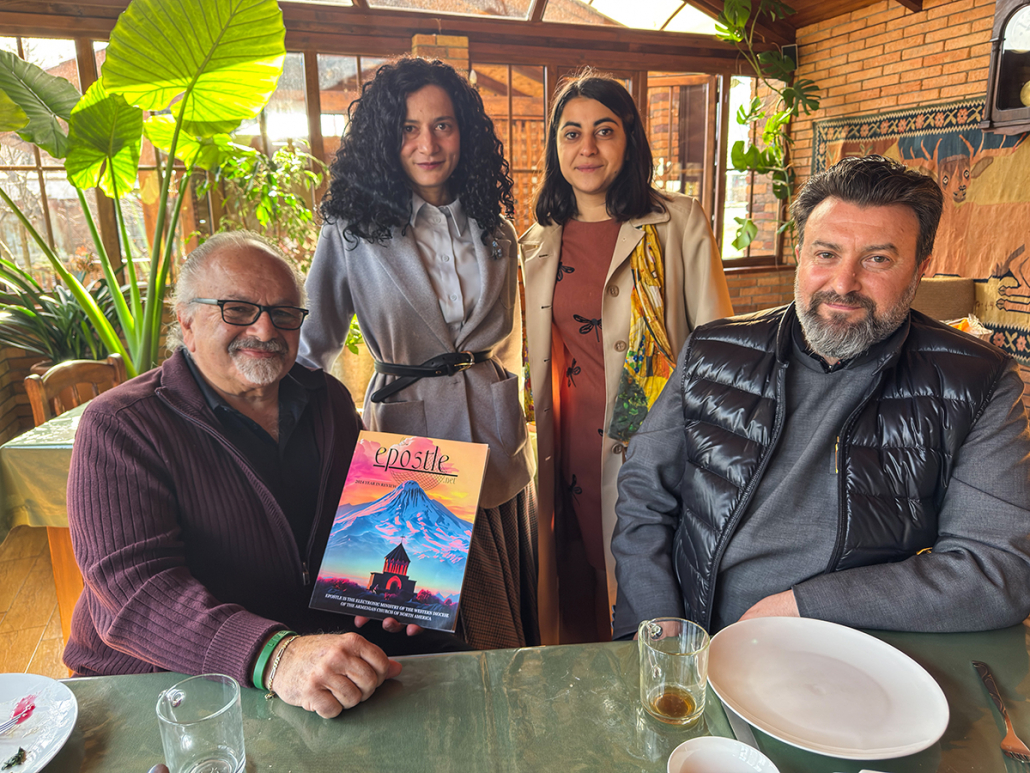
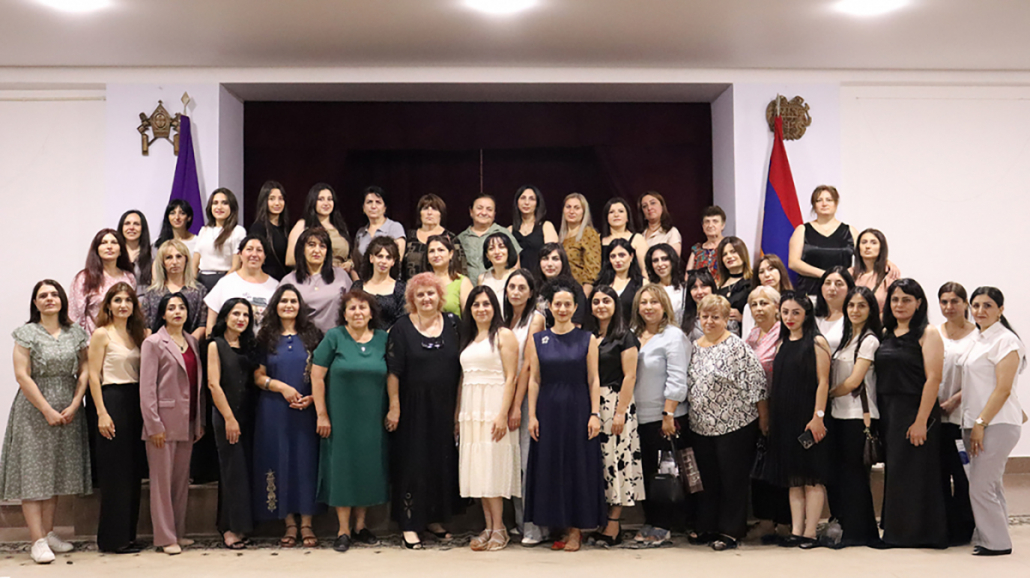
To fulfill this vision, we are intentionally building a borderless team, one that draws strength from diverse locations and shared purpose. After introducing our social media team in Yerevan, we are proud to present our Vanadzor Team, based in Armenia’s third-largest city. In March 2025, shortly after the Reclaim Conference, a small Epostle delegation traveled to Vanadzor to meet our newest members and lay the foundation for thriving outreach programs. We were warmly received by Bishop Hovnan Hakopian, Primate of the Gougark Diocese of the Armenian Apostolic Church, who shared his vision for the diocese’s future. This visit deepened our collaboration, focusing on real needs: spiritual and emotional support for refugees from Artsakh, a sewing center empowering displaced women to earn income and build self-reliance, and a children’s art center where young ones create freely, healing through expression.

At the heart of these efforts are two exceptional women whose experience aligns perfectly with Epostle’s goals and the community’s needs: Arevik Yeghiazaryan and Hripsime Mirzoyan, our Project Managers in Vanadzor. They serve as the vital bridge connecting Epostle’s main hub in Los Angeles with on-the-ground action in Armenia.

Arevik Yeghiazaryan brings strong project leadership and organizational skills. She holds a Master’s in Business Administration from the Public Administration Academy of Armenia and a Bachelor’s in Management from Vanadzor State University (with studies in Romania). Since 2021, she has been Project Manager at the Gougark Diocese, while leading “Bolor sar” NGO as President/Project Manager (2017–2025) and serving as founding member/Program Coordinator of WINNET Vanadzor (since 2020). Backed by trainings in CSO management and collaborative policy, she excels in communication, leadership, teamwork, and problem-solving, perfect for driving sustainable Epostle initiatives.

Hripsime Mirzoyan, a dedicated social worker born in Vanadzor, brings deep compassion and extensive community experience. Educated in Social Work and Social Policy at Yerevan State University’s Lori Regional Center, she has led the Social Programs Department at the Gougark Diocese since 2018. She coordinates programs like “Her Power, Her Future” (with CARE Caucasus and WINNET, 2023–present), psychosocial support, children’s education, and refugee aid. As Founding Member and President of WINNET Vanadzor (since 2020), she focuses on women’s and youth empowerment. Hripsime excels in communication, leadership, organization, and conflict management, making her an ideal heart-led partner for Epostle’s work.

During our March visit, these programs truly came alive. We met refugee women in the basement of Narekatsi Cathedral, listening to their stories of loss and exile while honoring their hope to return home. Dr. Talar Tejirian, our accomplished physician and surgeon from Los Angeles, spoke candidly about staying active and positive. She offered gentle assessments and introduced gratitude journaling. Her magnetic presence and professionalism left a lasting impression, embodying the empowered woman as a beacon of perseverance and possibility. To many Artsakh refugee women, Talar represents hope and what’s achievable through committed action, a living example of Epostle’s vision: light over darkness, possibility over fear.

Our refugee support began last year with fundraising like the Cars and Coffee event at St. Leon Ghevontyants Cathedral in Burbank, channeling funds to the sewing center and self-sustainability efforts. At the children’s art center, we saw joyful creativity and held open conversations with youth about faith and adolescence. Gregory Beylerian, Epostle’s creative director, shared insights on the children’s drawings, underscoring art’s role in healing and power of creative expression. We also reflected at the tomb of beloved former Primate Archbishop Sebu Chuljian, whose legacy of leadership and youth exchanges, including our continuing sister-camp programs, endures with our support.

With Arevik and Hripsime as our heart-led liaisons in Vanadzor, Epostle is achieving these goals with remarkable effectiveness. Teamwork is central: we co-create in rhythm, guided by conscious orientation and faith. Our team is built not on need or security, but on the heart, aligned with the teachings preserved by the Armenian Church at the base of Mount Ararat 2000 years ago. As a heart-led team rooted in divine intelligence, creativity, and action, the sky is not our limit; we reach beyond to the stars and further.

Looking to 2026 and beyond, we see a canvas of possibility. We are not dissuaded by society’s challenges because we choose to be part of the solution, a choice open to everyone. At Epostle, we have chosen to preserve and honor our past while shaping an illuminated future. We are deeply grateful for Arevik and Hripsime, whose dedication brings the light of Christ to life in Vanadzor. Their work uplifts families, empowers women and youth, and strengthens the global Armenian community’s bonds of faith and solidarity.

Together, we follow the light.

A Humbling Choked Voice

Armodoxy for Today: A Humbling Choked Voice

In birthing rooms, homes, and fields throughout the world, parents meeting their child for the first time are overwhelmed with tears and choke on finding the words to express that awesome moment of life. Our Lord Jesus refers to this moment, “When a woman is in labor, she has pain, because her hour has come. But when her child is born, she no longer remembers the anguish because of the joy of having brought a human being into the world.” (John 16)

At a full solar eclipse a few years back, as the Moon covered the Sun and only the solar flares were dancing around the circular disk in the sky, I was moved to sing the Armenian Hymn, sharagan, “Aravod Looso” – a praise to the morning Sunrise and to the Light. Try as I may, words were not coming out of my mouth. I was choking in emotion. Overwhelmed by the event.

In 1985 Carl Segan and his wife Ann Druyan authored the book, “Contact.” The story explores the possibilities of contact between humans and extraterrestrial beings.  About a decade later the story was made into a motion picture starring Jodi Foster and Matthew Machaney. It was fascinating because the story was written from a science perspective, as would be expect from Carl Segan, who was an astronomer and planetary scientists, and very eloquently articulated scientific concepts for the average man. He was an advocate of skeptical scientific inquiry and the scientific method. Yet at the end of Contact he concedes that words and the expressions we possess are inadequate in explaining or expressing the events of the first human contact with the extraterrestrial world. In common parlance we can say he choked.

Events that are bigger than life – whether exploding in the cosmos or the first glance at new life, humble us. They choke our voice so we speak with our heart, and a tear in our eye. They are subtle reminders of the grandeur of God.

We pray from the Book of Sirach, Because of Him each of His messengers succeeds, and by His word all things hold together. We could say more but could never say enough; let the final word be: “He is the all.” Where can we find the strength to praise Him?  For he is greater than all His works. Awesome is the Lord and very great, and marvelous is His power. Glorify the Lord and exalt Him as much as you can, for He surpasses even that. Amen. (chapter 43)

My Neighbor? You’re kidding!

Armodoxy for Today: My Neighbor? You’re Kidding!

“Love your neighbor,” said Jesus, to a man looking for the answers to life. The man responds to Jesus with a question which leads us to one of the most celebrated parables of Christ, yielding the greatest measure and definition of Christian love, compassion and outreach. The man simply asks, “Who is my neighbor?”

Jesus answers, “A certain man went down from Jerusalem to Jericho, and fell among thieves, who stripped him of his clothing, wounded him, and departed, leaving him half dead. Now by chance a certain priest came down that road. And when he saw him, he passed by on the other side. Likewise, a Levite, when he arrived at the place, came and looked, and passed by on the other side. But a certain Samaritan, as he journeyed, came where he was. And when he saw him, he had compassion. So, he went to him and bandaged his wounds, pouring on oil and wine; and he set him on his own animal, brought him to an inn, and took care of him. On the next day, when he departed, he took out two denarii, gave them to the innkeeper, and said to him, ‘Take care of him; and whatever more you spend, when I come again, I will repay you.’”

Jesus asks, “So which of these three do you think was neighbor to him who fell among the thieves?” The answer obviously is the one who showed him mercy. Jesus then says, “Go and do likewise.” (Luke 10:25–37).

The story of the Good Samaritan has been heard from Sunday School classrooms to pulpits, from children’s books to movie screenplays, and, most importantly, has certainly stirred many people to action. Perhaps the one point that hasn’t been accented adequately is the definition of a Samaritan. We can deduce that it was a person who lived in Samaria, but the significance of that place, and the people of Samaria is what sets the parable of the Good Samaritan on fire. These were people that were looked down upon, held in very low esteem by the Jews of the time, so much so that they were outcasts from mainstream Jewish society. In John chapter 4, Jesus asks for a drink of water a Samaritan woman who responds, “How is it that You ask a drink from me, a Samaritan woman?” And the Gospel evangelist adds, “For Jews have no dealings with Samaritans.”

Armodoxy demands that we place ourselves in the shoes of others. It challenges us to look at the full impact of Christ’s parables on our lives. And so, I am certain, that if Jesus were speaking to us today, the parable would be adapted to his audience. The spirit of this parable is to understand that the Good Samaritan is the object of our intolerance. Speaking to Armenians, the hero character would be a Turk who pulls out his credit card and covers the hospital expenses until his return. To the Israeli, the hero would be a Palestinian. To the Ukrainian, a Russian. To the white supremist, a black man. And to the self-appointed righteous, perhaps a member of the LBGT community?

Yes, the message is an uncomfortable one. Jesus was not one to keep us in our comfort zones. The number of Samaritans in the entire world today is under 1,000 individuals, accenting even more that the bottom line of the parable is not aligning ourselves with the Samaritans, but rather answering the question, “And who is my neighbor?”  The one who offers mercy, to which Jesus’ message is addressed to us, “Go and do likewise.” Today, we are invited to seek the “neighbor” in everyone, even a foreigner or a so-called enemy.

Let us pray, “Lord Jesus Christ, you instructed us to not judge, but to live. With all the complexities of life today, open my heart to your love, so I may see my neighbor in everyone, and others may see their neighbor in me. Amen.”


The Atmosphere that Saves Us

Armodoxy for Today: Atmosphere

If you’ve ever looked up at the illuminated moon, or studied close pictures of its surface, you can’t help but notice its pock-marked surface. Craters, large and small, are the witnesses to eons of bombardment by meteors, chunks of planets, debris, rocks, and ice slamming into its surface. Everywhere you look on the moon’s surface, there are craters. There’s no escaping the destruction of space-stuff on that surface.

The moon is our closest astronomical neighbor. It belongs to planet Earth, circling around us as Earth’s largest natural satellite. And yet, the surface of the Earth and the surface of the Moon have no resemblance.

The Earth is traveling around the Sun in its orbit, along with other planets and an assortment of debris, rocks, ice and space-stuff. Once these small bodies of matter enter the Earth’s atmosphere, they light up and we conveniently label them as meteors. They streak across the sky and we call them shooting-stars. Actually, they are merely matter becoming incandescent as a result of the friction. Thanks to our atmosphere, most of these objects burn away or slow down so much that their destruction is minimal. Thanks to our atmosphere, the surface of the Earth differs from the surface of the moon quite dramatically. Not only do we not have craters, but we have lush forests, vegetation, oceans, water and therefore, we have life! Of course, the atmosphere is also responsible for our weather patterns, which include beautiful moderate to fair weather, as well as hurricanes and tornadoes. Storms and monsoons cause floods and sometimes there is loss of life because of the harsh conditions. The atmosphere is responsible for life, as well as for the loss of life.

Natural disasters are built into the design of life. An earthquake happens because the tectonic plates, deep below the Earth’s surface, upon which we build our civilizations, settle and shift. Much like the atmosphere that saves us from meteors, the earth below our feet gives us an environment to build and create life.

We end today, with a short reading from the Gospel of St. Luke (chapter 13) where our Lord Jesus Christ explains that natural disasters are not based on our guilt, our sins nor the sins of our fathers.

Do you suppose that these Galileans were worse sinners than all other Galileans, because they suffered such things? I tell you, no; but unless you repent you will all likewise perish. Or those eighteen on whom the tower in Siloam fell and killed them, do you think that they were worse sinners than all other men who dwelt in Jerusalem? I tell you, no; but unless you repent you will all likewise perish.”

Punctuation Marks that Mark

Armodoxy for Today: Punctuation

One of the ways that knowledge is passed along from teacher to students, from generation to generation is through by the written word. The Bible evolved from an oral tradition to the written word, to the printed collection we carry today. It was written in Greek, Biblical Hebrew and Biblical Aramaic. The printing press was not invented until the 15th century. Up until then, it was transferred to new audiences by scribes who painstakingly copied words from one manuscript onto new parchment and arduously inspected the words, to avoid mistakes, and those words became the stories of the Faith.

Interestingly enough many of the texts, especially the Greek text in the New Testament were written in ALL CAPITAL LETTERS with no spaces and probably no punctuation.

Punctuation is necessary to give meaning to the words strung in a sentence. Take, for instance, the sentence, “Women without her man is nothing.” Now hold off, before you decide to stop following this post, I want you to realize that the sentence is void of punctuation. Again: Women without her man is nothing. Now, let’s add some punctuation: Woman, without her, man is nothing. The same words, with added punctuation, reveal a sentence that expresses a thought quite the opposite of the original one.

Imagine now, the tremendous task that was before the Church in deciphering the sentences and the sentence structures. When Jesus turns to the thief on with me the cross and says, “Truly I tell you, today you will be with me in paradise,” there is a certainly that life continues after death immediately. But if a comma were to move over by one word “Truly I tell you today, you will be in paradise” the immediacy of the moment is lost opening up speculation about the next step after death.

Fortunately, the Church was there from the beginning and knew the meaning of the words before they were written in a sentence.

Punctuation – a dot, a line, a squiggle – is more than a pause or an accent. It’s a way of passing along a message.

We pray today, “Lord, open my heart to your word. I hear with my ears and read with my eyes, but it is my heart that I commit to you. Amen.”