Groundhogs, Pagans and Celebrations

Armodoxy for Today: Candlemas, Groundhog Day and the Celebrations

A shadow is worth six weeks, at least if the shadow is that of Punxsutawney Phil. Yes, it’s Groundhog Day here in America and the little rodent came out of his hole with all the fanfare of the local community and those watching virtually on monitors throughout the country.  Before you think that you’ve tuned into the weather forecast or a small animal’s nature show, let me mention that today, February 2nd also has religious significance.

In Christianity, February 2nd marks 40 days after Christmas. In Scripture, the Evangelist St. Luke tells us that Joseph and Mary took the baby Jesus to the Temple as was the custom on the fortieth day after birth for all babies to be presented to the Temple, hence, the name “The Presentation.” In the West, it is referred to as Candlemas.

Candlemas and Groundhog Day share deep roots in ancient pagan traditions that marked the midpoint between winter and spring. Candlemas—linked to the festival of Imbolc—originated as a pagan observance in the Roman world before becoming a Christian feast celebrating the presentation of Jesus in the Temple, observed forty days after Christmas on February 2. In German folklore, weather predictions were tied to the behavior of a badger, a tradition that German immigrants carried to Pennsylvania, where the groundhog eventually took the badger’s place. The belief that a groundhog’s shadow on February 2 foretells either six more weeks of winter or an early spring became formalized in Punxsutawney in 1887, evolving into the cherished American custom celebrated today.

Because we in the Armenian Church celebrate the Nativity of Christ on January 6th as part of the Theophany Celebration, the Presentation is celebrated in 12 days, on February 14, with rituals that take from other pagan observances.

There is no need to hide the pagan roots of any of our celebrations. They are pointers to life being lived and enjoyed. Jesus came into the world, in his words, so that we may have life and have it abundantly, (John 10:10), celebrations are outward expressions of the abundance of joy in our lives. Pagan society had their rituals and their enjoyment according to many of the cycles of nature. Whether it’s the midwinter, the Equinox, the Solstice, rituals celebrate the possibility of new life, of forgiveness, of moving forward in the face of adversity.

Christ’s message is celebratory. It celebrates the defeat of darkness by light, evil by good and hate by love.

We pray, a prayer of St. Mesrop Mashdots of the 5th Century: Mighty King, refuge to the thirsty, Savior of the troubled, who succumbed to suffering for us at the hands of rulers. Prohibit Satan from enslaving those whom You have saved. Forbid the Evil One from seeking refuge in the House of God. With Your divine love, have mercy upon your creation. Amen.
Thousand Word Pictures Alive

Armodoxy for Today: 1000 Word Pictures of St. Sarkis

Over the weekend we commemorated St. Sarkis, in the Armenian Church. Throughout the year there are several saints that are remembered on the Church calendar. St. Sarkis is one of the more revered saints. He is a fourth century personality who served as a warrior in the Roman army at a time when Christianity was spreading through the Empire.

Yesterday I shared with you the story of St. Sarkis, as the Armodoxy message of the Day. Instead of covering the episode with a picture of St. Sarkis the warrior, donning the battle gear and weaponry, I placed a picture of a couple looking into the “fantasy” mirror, imagining themselves decked out in elegant clothing standing before a high-end car.

Every now and then I like to provide an explanation, especially to those new to Armodoxy and just as a reminder to those who may think we erred in finding a cover picture. The messaging we refer to as Armodoxy, takes the form of stories and imagery that point to expressions of the ancient stories articulated in our lives today. St. Sarkis, or any of the saints we commemorate, is a character in history. They have biographies that can be search and discovered in books, pages on-line, virtual queries and in just about every church weekly bulletin. The challenge for us has been and continues to be, how to raise the historical figure off of the pages of the history book in such a way that his or her life becomes a model of living today.

As I mentioned yesterday, Christians are being persecuted daily for their beliefs. We may not see the swords of the emperors or outright proclamations by Kings, but the weapons that strike us are just as deadly. We succumb to the lure of materialism, believing that our possessions define us and growing indifferent to the plight of others. With a contempt for Christ’s call to love, we sign our own death sentence.

Saints are the expression of life lived for Christ. Armodoxy is the witness to the relevancy of that expression in our life today.

We end with St. Nersess Shnorhali’s prayer of the fourth hour, where in the same spirit he refers to the thief on the cross next to Christ’s as one to touches us today. Son of God, true God, who descended from the bosom of the Father, and took flesh of the Holy Virgin Mary for our salvation, who was crucified and buried, and rose from the dead, and ascended to the Father, I have sinned against Heaven and before You; remember me like the robber, when You come in Your kingdom. Amen.

A Day at the Meta Lab

Inspiration In The Making: From coffee rituals to AR Breakthroughs, how innovation fuels the Epostle Vision.

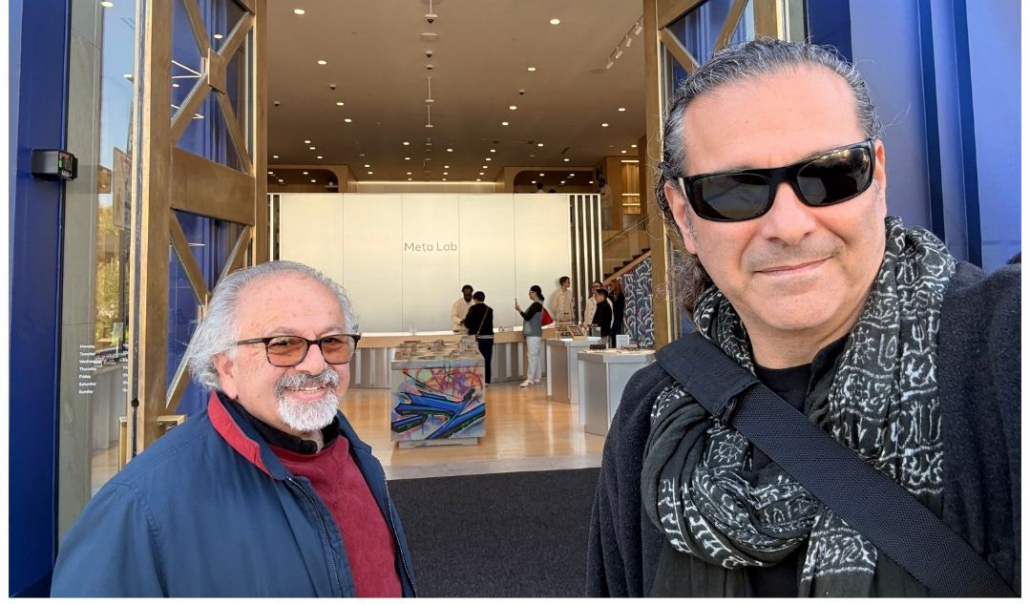
There’s a kind of rhythm that forms when Father Vazken Movsesian and I (Gregory Beylerian) meet. Our gatherings have never been casual catch-ups, they’re rituals. Moments where ideas spark like flares in the night sky, where conversation becomes its own creative engine, and where inspiration flows as freely as the coffee we always share. Sometimes it’s his legendary Armenian brew, strong enough to alter the fabric of time, or an artisanal cup from a local roaster. Either way, coffee has become our silent companion, a symbol of the warmth and intention behind our partnership.

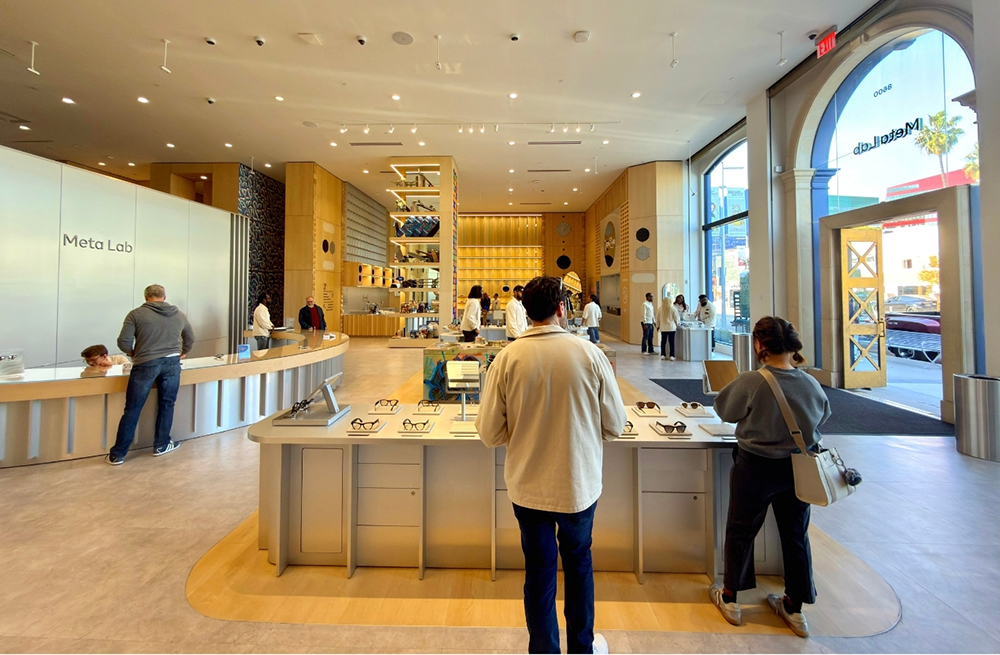
So when we stepped into the Meta Flagship store on Melrose Avenue in Los Angeles, we had to laugh. There, tucked between glistening devices and clean lines of futuristic design, was a full coffee bar, gourmet doughnuts, curated seating, the works. Whoever dreamed this up must have been tuned in to our wavelength. After our guided walkthrough with the Meta team, it became the perfect place to sit, sip, and let our minds stretch into the horizon of possibility.

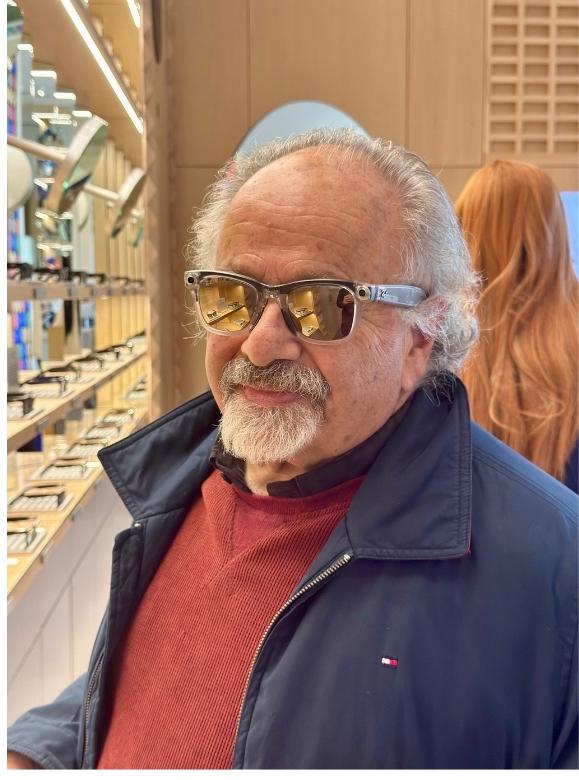
We were there to test-drive Meta’s newest creation, released just a month prior, the Meta Ray-Ban Display glasses and their accompanying neural wristband. As two longtime lovers of tech, and as the visionaries behind Epostle, these moments speak to us. Innovation, when guided by purpose, has always been one of our greatest tools. And Epostle’s work in education, outreach, and heritage preservation has been deeply intertwined with emerging technologies from the very beginning.

Today’s visit was no different. It was a look forward, a vision-quest into the future of how Epostle might evolve and serve in new ways.

We’re already immersed in virtual reality experiences through Meta’s Quest 3 system and Apple’s Vision Pro. But this was different. This was the edge of what’s coming in augmented reality, something lighter, more intuitive, more seamlessly integrated into daily life. And from the moment the Meta Lab team fitted us with the neural wristbands and placed the glasses in our hands, we could feel it: we were entering the first moments of a new chapter.

The experience was astonishing. Standing side-by-side, guided by the warm enthusiasm of the Meta team, we watched as a new world quietly shimmered into view. Messages appearing directly in the lens. Turn-by-turn directions floating before us like subtle constellations. Hands-free photo capture triggered with a simple gesture. And then the moment that truly stunned us: live translation, unfolding in real time as someone spoke.

Words materializing before our eyes, clear, instant, and deeply human. We looked at each other and immediately understood the scope of what this could mean. Not someday. Now!

Ideas poured out faster than we could articulate them. Each feature hinted at new possibilities for connection, storytelling, teaching, and reaching communities scattered across the world.

And yet, for all its brilliance, the technology is still in its infancy. Much of what we asked about is “too new,” still behind closed doors, not yet ready for release. Standing there, we felt the unmistakable sense of being at the frontier, witnesses to something both powerful and fragile in its beginning stages.

But with that excitement comes a recognition of the moment we’re living in. The past twenty years have unfolded at a pace the human mind was never designed to absorb. Today we see the consequences, disconnection, doubt, identity confusion, and a pervasive sense that the ground beneath us is shifting faster than we can stabilize. Younger generations, who never knew a world without constant digital stimuli, face these challenges in even deeper ways.

Yet this is not a reason to reject technology. It is an invitation, a call to remember what it means to be human.

This is where Epostle steps in.

Our mission has always been to reconnect people to the root source of existence, the light from which all spiritual insight emanates. Armenia’s monastic culture preserved this wisdom, the OG Christian message, through centuries of sacrifice, carrying it intact from 301 AD to today. Epostle exists to share this treasure with the world, in its clarity and its original form.

And so, when we explore new technologies, we do it not to add more noise to a noisy world,

but to build a bridge. In Armenian tradition, this bridge is symbolized by the sacred “Eh”,

the eternal vowel placed above every altar, signifying presence, open-heartedness, the divine spark within us.

Technology itself is neutral. It doesn’t judge. It amplifies the intention of the one who wields it.

Our calling is to infuse these tools with the essence of Eh, using them to uplift, reconnect, and remind humanity of its inherent light. To bring people closer not to distraction, but to depth.

Not to fragmentation, but to unity.

As we walked out of the Meta Flagship store that day, Father Vazken and I felt it clearly: this future rushing toward us can be a force for incredible good. If held with heart, it becomes a conduit for peace, understanding, and community across continents.

That afternoon, over coffee in the most unexpected of places, we caught a glimpse of a world where technology becomes a companion to spirituality, not its competitor. A world where Epostle continues its mission as a bridge, guiding humanity not toward fear and disconnect, but toward its highest potential.

And this is only the beginning.