 2009 Fr. Vazken
A Cemetery with a Living Name
Armodoxy for Today: A Cemetery with a living name
A few years back, I was invited to celebrate the Divine Liturgy in Nashville, Tennessee. For the few Armenian families in the area, the Armenian Church Diocese designates this as a mission parish. Space for services is rented at an Episcopal Church and once-a-month a priest is sent from the Diocese is to celebrate the Divine Liturgy and distribute the Blessed Sacrament to faithful children of the Church.
A dear friend picked us up from the airport and on our way to the services we drove past an exit sign on the freeway boldly marked, “Ararat Cemetery next right.” I was intrigued. Is it possible that this Armenian community that does not have enough people to constitute a parish, has enough dead to buy and maintain an Armenian cemetery? Even deeper, is it possible that a community existed and was wiped out? If so, how?
Don’t be bewildered by my questioning, you see, as an ethnic Armenian, I’ve grown up associating anything with the Ararat label with Armenia and Armenians. We are the people of Ar, Armenian, Ararat, that “Ar” has special significance. By definition, Armenians are the people who live at the base of Ararat, the same mountain range referred to in the Bible, Genesis chapter 8, as the resting place of Noah’s Ark, following the flood.
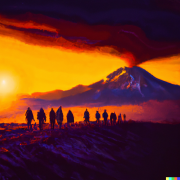
At 17,000 feet above sea level, the mountain range is easily visible from the moment one arrives in Armenia at the Zvartnots Airport and shows itself especially nicely from the capital city of Yerevan. And if by chance the air is foggy or misty, and a cloud covering hides the mountain, the uniquely shaped two-peak mountain can be seen on logos of coffee shops, souvenirs, just about any type of clothing accessory one can imagine, and even on cigarettes. Most homes have a picture of the mountain hanging somewhere in the house, even if they can see it from their window. And until recently, the outline of mountain was stamped on the passport when one entered or exited the country.
Being exiled from their historic home, most Armenians on earth live in the diaspora. Mount Ararat is a symbol of all things Armenian.
So that morning heading to church in Tennessee, when I saw that sign pointing to Ararat cemetery, I was operating on the notion that Ararat implied it was an Armenian Cemetery. As we got closer to the cemetery, the sign read, “Ararat Baptist Cemetery.” It was, in fact, run by the local Baptist Church with absolutely no Armenian ties or overtones. It had escaped me that the mountain’s claim-to-fame on the international scene is because Brother Noah navigated the ark to Ararat, where humanity was given a second chance.
Much of what we believe, we are conditioned to believe. I’ve spent my entire life associating things labeled “Ararat” – from the local nursing home to the bubbly water, from the restaurant to a type of slipper, to the cognac – with the Armenian nation. If we had not taken an extra step to take a closer look at the sign, I would have lived with the false notion that Tennessee had an Armenian cemetery.
Issues of the faith are even more important than discovering what’s under a label. Whether a cemetery or an article of faith, take a moment to go beyond the label.
Tomorrow, we’ll look at the magic that comes with Mount Ararat.
We pray from the Book of Hours, “Heavenly King, You are forbearing toward all, do not disregard those who rely on You, but protect them with peace by Your precious and Holy cross. Amen.
 2023 Fr. Vazken
 2009 Fr. Vazken
 2026 Fr Vazken


 2025 Epostle
Leave a Reply
Want to join the discussion?Feel free to contribute!