
Then & Now: A Century of Faith Captured in One Photograph
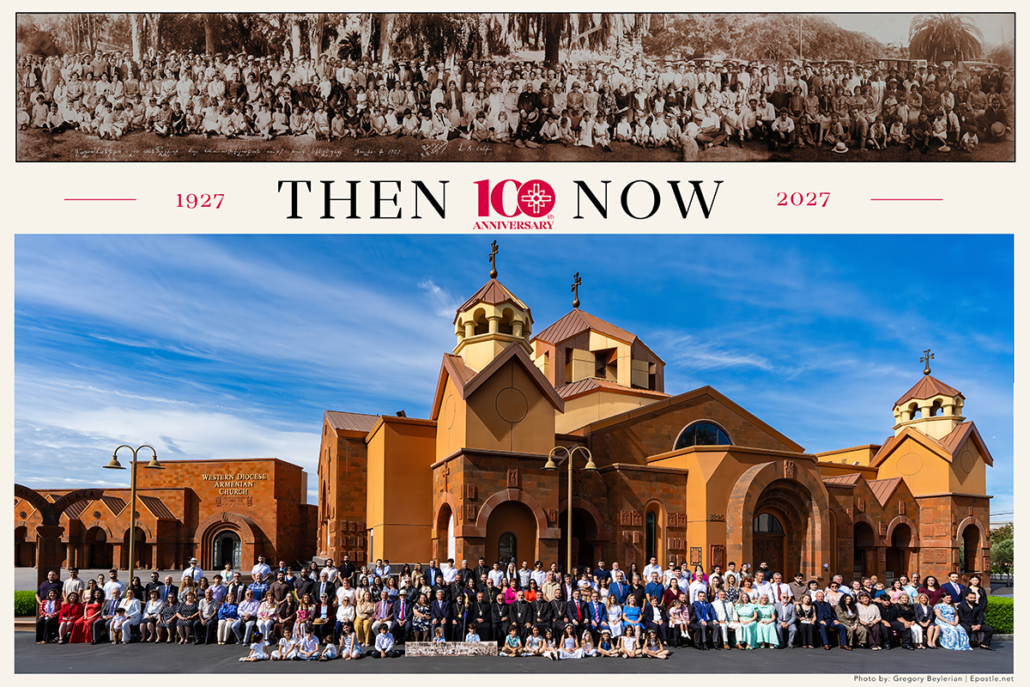
In 1927, the early pioneers of the Armenian Church in the West gathered with their priest, Fr. Adom Melikian, for a Fourth of July picnic at Elysian Park in Los Angeles. Together, they posed for a remarkable panoramic photograph that preserved the faces of a young Armenian community taking root in America.
Nearly one hundred years later, the Western Diocese has grown across the Western United States and Mexico, with generations of parishioners, clergy, families and communities carrying that legacy forward.
As the Diocese approaches its Centennial in 2027, His Eminence Archbishop Hovnan Derderian invited clergy and the faithful to gather once again on July 4 to recreate that historic moment, this time before the St. Leon Ghevontiants Armenian Cathedral.
Epostle was entrusted with helping bring the vision to life.

Recreating a Lost Photographic Process
The original 1927 image was created using a specialized large-format panoramic camera developed by Kodak. The remarkable system could photograph very wide groups while maintaining exceptional clarity and minimal distortion from edge to edge.
That technology is no longer readily available.
For Epostle Creative Director and professional photographer Gregory Beylerian, the challenge was immediate: how could nearly 200 people be photographed today while preserving the extraordinary detail and perspective of the original image?
After extensive research and testing, a new photographic method was developed specifically for the project.
Rather than making a single wide-angle exposure, the new portrait would be created from a sequence of 11 vertical photographs made one after another and later joined into a seamless panoramic image.
The approach offered extraordinary resolution, but also considerable risk. With nearly 200 participants, even small movements, changing expressions or shifts in position could make the individual photographs difficult to align.
Unlike a conventional group photograph, there would also be no finished image to review on the back of the camera.
There would only be fragments.
The Morning of July 4
Preparation began well before the community arrived.
The Cathedral was studied from multiple viewpoints to find the most beautiful architectural perspective and the best place to organize such a large gathering. The direction of the morning sun was also carefully considered, since the photograph was scheduled for 9:00 a.m.
Still, one thing could not be tested beforehand: 200 people.
On July 4, clergy, families, children, community leaders and parishioners arrived dressed for what everyone understood would become a historic moment.
Just before the photograph, Fr. Vazken Movsesian asked Beylerian, “Ready?”
“Yes,” he replied.
Archbishop Derderian smiled and added, “You got this.”
Within moments, the entire gathering was positioned before the Cathedral.
Three complete sequences were photographed, 33 exposures in total.
The process was surprisingly fast and joyful. People were peaceful, smiling and fully present.
Then came the uncertainty.
“For the first time in more than thirty years as a professional photographer, I drove away not knowing if I had actually gotten the shot,” Beylerian recalls. “There was no complete photograph yet. There were only 11 separate pieces that somehow had to become one.”

When the Image Appeared
The process of assembling the photographs took about a week.
Slowly, something remarkable began to emerge.
The architecture aligned beautifully. The lighting remained consistent. The perspective felt natural. The faces retained extraordinary clarity.
Most surprising of all, nearly every person in the photograph was looking directly into the camera.
Anyone who has photographed even a small group knows how rare that is. Someone usually moves, looks away or closes their eyes.
Here, across nearly 200 people, an extraordinary sense of unity appeared.
For Beylerian, the experience became something more than a technical success.
“What emerged felt guided,” he says. “I could recognize the preparation and experience that went into it, but I could not take complete responsibility for what I was seeing. Everything had come into alignment.”
One detail became especially striking: the golden scepter held by Archbishop Derderian appeared to radiate with a brilliant luminosity in the completed photograph.
For Beylerian, the entire experience carried a sense of divine providence.
“The lesson for me was about moving beyond fear and trusting the guidance that comes through the heart,” he reflects. “There were many rational reasons to believe the process might fail, but the project simply continued to unfold.”
A Monumental Portrait of a Living Community
The new photographic process produced such extraordinary detail that the finished portrait could be enlarged dramatically without losing clarity.
A monumental print measuring approximately 14 feet wide by 10 feet high was installed on the exterior of the St. Leon Ghevontiants Armenian Cathedral.
At that scale, the image becomes more than a group photograph.
Viewers can approach it and encounter individual faces — children, elders, clergy, families and community leaders — while still experiencing the gathering as one united body.
The photograph becomes at once a technical achievement, a historical document and a portrait of a living faith community.

Then. Now. And the Century Ahead.
The 1927 photograph captured a generation of Armenian pioneers building a new community.
The new photograph captures the community that grew from their vision.
Between the two images lies a century of faith, sacrifice, family, ministry and continuity.
The people photographed in 1927 could not have known what the Western Diocese would become one hundred years later. In the same way, those photographed today cannot know exactly what the community will look like a century from now.
But that is precisely what gives this project its meaning.
Each generation receives something precious from the one before it, and each generation is called to carry it forward.
For Epostle, the Then & Now project reflects its mission to use creativity and contemporary technology in service of something timeless.
One hundred years from now, another generation may look into the faces of this photograph just as we look today into the faces of those gathered in 1927.
And perhaps they will recognize the same message:
We were here.
We are here.
And the light continues forward.
The Then & Now photograph is one of many initiatives organized as part of the Western Diocese Centennial celebration. The full program of Centennial events will be unveiled on October 6 at the Western Diocese Clergy Conference.
To learn more about the photograph and order quality reproductions, visit epostle.net/then-and-now.




 2014 Fr Vazken
 2025 Epostle
Leave a Reply
Want to join the discussion?Feel free to contribute!