King of Glory

Armodoxy for Today

King of Glory

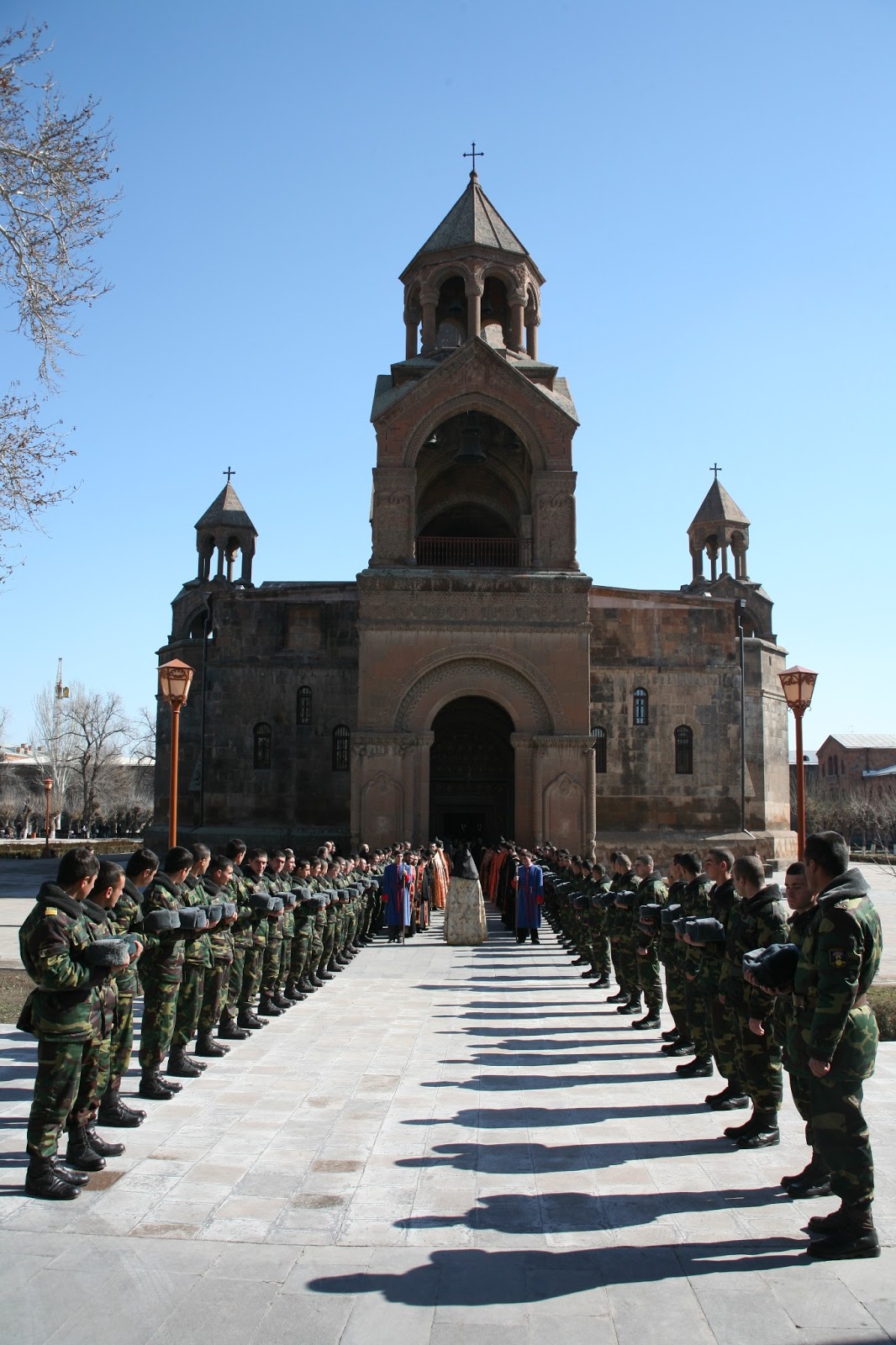
Armodoxy has developed in a land and among a people that have not known peace for long stretches of time. Armenia, at the intersection of three continents, Africa, Europe and Asia, has been trampled on by invaders, barbarians and would-be conquerors.

Sunday after Sunday in the Armenian Church, there is a “question-and-answer” session which takes place during the Divine Liturgy. This Q&A has been going on for centuries. The deacon, with the chalice in hands, approaches the priest and asks that the doors be opened for the “King of glory.” The priest asks, “Who is this King of glory? The Lord strong and mighty, the Lord mighty in battle?” The questioning continues and upon his second inquiry, the deacon announces, “This is the King of glory!” and hands-off the chalice for the priest to prepare the Holy Eucharist.

It was the Psalmist who first framed the dialogue on behalf of a hurting world (Psalm 24:8-10). And it has been heard and overheard from altar areas ever since, during times of trouble, persecution and war.

Priest: Who is the King of glory… mighty in battle?

Deacon: This is – He is – the King of glory!

Wars are won and wars are lost but in the case of Armenia, the number losses far outnumber the wins, prompting a more appropriate question: Who is this King, so mighty in battle, that the war was lost? Perhaps not as an audible chants by the deacon, but definitely in the solitude of the mind. Ultimately, what does it mean to proclaim God as almighty – mighty in battle – in the face of horrific tragedies that we endure?

In Holy Scripture, time and time again, we find our Lord Jesus teaching by example. When a tragedy befalls another, he touches them with his love and asks us to do the same. During the Divine Liturgy, the deacon is heard inviting people to worship. He beckons the congregation to stand in peace, to pray fervently, to listen in awe, to prepare themselves and to approach the Blessed Sacrament. Simply put, he calls everyone to celebrate the victory of Christ. His pronouncement “He is the King of glory!” is a response to the priest’s question and at the same time it is an invitation for us to engage in the Kingdom which is in our midst.

“The kingdom of God does not come with observation,” says Christ our Lord, “Nor will they say, ‘See here!’ or ‘See there!’ For indeed, the Kingdom of God is within you.” (Luke 17:20-21)

“The King of glory mighty in battle,” is the answer the Deacon proclaims to the priest and in-turn to all of us, every Sunday. We are invited to explore, engage and discover the King of glory for ourselves, “mighty in battle” who is here answering us, our sufferings, our dilemmas, and our wars, by touching us with his love and compassion. By accepting the invitation, we engage in the Kingdom of God. We accept a call to personal and community responsibility to extend ourselves. Indeed, the Kingdom of God is within us!

The Q&A, the Divine Liturgy and hence, our Church is calling us to this higher understanding of our Christian Faith, as members of the Kingdom, to engage in the struggles and sufferings that are all around us, not with a question but with the solid answer: He is the King of glory, mighty in battle.

Today we pray from the Lords prayer, “Our Father, may your kingdom come, may Your will be done on earth as it is in heaven.” Amen.

Outward Love

Armodoxy for Today

Outward Love

Yesterday we made a bold proclamation by saying there was something greater than God, and Jesus pointed to it when he instructed the people to approach God only after reconciling with their brothers and sisters. St. John the Evangelist, in his letter, focuses on the reasoning behind this pronouncement.

“No one has seen God at any time,” says St. John and continues, “If we love one another, God abides in us, and His love has been perfected in us. … We have known and believed the love that God has for us. God is love, and he who abides in love abides in God, and God in him. … If someone says, ‘I love God,’ and hates his brother, he is a liar; for he who does not love his brother whom he has seen, how can he love God whom he has not seen? And this commandment we have from Him: that he who loves God must love his brother also.” (I John 4)

Love, for the Christian, is not a conceptual idea, nor is an abstract thought. Love is expressed and understood in our relationships with one other. Loving is caring. Loving is embracing. Love is real. It is God given and demanded back in return by loving and caring for others here in this lifetime.

Let us pray a prayer from the Armenian Church’s Book of Hours (Jamakirk), “Lord our God, we give thanks to You, for You have granted us to pass the day in peace. Grant us, Lord, to pass the evening and the night without sin and stumbling, and to stand firm and abide steadfastly in faith, in hope and in love, and in the observance of Your commandments. Give peace to the entire world and stability to Your holy Church and salvation to our souls. For to You is befitting glory, dominion and honor, now and forever and ever. Amen.

Greater than God

Armodoxy for Today

Greater than God

For Jesus, there is one thing which is greater than God. It probably sounds unusual to express this, in this manner, but in fact, when all is said and done, Jesus makes it very clear that one thing is more important than God.

In the Sermon on the Mount, Jesus says, “If you bring your gift to the altar, and there remember that your brother has something against you, leave your gift there before the altar, and go your way. First be reconciled to your brother and then come and offer your gift.” (Matthew 5)

Jesus makes it clear that the sacredness of church, the worship practice, or even supporting your church are all secondary to our reconciliation with one another. He draws a line separating sincerity from hypocrisy, it doesn’t make sense to give outwardly if you aren’t at peace inwordly. “Leave your gift there before the altar,” he says. There is something much more important, and that is for us to be at peace with one another, reconciled and in union with one another. In fact, this is the first message given to us on the night of Jesus’ birth: “Peace on Earth/Good will toward one another.”

Christianity is about our reconciliation with one another and thereby being reconciled with God.

Let us pray the prayer of St. Nersess Shnorhali (23), “All merciful Lord, have mercy upon all your faithful, on those who are mine and those who are strangers to me, on those whom I know and those whom I do not know, on the living and on the dead, and forgive all my enemies, and those who hate me, the trespasses that they have committed against me, turn them from the malice which they bear towards me, that they may be worthy of Your mercy. Amen.

Brokenhearted and Captive

Armodoxy for Today
Brokenhearted and Captives

In the Gospel of St. Luke we read Jesus’ mission, and thus the mission statement of the Apostolic Church (see Mission and Continuity) is to preach the gospel to the poor, heal the brokenhearted, liberate captives and the oppressed and recover sight to the blind.

It is tempting to consider these groups in the category of the other – people outside of ourselves. We may think of the blind as those missing sight receptacles in their eye sockets, when in fact we know many who walk around with eyeballs and yet are blind to the beauty around them. We think of the captives as those who are imprisoned or held in slavery against their will, yet there are those who living in freedom are enslaved to their money and their possessions.  When we fall for the temptation of categorizing the hurting and frail as others, we deny ourselves the opportunity for self-evaluation and thereby self-improvement.

We are all in need of healing, we all long for true freedom, and we all search for complete love, understanding and belonging in life.  Jesus said, “Those who are well have no need of a physician, but those who are sick. I did not come to call the righteous, but sinners, to repentance.” (Mark 2)

Let us pray the prayer of St. Nersess Shnorhali, “Lord, who wills that which is good, and are the director of the will, let me not follow the inclinations of my heart, but lead me to live always according to Your good will. Have mercy upon Your Creatures and upon me, a great sinner.

Mission & Continuity

Armodoxy for Today


Mission & Continuity

Jesus began his ministry in the town of Nazareth. St. Luke the Evangelists records (chapter 4):
So He came to Nazareth, where He had been brought up. And as His custom was, He went into the synagogue on the Sabbath day, and stood up to read. And He was handed the book of the prophet Isaiah. And when He had opened the book, He found the place where it was written:

“The Spirit of the Lord is upon Me,
Because He has anointed Me
To preach the gospel to the poor;
He has sent Me to heal the brokenhearted,
To proclaim liberty to the captives
And recovery of sight to the blind,
To set at liberty those who are oppressed;
To proclaim the acceptable year of the Lord.”

Then He closed the book, and gave it back to the attendant and sat down. And the eyes of all who were in the synagogue were fixed on Him. And He began to say to them, “Today this Scripture is fulfilled in your hearing.” Thus, proclaiming his mission.

When we describe the Armenian Church as “Apostolic” it means we are in a link to the apostles themselves and carry on their mission, which is the mission of Jesus Christ. Today, in our hearing, Jesus has proclaimed His mission. Our mission.

Gratitude: Not an attitude

Armodoxy for Today

Gratitude: More than an Attitude

Often, we have heard the sage advice that attitude is a major component of a healthy life. There are even popular statistical notations that tout that success in life is primarily a function of attitude as opposed to circumstances. No doubt, these quaint sayings are easy to understand but more difficult to implement especially because we look for some backing and proof.

Armodoxy is a history that supplies the proof for the miraculous. Armenians have faced a history of terror, butchery, and barbarous crimes, all contributing to a country and a people that have been void of peace for centuries. Yet the essence of Armenian spiritual prayers and hymns is thanksgiving. The Armenian Church prayer book, Jamakirk, is a collection of praise and worship. In the face of horror, Armenians have composed hymns and recited prayers that reflect thanksgiving and gratitude.

If anyone has a right to protest to God for the horrors inflicted on its people and land, it is the Armenians. Instead of protest, their prayers reach to the highest heavens with praise and worship. It is herein that the Armenians have survived and built life in the face of death, being a living witness to resurrection in the face of crucifixion.

Armodoxy is the witness that gratitude is more than an attitude.

We are reminded of our Lord Jesus’ words, “…I have spoken to you that in Me you may have peace. In the world you will have tribulation; but be of good cheer, I have overcome the world.” (John 16)

Repayment – Daily Message

Armodoxy for Today
Repayment – Daily Message

Jesus instructs, “Do unto others as you would want them to do unto you” (Matthew 7:12). This is often called The Golden Rule. Social psychologists categorize this rule under the principle of reciprocity, that is, in different social situations we pay back what we received from others. In other words, if someone does you a favor, you’re likely to do a favor in return. It’s common for organizations to send a gift – labels, calendars, cards, etc. – with an envelope expecting that the principle of reciprocity will kick in and you’ll send back a donation.

In Armodoxy, our actions are not based on the actions of others. We are called to give and share our God given talents without expecting in return. The Golden Rule is a proactive rule for conduct, but in terms of repayment, Jesus points to a hirer rule when he says, “Love your enemies, bless those who curse you, do good to those who hate you, and pray for those who spitefully use you and persecute you…” (Matthew 6:44).

The higher expectation is in fulfillment of Christ’s invitation and challenge to, “Be perfect, just as your Father in heaven is perfect” (Matthew 6:48). In fact, to repay goodness with goodness is only human. To repay goodness with evil, is diabolic. But to repay evil with goodness, is divine.

So much of our life is built as a reaction to the actions of others. The challenge is to live proactively, not waiting for repayment, but doing what is good and the way we would expect others to treat us.

Let us pray from the Book of Hours of the Armenian Church, “Receive, O God, these prayers and our service. Make Your light of righteousness and wisdom shine forth upon us and make us children of light and of day, so that in godliness we may lead our life and fulfil it without offence, for you are our helper and Savior and to you is befitting glory and honor. Amen.

Small Steps – Daily Message

Armodoxy for Today
Small Steps – Daily Message

Richard Dawson was a popular game show host during the 1970s. In one episode of the “Family Feud,” he came out to the cheers of the studio audience and in front of the millions who had tuned in to the weekly show. He took a long puff from a cigarette, exhaled, threw the butt on the floor, stamped it out, turned to camera and exclaimed, “That was my last cigarette!” The audience cheered even louder. And then, without missing a beat, he added, “… for the rest of the show.”

Often we are overwhelmed with the size and magnitude of our dilemmas and problems. Sometimes the solutions seem overwhelming and out of reach for us. We have heard the Chinese proverb, “The journey of a thousand miles begins with one step,” but our gaze is usually stretched out so far ahead that we succumb to the feelings of disappointment and abandon the run.

Armodoxy is discovered in the long run. It has been cultivated through a history which has run the course of human history. Armodoxy came from a people who thanked God for the day and found themselves in continuous prayer for millennia. It is the small victories, the day-to-day accomplishments that add and make the entire story of life. Take a moment to enjoy the victory of a single minute, hour, day, year and you’ll find that the prize is a life filled with meaning and purpose.

Today we pray a prayer from the Armenian Church’s Book of Hours, Jamakirk, “Lord our God, we give thanks to You, for You have granted us to pass this day in peace. Grant us, O Lord, to pass this evening and the night before us without sin and stumbling, and to stand firm and abide steadfastly in faith, in hope and in love and in the observance of Your commandments. Give peace to the world and stability to Your holy Church and salvation to our souls. For to You is befitting glory, dominion, and honor, now and forever and ever. Amen.

Amen – Daily Message

Armodoxy for Today

Amen – Daily Message

Letting go, for many people, is perhaps one of the most difficult things to do. Letting go means an end has come to a relationship and continuing life with that relationship is no longer an option. We are emotional creatures and continuity, as the word relationship implies, gives us stability. Letting go threatens that stability and therefore is often mixed with painful feelings.

Interestingly enough, we end our prayers with a statement that proclaims we have let go. The word, “Amen” is our resignation to the fact that we have turned over our cares to God. Amen is an affirmation of our trust, our hope and our faith in God. We end each prayer saying, “So be it” or “Let it be so.” Amen. It is the ultimate statement of letting go. We relinquish control.

Letting go is essential, particularly in this age of information. Being bombarded day in and day out with news, it is easy to become distraught and lose hope. In fact, most of the news items we are given fill us with information and not much more. And so, it becomes exceedingly important, for us to admit that certain events and issues are beyond our immediate control. Turning to Armodoxy – you find that relinquishing access of those things you cannot control allows you to sort out your life and be more productive and spiritually alive. We end our prayers with the word “Amen” as an outword profession that we have turned over matters to God: Let it be.

Protestant theologian Reinhold Niebuhr authored a short prayer that is often used in 12 step programs.  It allows us to place issues and events in context. It turns over to God what we cannot do and confesses “Amen” or “let it be.”

Therefore, join me in prayer: “God, grant me the serenity to accept the thing I cannot change, Courage to change the things I can, and the wisdom to know the difference.

Amen.

Listening with the Heart – Daily Message

Armodoxy for Today

Daily Message – Listening with the heart

In our Daily Message about prayer, we defined prayer as a conversation involving speaking as well as listening. The art of listening is not limited to a function of the ears. For instance, in the Lord’s prayer, the request to forgive our trespasses, or sins, is dependent on our ability to forgive others who trespass against us.

The act of listening, in this case, requires that we contemplate our pattern of forgiveness. To listen, means we reflect on all those who have hurt us, “trespassed” against us, and ask ourselves sincerely, if we have forgiven them. For the condition of forgiveness from God is dependent on our forgiveness of others. “Forgive us our debts, as we forgive our debtors.” Did we forgive them half of their debt? Then we can expect God to forgive half of our debt. In other words, by saying “Forgive us our debts, as we forgive our debtors,” we are responsible for our own reward or condemnation. By our own mouth we write out a ticket of peace or a path of torment. In fact, so great is this condition, that Jesus reiterates it at the conclusion of the “Lord’s Prayer.” In Matthew 6:14-15, Jesus adds these verses to the Lord’s Prayer, “If you forgive other people when they sin against you, your heavenly Father will also forgive you. But if you do not forgive others their sins, your Father will not forgive your sins.”

Listening is the act of introspection. God talks to us on a multitude of levels – think of them as different frequencies and bandwidths. Don’t expect to hear the thunderous voice of God, if you first haven’t heard His soft whisper in your heart. It’s a voice that says look within, forgive and move forward. Converse with God and remember to listen, especially with your heart.

I share with you the prayer of St. Nersess Shnorhali, from the 23rd hour:

All merciful Lord, have mercy on all Your faithful, on those who are mine and on those who are strangers, on those whom I know and on those whom I know not, on the living and on the dead, and forgive all my enemies, and those who hate me, the trespasses that they have committed against me, turn them from the malice which they bear towards me, that they may be worthy of Your mercy.