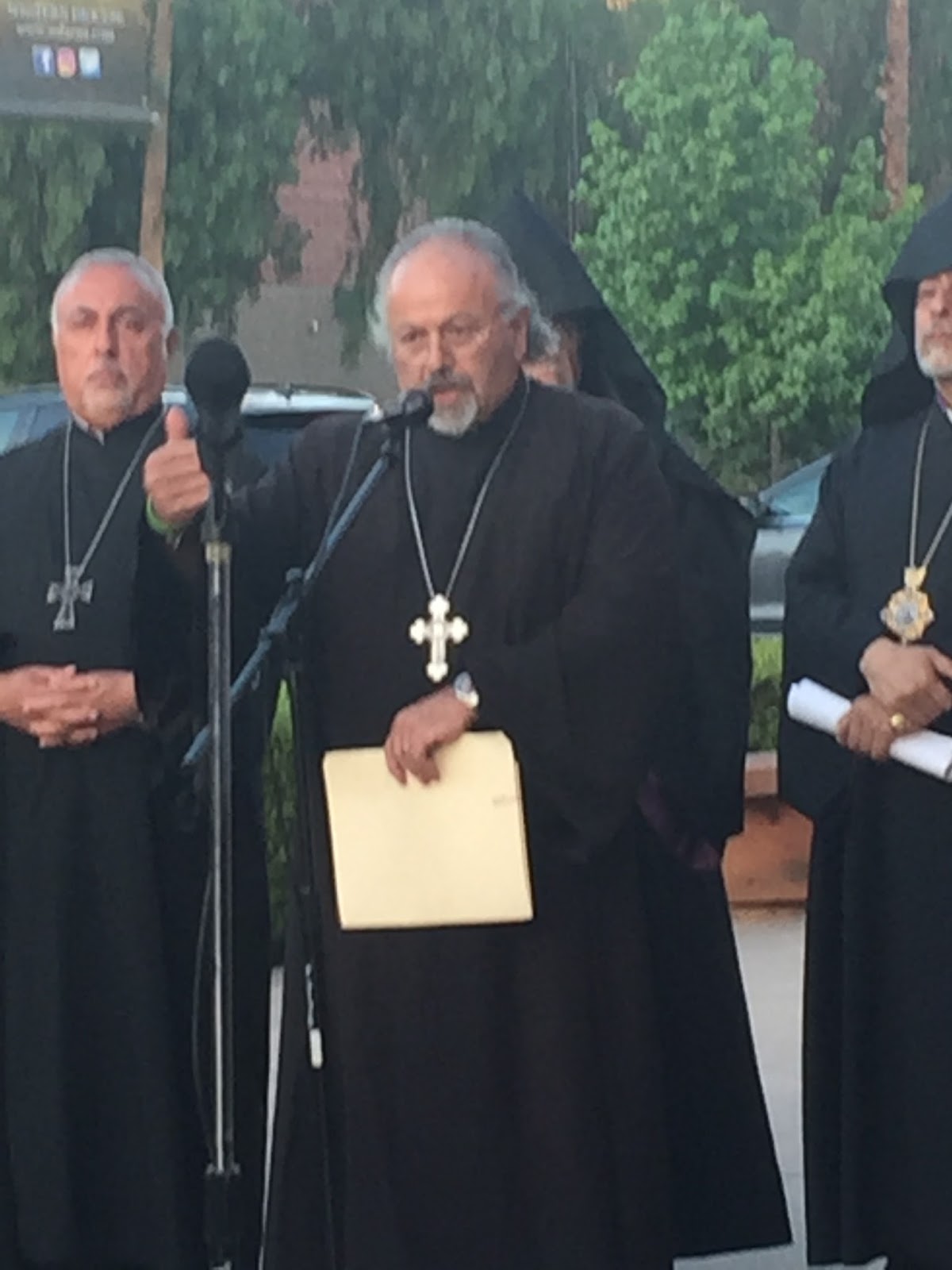
Keeping the Dream Alive: Homily on the 50th Anniversary of the Martyrs’ Monument
by Fr. Vazken Movsesian
St. Leon, Srbots Ghevondyants, Armenian Cathedral, Burbank, California
April 24, 2018
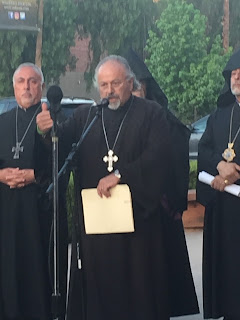
It is truly an honor to be offering this homily this evening. I thank His Eminence Archbishop Hovnan Derderian, Primate of the Diocese for giving me this very special honor his evening.
It is with a thankful heart that we gather this evening as we experience yet another chapter in Armenian history opening up in front of us with developments of the last several days. We are thankful that transitions are taking place in Armenia without bloodshed or violence. While we gather here this evening remembering the atrocities of 1915 and all their ramifications, we are very aware of the difficulties our brothers and sisters are enduring in the homeland. We know of their sufferings and the makings of the political system. And so, I was up against a difficult set of circumstances in regard to my position this evening. The magnitude of the demonstrations that took place this past week and especially this past weekend, left me wondering about the direction of my remarks and the message of this sermon.
Obviously, there is no staying silent either about April 24 or about Armenia today. And so, the homily I wish to offer this evening is to give honor and respect to both of these realities. I have chosen to speak about Dreams, about dreaming as individuals and as a collective…. And to speak about a very special dream that came our way in 1968 – namely with the opening of the Armenian Martyrs’ Monument in Montebello which was unveiled exactly 50 years ago.
I speak of dreams today because I have come to realize at the saddest people I have met are those who have no dreams. They are people who have no hope. Whether because of loss, disease, separation, desperation – they have lost hope, they no longer dream of better days, and the ability to dream is one of the most beautiful aspects of our humanity. That’s what the Turks did on April 24: the Turks rounded up the leadership – the writers, the poets, the priests, the intellectuals – in one word they rounded up the dreamers. If they could kill the dream the people would perish, they thought.
Dreaming and where our dreams CAN lead…
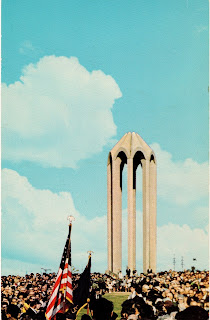 |
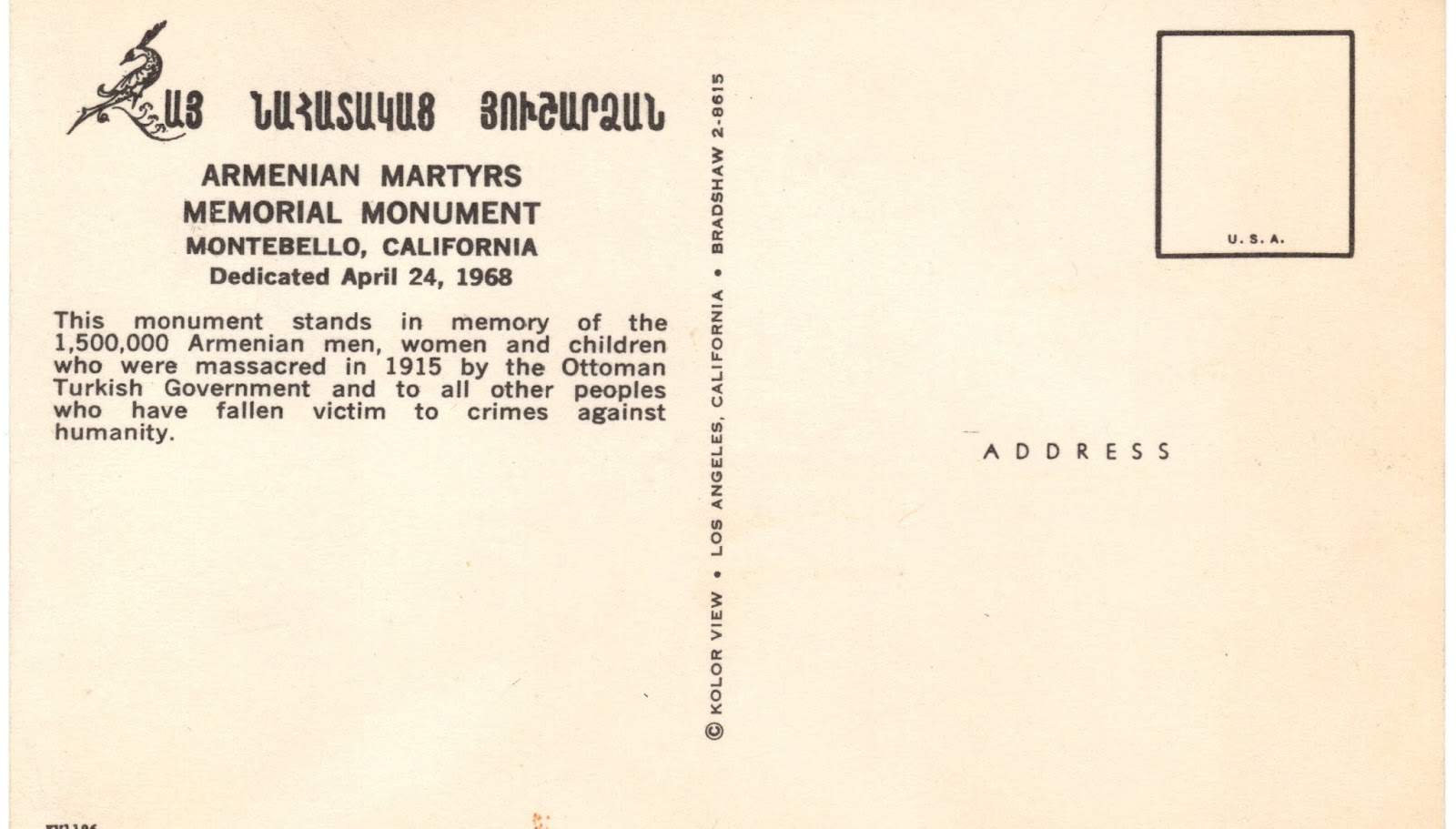
1968 postcard: Armenian Genocide
Martyrs’ Monument in Montebello, CA |
Our story as Armenians living in the diaspora did not occur in a vacuum. There are many factors that played into how we remember our past and how we celebrate our todays. I’d like to share with you some experiences from my childhood. It’s a story that doesn’t often get told – the plight of the first generation of Armenian settlers here in the United States. Not too far away, the 1960’s decade was a turbulent one in the United States. It was marked by accomplishments and tragedies that would reverberate for years, decades, and now, a half a century later the effects of the 1960’s are still being felt. The 1960s began with the election of one of the youngest and most vibrant presidents of the United States. In John Kennedy people saw hope, because he was dreamer. They saw courage and the ability to achieve the impossible opportunities. He promised to put a man on the moon before the end of the decade and it happened. His dreams led the people. He established by executive order the Peace Corps. But, unfortunately, what people of my generation remember most about Kennedy was that an assassin’s bullet in 1963 left his dreams unfulfilled.
Civil rights was in full swing in the 1960s. We were fighting a horrible war in a place called Vietnam and the images of mayhem were being pipped into our living rooms on the five channels that our television sets had at the time. Meanwhile in America race relations were exploding. Rev. Dr. Martin Luther King Jr. set the tone for dreaming on the principle he had learned from the Gospel of Christ. He dreamed there would come a day when people of the world could put aside their differences and focus on the common thread of humanity. He dreamed of a day when we would not be judged by the color of our skin (or our ethic make-up) but rather on the content of our character. New dreamers were coming along, one of which was the slain president’s younger brother Robert Kennedy.
It was in thatAmerica that people began to feel comfortable with their skin, with their background and their history. Ethnic pride was highlighted with statements such as “black is beautiful” encouraging men and women to stop trying to eliminate ethnic traits by straightening their hair and attempting to lighten or bleach their skin. In that climate of expressing ethnic pride, the Hispanic community adopted a saying “brown is beautiful” and we Armenians followed suit. Fifty years after our Genocide, we knew the time had come and the time was right to tell our story.
In the early 1960’s our churches were at the center of our communities. Armenian Schools were dreams that were becoming realities. My mother, as a first generation daughter of survivors had just authored an Armenian-American textbook for learning basic Armenian conversation. It was published by the Western Diocese and was being used in the Saturday schools of the churches.
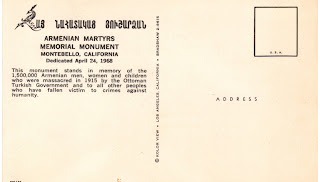 |
Backside of postcard: Armenian Genocide Martyrs’
Monument in Montebello 1968 |
In 1965 I had just turned nine years old when the Armenians in Los Angeles organized a march – 3,000 marchers began at St. Sophia Greek Orthodox Cathedral on Pico and Normandy and ended up at the Ambassador Hotel on Wilshire Blvd. Afterwards the dream was articulated – we needed a place in the Los Angeles area where Armenians could gather and commemorate the Armenian Genocide. In a sense, that Ambassador Hotel on Wilshire was the place where the dream was first dreamt.
A group of dedicated Americans of Armenian descent, representing all different aspects of the community, came together in the spirit of unity and organized as the Monument Council.
For the record – the original Council are recognized on a plaque at the Monument (alphabetically):
Hagop Abdulian; Hrant Agbabian; Krikor Aivazian; Hagop Arshagouni; Marilyn Arshagouni; Vartan Fundukian; Harmik Hacobian; Richard Hovannisian; Osheen Keshishian; George Mandossian; Hagop Manjikian; Michael Minasian; Vasken Minasian; Bob Movel; Varougan Movsesian; Hagop Nazarian; Misak Sevacherian; Jivan Tabibian.
My father, Varougan Movsesian was one of the dreamers.
After three years of dreaming, deliberating, planning, developing, organizing, fund-raising and fighting political obstacle – tremendous pressure of the Turkish lobby not withstanding – the Armenian Genocide Martyrs’ Monument was waiting to be unveiled. The dream was about to become reality.
Then in 1968, I was about to turn 12 years old and the Armenian Martyrs’ Monument was about to open, when on April 4 the first of two tragic events were thought to bring an end to dreaming. The Rev. Dr. Martin Luther King Jr. was struck down and killed in Memphis, Tennessee. Dr. King was 39 years old. Exactly two months later Robert Kennedy was assassinated in cold blood at the Ambassador Hotel – the same hotel where the dream for the Armenian Monument began. Bobby Kennedy was 42.
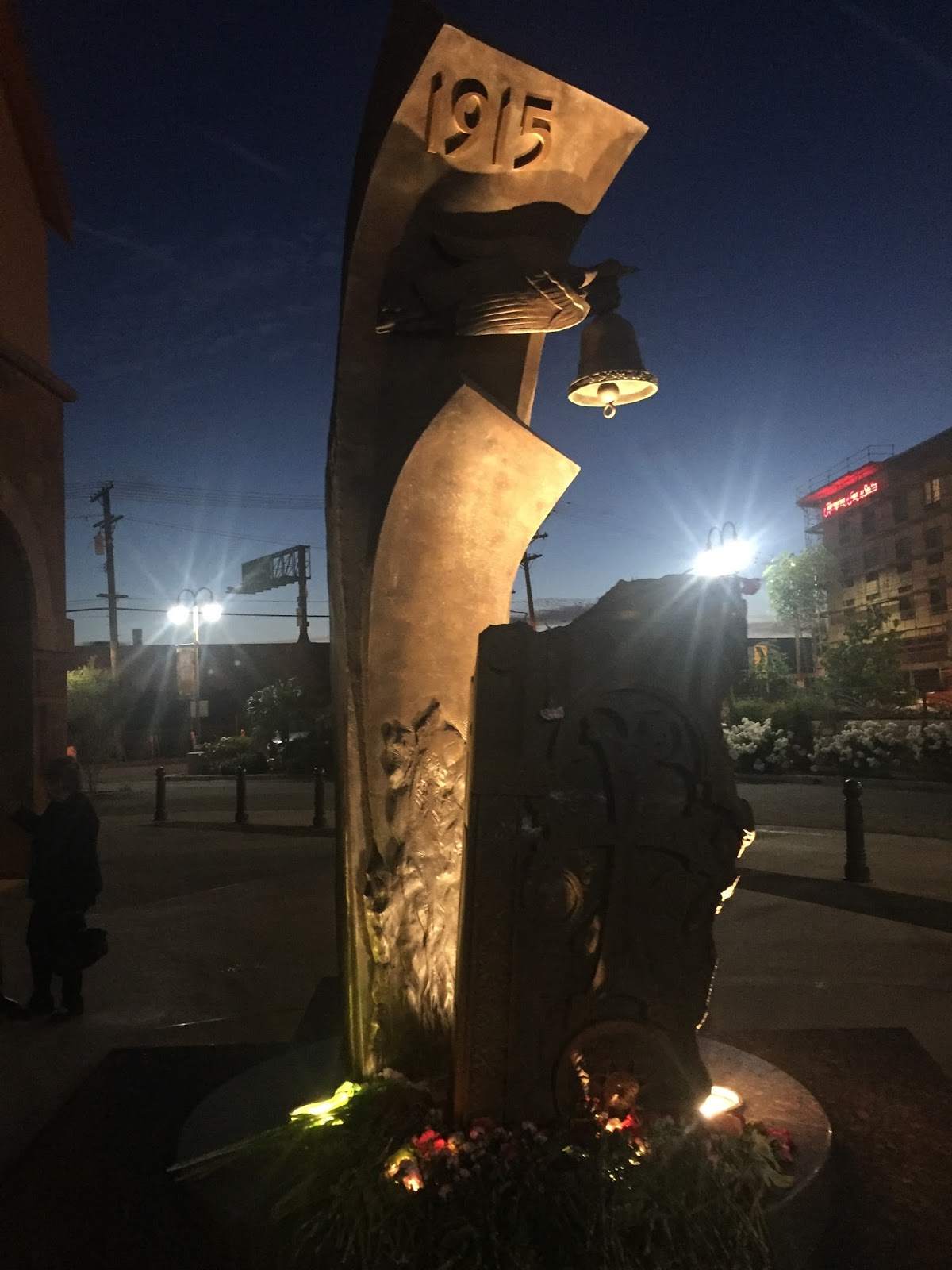
In the middle of these two horrific events, the Armenians in Los Angeles did not lose the dream; the Martyrs’ Monument was unveiled on April 21 to a waiting and anxious public. That day was a true celebration for the Armenian community in particular but even more for the entire community in general. “This monument erected by Americans of Armenian descent,” says the inscription at its base, “Is dedicated to the 1,500,000 Armenian Victims of the Genocide perpetrated by the Turkish Government, 1915-1921, and to men of all nations who have fallen victim to crimes against humanity.” The monument reaching for the sky was tall and big. It was even bigger for us as little kids. It was telling a story that went beyond Armenians. The Monument could not be hid and neither could the crimes to which it was pointing be forgotten.
The monument in Montebello was a dream come true for us. At age 12, in the midst of civil rights struggles, wars, the counter-culture movement, rebellion, Rock & Roll and revolution, this monument was standing there to give us meaning and definition. The Armenian Community had its churches, its schools, its organizations, and now a monument – a statement which acknowledged the past in a grand manner.
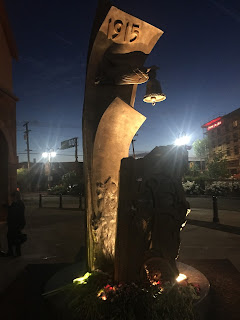 On the day of the opening my father, along with the other committee members was busy taking care of details in the background. I remember he had handed me a camera to walk around that day to take pictures for posterity. There was a Turkish man standing on Garfield Ave on the road leading up to the monument. He was holding up a poster with demeaning and defaming words against the Armenian people. I remember taking the last picture of him holding that sign as Lindy Avakian, author of “The Cross and the Crescent” came up and tore the poster in his face. Needless to say, the rest of the crowd sent the misguided man on his way.
 The opening of the monument was a monumental event, no pun intended. But little did we know that there was something greater coming along that we could not have imagined.
Just a few weeks after the opening of the monument, on May 18, 1968, His Holiness Vazken I, of Blessed Memory, the Supreme Patriarch and Catholicos of All Armenians arrived and blessed the monument and the community. This was something that was unseen for us, and left an indelible mark on our psyche. From the Mother See of Holy Etchmiadzin His Holiness brought with him two khatchkars etched with the words of endurance, hope, resurrection and victory. No, there weren’t four words on that stone, only one.
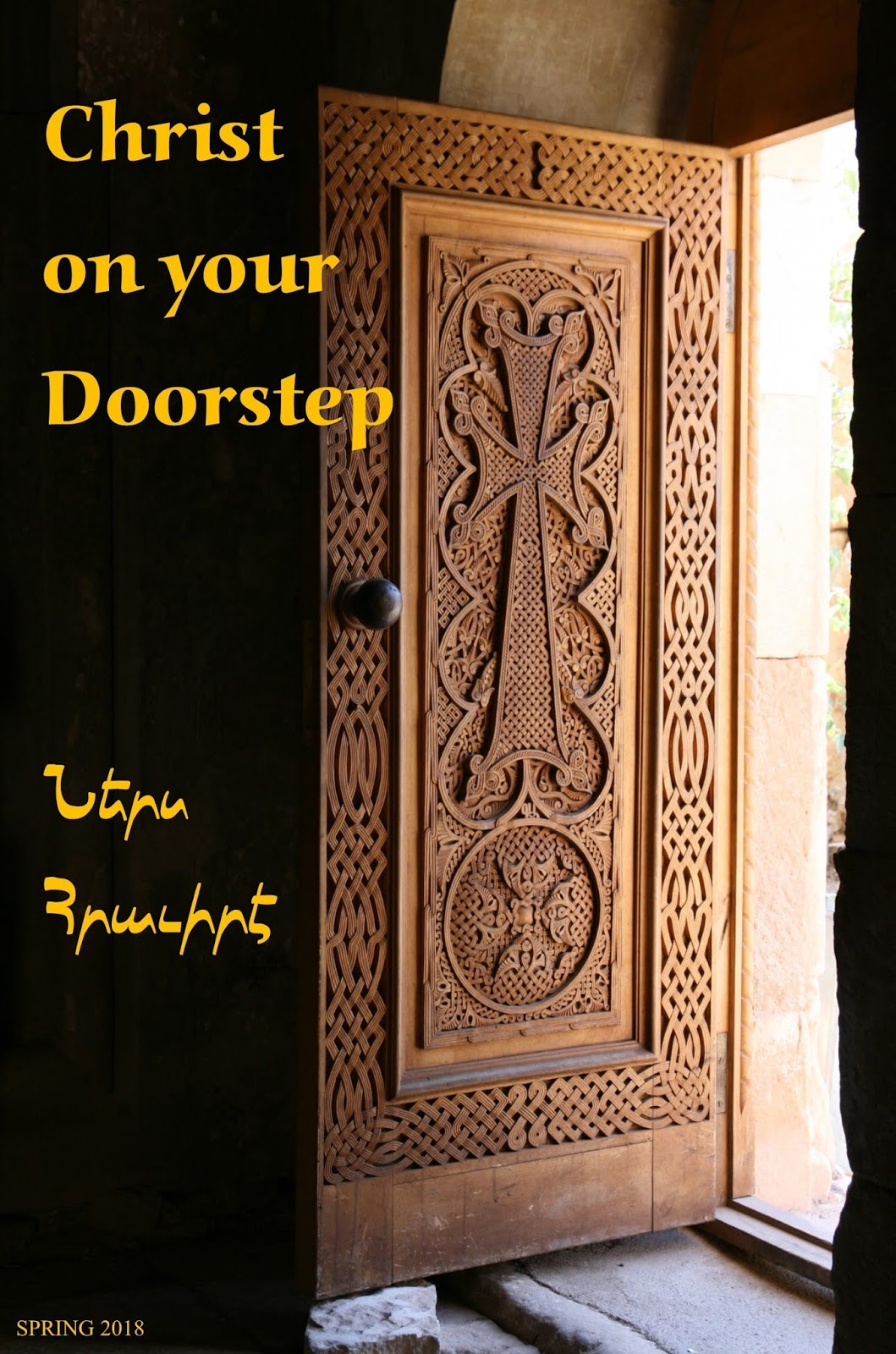
On the khatchkarwhich was mounted on the monument, was carved the word “Etchmiadzin.” While to many Etchmiadzin is a name from history, or a the name of a place, for us it was much more. I remember my dad telling me that day, to gaze at the letters on the stone beginning with the might “Է” symbol. He said there is a secret message inscribed on that stone, a hidden message for dreamers to keep dreaming. It is the message of hope.
And here, 50 years later, I am coming to understand what he meant by that cryptic message. Etchmiadzin is the name of St. Gregory the Illuminator’s Dream. It’s the beginning place of our Armenian soul and being. Etchmiadzin is a dream in which Christ descends and points to where the Church of the Armenian people is to be built. Etchmiadzin literally means the “descent of the only begotten.” Or very plainly: God is with us! Աստուած ընդ մեզ է: It is that dream of Etchmiadzin that has kept us alive – a dream to acknowledge the One who said, “I will NEVER leave you!” The one who said, “In this world you will have much trouble, but courage, the victory is mine! I have overcome (conquered) this world.” (John 16)
On that historic day in 1968, at the footsteps of the Monument, the Venerable Catholicos Vazken I, as the spiritual father of all Armenians, addressed his children and the general public. His words were met with thunderous applause and massive gratitude. “From those dark days in 1915, an entire country was destroyed… an entire people was decapitated… but just as Christ rose three days after death, three years after 1915, in 1918 our Independent Armenia had risen.” He spoke it plainly, the Armenian people have resurrected and we have a message for the world: good is more powerful than evil, light always overcomes the darkness, dreams are what give us hope and are meant to be dreamt until they are actualized.
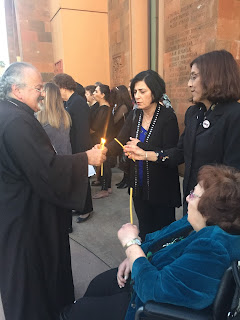 Today we stand 103 years removed from a day that was supposed to have left us with only one Armenian propped up in a museum. April 24, 1915 remembers the day the Turks went after the dream! By killing off the writers, the poets, the priests, the intellectuals and the leadership they thought they would kill the dream! Kill the dream and the people will lose hope and die. But our hope and our dream was greater: Etchmiadzin – “Christ is with us!” “God is with us!” That’s a dream that cannot be killed!
The monument of 50 years ago, with the Etchmiadzin khatchkar at its base, continues to stand as a beacon of hope – where you stand with a dream, there is hope.
Our brothers and sisters in Armenia are standing together in defining the new course of a civilization. Ours is one of understanding and dreaming with them. I always mention that in looking at Armenia let us not be impatient, but let us dream of better days. Independence is only 26 years old! What was America 26 years after independence? There was slavery. There was struggles to define the limits and extent of democracy. Misunderstandings led to conflict. But it’s the dream of America that gives us hope.
And so today, let us continue to dream. Those dreams keep hope alive. Dream the dream of “Etchmiadzin” – God is with us! The possibilities are endless. Look at the proof all around us. Each one of you here today, is here because the dream has come true. Therefore, each of you is a monument to the dream – you have survived, you are living and creating! We’re an interesting group of people because we name our children “revenge” (=Vrej) but we also name them “resurrection” (=Haroutiun). Our revenge is in our resurrection.
Tonight – a group from GenNext is with us. Young people who are dreaming of their brighter futures. They are keeping hope alive. Sure, we have people who may not understand the language but they understand the heart – the place where dreams begin. They are part of the dream as everyone who came before them.
Tonight in celebrating the monument at age 50, let us celebrate the spirit of unity of a community coming together. Let us celebrate dreams, however impossible they may seem, to becoming reality. Let us celebrate the lives of the crowned saints, the Holy Martyrs’ of our Church, for the life they lived as living monuments to “Etchmiadzin” … to the fact that God is with us!
God bless you all. God bless the Armenian people and nation. Keep Dreaming.