Armenians have a custom, which is blessed by the Church, of making vows which are paid for by sacrifice to the needy. It is called “Matagh” (Մատաղ). The idea is simple enough, you make a vow to feed the needy for a goodness that has been granted to you. Good health, prosperity, children’s achievements, are some of the reasons, and sharing the goodness with those who suffer is a way of expressing gratitude. The Church blesses this gesture with a prayer over the offering. We believe, God’s blessings shower on those who give. (Acts 20:35)
In the early days of the Youth Ministry Center we met a young man named Haig. He was a Clark-Kent type, in that during the day his work demanded a suit and tie, and in the evenings he’d don is “working clothes” to do some super work: feeding the needy and providing for the homeless. His presence at the Youth Ministry was the perfect fit, especially since we had just started the In His Shoes mission which emphasized our resurrection as a people and the Christian mandate to celebrate by helping others. Imagine that, the once-starving Armenians were now feeding others.
The game plan was this: We’d boil 20 gallons of water. Mr. Mehrabian had furnished us with an industrial kitchen, making tasks like this easy enough. The water would go into large thermoses and into the back of a car. We’d pile into two or three SUV’s or vans, along with boxes of soup-in-a-cup, spoons, and some staple food. We’d head out to downtown Los Angeles’ “Skid Row” where we’d park on a corner and distribute a hot meal, of soup and more. Sometimes we’d take clothes and shoes, from collections we’d organize at the center. We’d make a few stops in downtown, and people would come to the vans.
The contact with the homeless was often strangely festive. There would be casual chatter about life and always ended with a lot of gratitude. We were like a small brigade – we’d arrive to a corner, jump out of the cars and do our work. Everyone had a job: drivers, secure the area, open the soups, pour the water, offer food and bottled water, show clothes and shoes. We’d drive away always with the joy of helping, but with a deep sadness that it was only a temporary fix and we’d be back next week.
Finding volunteers for this homeless run was always easy. Tell them you’d want them to serve on a committee for an upcoming event, you’d get blank stares, ask them to go on a “skid-row run” and we sometimes had to turn away volunteers. We’d start and end each run with a prayer, asking God for strength as we went to meet our brothers and sisters on the street.
One night a man came up to our soup-distribution graciously declined the soup. Instead, he asked two of our volunteers, Anush and Suzie, for a sandwich and “maybe salad.” They explained that the night’s offering was soup and a snack, and even offered to provide the dry soup, ready for a meal tomorrow. Once again, he politely refused the soup saying he didn’t want to take it away from someone who might be hungry.
The kindness we witnessed on the street was exemplary, it’s the kind you point out to your children. “Please,” “Thank you,” “God bless,” were the words we heard, even when we didn’t have what they requested, in this case, a sandwich.
We continued with our distribution, when suddenly a car stopped by our van. “Do you guys need some more food to give away?” yelled out a voice. “We were at Starbucks at closing time and they were giving away their unsold daily food, we figured there’d be people who could use these.” Anush and Suzie responded in unison, “Sure, what do you have?”
“Sandwiches and salads.”
Suzie accepted the goods and Anush found the man in the crowd. When we came over and we presented him with his requested meal, his reaction was not one of surprise. He was grateful. He took the sandwich and salad, and right there, dropped to his knees on the sidewalk, raised the food to the heavens and gave thanks.
Another time a man asked for a size 8.5 shoe. We tried to find a fit, but a size 9 was the best we could do. He tried it and it wasn’t a good fit so he thanked us and went his way. At the next stop we found a person who could use the size 9 pair. He tried them on. They were perfect. In trade, he took off his shoes and donated them to us saying someone else could use them. The shoes he gave us were a size 8.5. We found the first man on the street, brought him the shoes, they were a perfect fit.
Stories like this motivated us and pointed to something greater at play during these distributions. The streets of Los Angeles have since gotten scarier and a few years back the police advised us to stop the distribution. We now distribute at a local shelter, and do so in the name of the Armenian people as a form of matagh.
Join me tomorrow as we explore more stories of faith and community building from our time at the Youth Ministries Center.
https://epostle.net/wp-content/uploads/2023/05/ac26e1ba-e026-44e4-bcb5-a045290a212b.jpg10241024Vazken Movsesianhttps://epostle.net/wp-content/uploads/2022/07/final_logo_large_for_epostle_web-300x189.pngVazken Movsesian2023-05-05 00:01:322023-05-04 22:48:59Matagh for a Vow
This second run of questions focuses on peace: Answers from AI. Interesting that when I wrote in Western Armenian (first question), ChatGPT responded in Western Armenian spelling, but Eastern Armenian sentencing. I changed to Eastern Armenian after the first question figuring that it is more likely that Eastern is more native to AI. Take a look.
հայերէն կը հասկնաս
ChatGPT
Հայերէն ե՞ք պատրաստ խոսել: Եթե իմանալու եք թե ինչպէս է կարող եք օգնել, ես շատ շնորհակալ կլինեմ և փորձի տալիս կարդալ ձեր հարցերը:
User
Մի բացատրություն տուր թե ինչ է պատահում հայերի և Թուրքերի հետ այսօր
ChatGPT
Այսօր հայերի և Թուրքերի մի քանի տարի երկրների միջեւ մեկ դեմ մի քանի բան է երկրում պատահում և համակարգչային հարցեր առաջարկվել են կայքում, ինչպէս օրինակ լուսանկարների կայքում կատարված հատուկ թեստը, որը պատահում է մարդկանց բնութագրությունները և նրանց դիմաց կատարված որոշ գործողությունները:
Ավելին, սակայն, այս օրինակներից հետո, մեծ մասնակից հայերի և Թուրքերի միջև կապերը պատրաստ են բացառել հիմնական խորհրդների ու ծրագրե
User
Ինչ է պետք որ խաղաղություն ապահովի Հայաստանում
ChatGPT
Հայաստանում խաղաղությունը կարելի է ապահովել մեկնաբանական և կոմունալ հարցերի միջոցով:
Առաջին հարցումը կարող է լինել դեպի ուժեղացում և սերվիսը մարմնակցությունը: Խաղաղության միջոցառումը կարող է լինել մեծատանիների, աշխատակիցների, սպորտական թիմերի, բիզնեսմենների և կանանց միջոցով կատարված արտահայտությունների մեջ:
Կոմունալ հարցերով խաղաղությունը կարող է լինել նվիրված ժողովրդավարության կամ հատուկ արտահայտության հետ
User
what would it take to have peace in Armenia today?
ChatGPT
Achieving peace in Armenia today would require addressing several underlying issues and conflicts that have contributed to the current political and social situation. Some possible steps that could be taken to achieve peace in Armenia include:
Resolving the conflict with Azerbaijan over Nagorno-Karabakh: The unresolved Nagorno-Karabakh conflict has been a major source of tension between Armenia and Azerbaijan for decades. Achieving a peaceful resolution to this conflict would require meaningful negotiations and compromise from both sides, potentially with the involvement of international mediators.
Addressing corruption and political instability: Armenia has faced significant political turmoil and instability in recent years, with protests and government turnover leading to uncertainty and unrest. Addressing issues of corruption and improving governance could help to stabilize the country and reduce tensions.
Strengthening the economy: Armenia has faced economic challenges in recent years, including high unemployment rates and a lack of economic opportunities. Strengthening the economy through investment and job creation could help to reduce social and economic tensions.
Promoting reconciliation and unity: The political and social divisions within Armenia have contributed to a sense of conflict and tension. Promoting reconciliation and unity across different groups within the country could help to reduce these divisions and create a more peaceful and cohesive society.
Ultimately, achieving lasting peace in Armenia will require a concerted effort from all stakeholders, including the government, civil society, and the international community. It will require a commitment to dialogue, compromise, and a shared vision for a peaceful and prosperous future.
User
what would it take to bring peace in the Ukraine?
ChatGPT
Bringing peace to Ukraine would require addressing the ongoing conflict in the eastern regions of the country, which has been ongoing since 2014. Some possible steps that could be taken to achieve peace in Ukraine include:
Negotiations between Ukraine and Russia: The conflict in eastern Ukraine has been fueled by Russian support for separatist rebels. Negotiations between Ukraine and Russia, with the involvement of international mediators, could help to find a peaceful solution that addresses the concerns of all parties.
Implementation of the Minsk agreements: The Minsk agreements, which were signed in 2015, provide a framework for resolving the conflict in eastern Ukraine. However, they have yet to be fully implemented. Commitment to the implementation of the Minsk agreements by all parties could help to reduce tensions and bring about a lasting peace.
Protection of human rights: The conflict in eastern Ukraine has had a devastating impact on the civilian population, including displacement, violence, and human rights abuses. Protecting the human rights of all individuals in Ukraine, regardless of their ethnicity or political affiliation, is essential to achieving a sustainable peace.
Economic development: Ukraine has faced significant economic challenges in recent years, including high unemployment rates and a lack of economic opportunities. Strengthening the economy through investment and job creation could help to reduce social and economic tensions and promote stability.
Reconciliation and dialogue: The conflict in Ukraine has created deep divisions within the country. Promoting reconciliation and dialogue between different groups could help to reduce these divisions and create a more peaceful and cohesive society
Ultimately, achieving lasting peace in Ukraine will require a commitment to dialogue, compromise, and a shared vision for a peaceful and prosperous future. It will require the participation and cooperation of all stakeholders, including the government, civil society, and the international community.
User
what would it take for Americans to find peace in their own country?
ChatGPT
Bringing peace to the United States would require addressing a range of complex issues and underlying factors that have contributed to social and political unrest in recent years. Some possible steps that could be taken to achieve peace in the United States include:
Addressing systemic inequalities: The United States has a long history of systemic inequalities based on race, gender, and socioeconomic status. Addressing these inequalities through policy reforms, education, and awareness-raising initiatives could help to reduce tensions and promote social cohesion.
Strengthening democratic institutions: The United States has faced significant challenges to its democratic institutions in recent years, including concerns about electoral integrity and the role of money in politics. Strengthening democratic institutions through reforms and increased transparency could help to restore trust and confidence in the political system.
Promoting constructive dialogue: The polarization of political discourse in the United States has contributed to a sense of division and conflict. Promoting constructive dialogue across political and ideological divides could help to reduce tensions and build bridges between different groups.
Investing in education and civic engagement: Education and civic engagement can help to promote understanding, empathy, and active participation in the democratic process. Investing in education and civic engagement initiatives could help to build a more informed and engaged citizenry that is better equipped to address social and political challenges.
Addressing economic insecurity: Economic insecurity has been a major source of tension and division in the United States. Addressing economic insecurity through policies that promote job creation, wage growth, and access to healthcare and education could help to reduce social and economic tensions.
Ultimately, achieving lasting peace in the United States will require a commitment to dialogue, compromise, and a shared vision for a more just and equitable society. It will require the participation and cooperation of all stakeholders, including government, civil society, and individuals from all walks of life.
Regenerate response
Հայերեն խոսում ե՞ս
ChatGPT
Այո, ես խոսում եմ հայերեն: Մինչև որ հիմա աշխատում եմ OpenAI-ում և խոսում եմ տեքստային ձևով, ինչպես դասախոս մեքենա: Եթե ինչ-որ հարց ունենաք, ուշադրության համար ասեք, որ պարզ համակարգի մեջ եք նախորդը:
User
Ինչ է պետք որ խաղաղություն ապահովվի Հայաստանում
ChatGPT
Խաղաղությունը ստանալու համար կարևոր է տարածքի համարը, անհրաժեշտ բաների առկայության ու այլ պայմանների առկայությունը: Հայաստանում խաղաղությունը պարտադիր է դառնալ նախաձեռների և մարդկանց կյանքում
Խաղաղությունը կարող է լինել տեղափոխություններ, արագություններ, սպորտային մրցակցություններ, արտադրանքի և բիզնեսի համար միջավայրի համար խաղաղության մեջ գտնվող մարդկանց աջակցությունը և արդեն հայտնաբերված խաղերի բարդությ
User
Ինչ են ամենից կարևորը Հայաստանի համար այսօր
ChatGPT
Այսօր, Հայաստանի համար ամենից կարևոր բնությունները հետևյալներն են.
Անձնական ապահովումը – համակարգերի միջոցով ստուգվող պահպանման ու ապահովումի համար կարևոր է պահել անձնական ինֆորմացիան:
Կրթություն – կրթությունն ու գիտելիքները կարևոր են մարդկանց զարգացման, բարելավման և բարձրացման համար
Գործիքների զարգացում – գործիքների ապահովումը համակարգի զարգացման, համակարգի միջոցով աշխատանքային գործիքների փոփոխման և ավելա
Regenerate response
Այսօր, Հայաստանում կարևոր բաներից մեկը է կորոնական վիրավորումները, որոնք կատարվում են COVID-19 վիրուսի դեմ: Հայաստանում պահանջվում է հեռացնել վիրավորումների միջոցով կանխելու պատճառը, որոնցից մեկը հիվանդանոցների և բուժքային գործոնների անհնար բազմությունը կատարելու դեպքում:
Այսօր նորություն է, որ Հայաստանը գլխավոր անձնական արտահայտություններով նշանակել է ուսանողների ու դասարանների դիսպանսերը և աշակերտների որոշման երկ
It was 20 years ago today: Untold Stories from the Youth Ministry Center
Today’s Episode: Impossible Forgiveness
There would soon be nothing to celebrate on Cinco de Mayo for the Aguirre family. It was in the year 2000 on the 5th of May that a young man named Raul Aguirre died outside his High School. In an effort to break-up a gang-related scuffle, Raul got caught in the mix and a knife meant for another boy, killed him instead. Raul was not a gang member. He was a student, a very decent and hard working students. He was 17 years old.
All this took place directly across the street from the Armenian Church Youth Ministry Center, in Glendale. Rival gangs made themselves known in the neighborhood as well as on the school campuses. Gangs were defined mostly along ethnic lines. And here, the listeners may understand why we refer to this as a place that Armenian organizations had abandoned and forgotten.
Our church and Youth Ministry Center opened in the year 2003 and so, I came to know Raul from the stories I heard about the day that he died. When we arrived on the corner, there were still students who remembered the tragedy with vivid details. However, I have to mention that the full story of Raul I only discovered after meeting his mother, Leticia, a woman who was a living testimony to the power of compassion, love and forgiveness.
On that tragic day Raul was late coming home from school. The phone rang and Leticia first received the news that her son had been hurt in a fight. Only three hours later, Raul died on an operating table.
Mrs. Aguirre recounted, “That moment was the most horrible in my life…. I felt that I would die, but the worst is that I didn’t die…”
During those early days at the Youth Ministry the community was very much talking about this murder. The trial was underway. The minor tensions that existed between the Armenian and Latino communities were even more pronounced by some of the students at the school. The boys who killed Raul were Armenian.
Day after grueling day of testimony Mrs. Aguirre attended the trial of her boy’s killers. And then the unexpected happened. Yes, I’ll admit it, even for me.
“I wanted justice to be done,” said Mrs. Aguirre. “In court I saw the mothers of the gang members kissing crosses and praying to God to forgive their sons and I thought how difficult this must be for God.”
But when Rafael Gevorgyan, one of three gang members being tried, begged for Mrs. Aguirre’s forgiveness on the final day of his trial, she gave it to him.
“I saw a boy, almost a child, in a situation so grave asking for forgiveness,” she said. “I felt huge compassion and huge tenderness.”
Mrs. Aguirre did the impossible. She forgave her son’s killers. She lived Christ’s command, to forgive. She expressed the final definition of love.
I was so moved by this story that I asked Mrs. Aguirre to come and share her story at our church. She accepted the invitation. She walked into an Armenian Church, packed to standing room only, with Armenian mothers, fathers and children. There was so much interest we set up speakers outside to handle the overflow crowd.
She stood up and spoke and told her story. Her words came out of her mouth in Spanish. A translator echoed the words in Armenian. The translator was unnecessary that evening. Everyone understood. Mrs. Aguirre was speaking the universal language, God’s language of love. There wasn’t a dry eye in the house.
Forgiveness is supernatural. Forgiveness is going beyond the expected and therefore the result is spectacular. Mrs. Aguirre’s actions were supernatural, that is, they rose above the expected argument of hatred and they acknowledged the power of love.
We witnessed many miracles while on that corner, and perhaps this was the greatest. Armenian ears heard a story spoken in Spanish and understood in Love. This day we learned that humans have the capacity to forgive and in so doing they reflect the Divine.
Join me tomorrow as we continue with the untold stories from the Armenian Church Youth Ministries Center, from 20 years ago today.
—
Leticia Aguirre’s speech
Translated from Spanish to English
Hello everyone,
My name is Leticia Aguirre. My husband and I came to Glendale from Guadalajara, Mexico many years ago searching for a better life. My husband and I had three daughters and one son, Raul.
Raul was a very youthful, kind, well in mind and body, full of ideas and dreams to live. He had a month left before graduating high school and worked part-time at Taco bell. His wish was to join the Marines and study planes, which he liked very much.
May 5th of 2000 was an ordinary day. My children had gone to school. Around 4pm, as I was preparing dinner, I became worried that Raul hadn’t come home yet. Since he started work at 5pm, he would usually come home, change, eat, then go to work. Suddenly, then phone rang. It was a call from [Raul’s] school, notifying me that Raul was hurt in a fight outside of the school. I was horrified and even thought that this was a mistake, that it wasn’t Raul. I had never before received any complaints from school about Raul getting into trouble. On the contrary, he was a very quiet boy, even a bit timid.
We rushed to the hospital, not thinking that the situation could be so grave. Upon arrival, the doctor told us that Raul had been seriously injured. He had been stabbed twice in the back and twice in the heart. The doctor said that they were operating, but there was little hope. Three hours later, he died.
Seeing my son dead so abruptly was the most horrible thing that had happened to me in my entire life. It’s a pain so difficult to describe. I felt like I had died, but the worst part was that I hadn’t died. I had to live what was to come by the minute.
Later on, I found out what had happened. Raul was waiting for the Beeline in front of school when Jimmy, a boy from a Hispanic gang, came to leave school. Jimmy was with his friends when a car full of youth from an Armenian gang drove by. They exchanged gang signs and suddenly, the kids from the car got out to fight Jimmy and the Hispanic gang members. When he saw Jimmy in trouble, Raul tried to help and saved his life, but they killed Raul.
This changed many of our lives. I no longer feel complete, like a part of me died with Raul. My daughters and husband have also suffered. My youngest daughter who was then 8 years old has spend 3 years in psychiatric therapy, taking anti-depressants. She was emotionally unstable and diagnosed with fibromyalgia when she had deep depression and had pain throughout her body. My husband was a diabetic and his health worsened. My other daughter, who was 12 years old then, does not ever want to talk about what happened. Our lives changed forever.
Raul left us, but still lives in our hearts and in our memories. I still have all of his clothes hanging in the closet and folded in the drawers, as if he were still here. I have his shoes and his homework – they’re the only things I have from him and I will keep them forever. A child is never forgotten.
Gang violence is a terrible thing and not only do the families of the victims suffer, but also the families of the aggressors.
But from the very first minute of this, I felt God’s presence around me, giving me the strength to survive through something so terrible. Only He gave me the courage and hope for continuing to live.
I know that God is loving, merciful and forgives us all, but I did not know how I could have forgiven the boys that had killed my son. I was present at every day of the trial of the boys – I wanted justice to be served. In court, I saw the mother of one of the boys kissing a cross and praying to God for the boys. I thought about how difficult this situation was for God – with whom would He be with? With the mothers who were asking for compassion for their sons? Or with me who was asking for justice for my son?
Now I understand that He was with them and with me.
When the day came for Jimmy – the Hispanic gang member – to testify, it was sad. He has been involved in gangs since he was 12 years old, committing all sorts of crimes. His life seemed so sad and empty. But he felt an even greater [pain – dolor] and guilt for what had happened to Raul – after all, he was the one who started the problem and even ran off when Raul got involved in the fight to help him. He told me that since the incident, he had left the gang and was trying to be a good person. He was too ashamed to look me in the eyes and looked down instead. After his testimony, I went to the hallway to find him and speak to him. He asked me for forgiveness, crying, and said that he would have preferred to have been the one who was killed and not Raul, who was such a good person. He said that he could no longer stand such guilt and I forgave him from my heart. I gave him a hug and told him that the only thing he could do was to keep trying to be a good person, so that Raul’s death won’t have been in vain. If Raul gave his life for Jimmy, he should leave behind the gangs and all the bad that they do.
I saw how his face and heart felt so relieved, as if a weight had been lifted off of his shoulders. He was very grateful and happy for my forgiveness.
I kept attending the trial of the Armenian boys, day after day, waiting for justice and still not understanding how God forgives us all, even the boys who killed my son.
When the day came to read the verdict, one of the boys, Rafael, who had struck my son with a crowbar, asked me for forgiveness. He told me that there was not a day that passed when he didn’t feel repentance for his involvement with what happened to Raul. He said that he knew it would be almost impossible for me to forgive him, but even if it were in 20 years or more, he hoped that one day I would forgive him.
At that moment, I felt something so hard to describe. I saw a boy, practically a child, in a situation so terrible, asking for my forgiveness. I felt great compassion and I forgave him with all my heart. I tried to give him a hug, but the judge would not allow it.
Then I understood God and how easy it was to forgive when you feel compassion, when you open your heart. God knew that I understood Him.
I know that Raul is happy to know that I have peace in my heart and that he is with God.
Since that day, Rafael writes great letters to me from prison where he tells me that my forgiveness gives him the strength to endure life in prison. He tells me that he is trying his best to be a good person. He graduated from high school in prison and that when he gets out, the first thing he plans to do is to visit Raul’s grave to tell him how sorry he is. I write back to him and try to tell him things that will help him move forward, that God always with him and that he is always in my prayers.
Time has passed and good things and sad things have happened.
Jimmy, the Hispanic boy, died a year ago; he was killed by the police. Apparently he couldn’t leave behind his bad habits. It was very hard for me and brought back all the pain that I felt when I lost Raul, my son. I felt that my son had died in vain, trying to help Jimmy, who couldn’t attain a life that was good and complete. But what I do thank God for is that He gave Jimmy and I the opportunity to open our hearts, for him to ask for my forgiveness and tell me how guilty he felt and for me to have forgiven him and to have felt the tranquility that I needed to feel. I think that if I had a different attitude and not listened to him, I would not have a clear conscious, to know that he would have died feeling so terrible.
Rafael, the Armenian boy, in one of his letters, told me that his appeal could cost him more years in prison. He tells me that if I am capable of forgiving him, after all the pain that he has caused me, then he also could be strong to get through his own pain and situation. He says that if he doesn’t get his appeal, for me not to worry because he is already grateful for the forgiveness that I have him for his error and this is a much bigger and real appeal compared to his situation.
These days, Rafael is happy to know that his sentence will be reduced by a few years and I am very happy for him.
It was 20 years ago today: Untold Stories from the Youth Ministry Center
Today’s Episode: Rejected Scholarships
The after-school mentoring program was offered to students from the Glendale cluster of schools across the street from the Youth Ministry Center.
At the time I was serving as the chaplain for the Armenian Students at USC and I made a quick connection between the two groups. Student from USC would volunteer once or twice a week as a mentor at the Center. They would help with homework, but more importantly they would mentor their younger “brothers” and “sisters” in the paths of higher education.
Our mentoring program had established a name in Glendale. It was a model program.
One day, the principal from Glendale High School called me. Glendale High was Hoover High’s cross town rival, but the call had nothing to do with rivalry nor with Hoover High. The principal confessed that she was confounded by a string of events that just didn’t add up.
At Glendale High, she had several students of Armenian backgrounds, who were high-achievers and had scored very high in college board and SAT tests, granting them admission and scholarships into some of the most prestigious universities in the nation.
That didn’t sound like a problem to me. The unexpected is what followed. She continued, several of these students had rejected admission, scholarships, even full-rides to the best-of-the-best universities in the U.S. I had a hard time understanding this, until she listed the universities, they were all out of the area – Stanford, Harvard, Colombia, Berkeley. They had not rejected admissions to either of the two main local universities – USC or UCLA. I didn’t need to do any detective work, the principal explained that the parents of these bright students were the ones blocking the paths to higher education. They didn’t want their children to leave home, and so they bribed them with high-end cars. The formula was: reject the university, here’s a Mercedes and go to Glendale Community College.
As someone who had to take out loans and pay for university education, I just could not even imagine how someone could turn away a full-ride to these universities. I mean, what’s the process of rejection? How do you throw away that letter of acceptance? Do you answer back, sorry, I decided I’m going to GCC?
Furthermore, these were not isolated incidents. It was as if the parents had organized a resistance movement based on their fears.
The principal was just as confounded as me and asked for help. I turned this over to the mentors, to the USC ASA student. The principal organized a parent-info evening and my ASA came out en force. It was an evening of open and candid conversation. The students presented strong arguments, accented with presentations about the importance of higher education. They fielded questions and gave persuasive answers. We left Glendale High School that night with a sense of accomplishment. They listened and heard not from me, but from those who had walked down this path.
We are currently in Eastertide, a few weeks after Easter and before Ascension Day. In the period following the Resurrection, Jesus appeared to several people and crowds for 40 days, after which he ascended to heaven (Acts 1). Most of the evangelism in the first century was by Jesus’ followers, and certainly it follows, that most of the Christian Church for the last 2000 years has been evangelized by Jesus followers. Every day and period have their unique challenges based on the circumstances. That night at Glendale High School we learned a lot about the community. The parents were recent immigrants who had struggled to bring their children to this country to enjoy the freedom they had only heard of. Now they understood there was more to America than the dream. Whereas in the traditional Armenian family children stayed and lived at home until they were of age to start their own families, the American reality gave chances for the children to pursue their dreams on a different time-table. For the first time in the family’s long history, children were academically smarter than their parents and if that reality was not presented diplomatically, it could blow up in unexpected ways. Also, the material glitter of America had lured to many into believing that the material wealth was an end in itself. Finally, for me, as the head of this mentoring project, it was important to allow the students to talk. In this case there was more power in the advice when it came from peers, rather than me.
The Youth Ministry was an experiment. This was uncharted territory. In many ways, so is the Christian Church, so is life. Each day and each time have their own circumstances demanding us to act and address them accordingly. Sermons, messages and direction must take into account the times and the conditions under which the message is given. It’s the call to relevance.
Join me tomorrow as we continue with stories from the Youth Ministries Center from 20 years ago today.
Between the years 2003 and 2016 we ran an experiment in an area of Glendale, California known as “Ground Zero,” a place that Armenian organizations had ignored and forgotten, a place where education, identity and prayer came together.
These are the untold stories from the Armenian Church Youth Ministries Center.
Today’s Episode: Jesus Blankets
The Divine Liturgy of the Armenian Church is truly a holistic experience engaging all of your senses. The melodies of the hymns captivate the ear (when sung properly). The vestments and shiny brass dance before the eyes. The olfactory senses are alerted with the frankincense. Greeting one another with the “Holy Kiss” calls our touch and feel into play. And of course, the culmination of the Liturgy comes with tasting the Holy and Precious Body and Blood of our Savior. Five of the carnal senses are at play every Sunday in our churches, and many other senses that we feel but shy away from defining. They are all real in the church, though they may not be seen, like the stars that are all around us during bright sunlight.
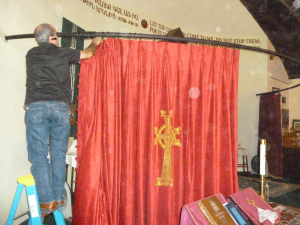
When we first built our altar area at the Youth Ministry Center we used a very heavy fabric for the curtain. It was a red velvety material with golden colored ropes and brocades. For our little church on the corner it was truly a majestic accent to the otherwise humble offerings around us in the church. It was also fairly difficult to open and close since it resided on a circular metal rod that had to be supported with extra garters because of the weight of the massive curtain. The deacons often pulled and pulled, sometimes in an awkward display of physical energy in front of the congregation. After a couple of years and a few hundred jerks and tugs at the garment, the curtain was showing wear and tear.
One of the members of the church donated new fabric for a lightweight curtain to be sewn. It arrived shortly after the order was place. We decorated the expanse of the curtain with beautiful cross brocades. Most importantly, now the curtain could easily be opened and shut with minimal effort.
While everyone was excited with the new arrival to our church, I had to figure out what to do with the old curtain. I knew old vestments had to be burnt and I figured the same was true of this huge curtain. Through the years, the curtain had absorbed the incense, smoke and prayers of thousands of faithful people whose cares and difficulties were expressed in prayer before this holy altar. The curtain was sacred and could not be put out for curbside pickup. I contemplated a huge bonfire in front of the church, inviting the neighborhood and community for a sacred burning, but the hassle of getting permits from the City of Glendale, which was already annoyed by our presence there, made it easy to opt out of that choice.
That week, during our homeless feed, we were going through the streets of LA’s “skid row” when it hit me! The curtain could be divided into several blankets for our homeless brothers and sisters! And a project was born!
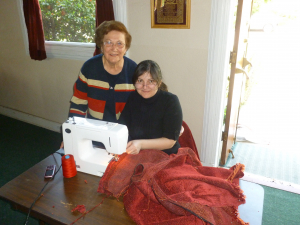
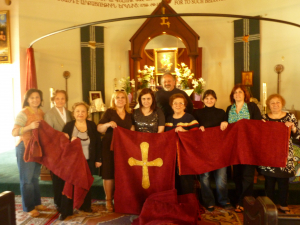
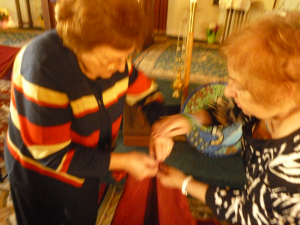
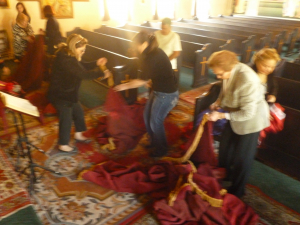
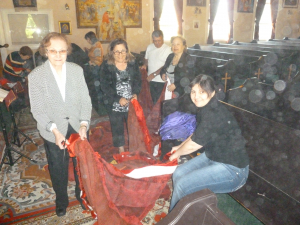
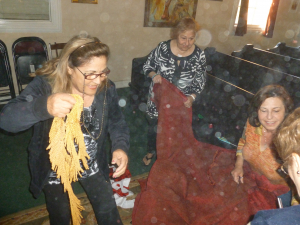
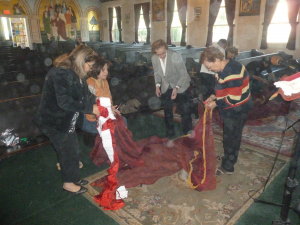
Several women from the Ministry brought over their sewing machines, others brought sewing shears, irons and manual labor. The church was converted into a sewing factor. I swear that there was music playing in the church that day, but I know it was a happy hum of the ladies doing what they knew was right.
They sewed and manufactured 50 blankets from fabric that smelled like incense and the housed the hopes, dreams, prayers and answers of the thousands. These Armenian gifts of hope were cleaned, wrapped and delivered to the residents of the street, with a small note of explanation and a prayer by St. Nersess Shnorhali. It came with the compliments of one group of people who were once homeless, to another group, that they might find hope for a better future.
On our weekly trips through skid row I would keep my eyes open to see if I would spot someone wearing or wrapped up in a piece of curtain or donning it like a cape. I thought what a beautiful expression of Jesus’ command to clothe the naked, to have a person walking the streets with an Armenian curtain, now turned blanket.
I never saw pieces of the curtain again, a tragic reminder as to how large the homeless population is in the City of Angels. That winter, I was sure that there were at least 50 people snug in a sacred blanket unlike any other. From an apostolic era church, the love of Christ was shared on the streets. It was one small miracle that came from the Armenian Church Youth Ministry Center.
Join me tomorrow as we continue with more stories of faith and miracles that were, 20 years ago today.
It was 20 years ago: Untold stories from the Youth Ministry Center
Today’s Inspiration: Suspended Angel
Barouyr* was a troubled kid. He was a 10th grader at Hoover High School when I met him outside the Youth Ministry Center. It was during the day, and he was pacing the sidewalk outside our church. He had been suspended from school. The school would dispense punishment according to the misbehavior of a student in a manner that escaped by understanding. Minor offenses led to detention – an after-school time spent in a supervised room with others. Enough detentions led to suspension – a period of time-off from the school. Finally, too many suspensions led to expulsion from the school.
There was Barouyr outside the church, looking around as if lost, but once you spoke with him you realized he was very aware of his surroundings. I greeted him and found a very respectful young man. We talked and he gave me excuses for being suspended, blaming teachers and administrators and their degree of “incompetence.” He was a young “tough guy.” He was from the streets and let me know he wasn’t afraid of anyone, but God.
At the time, I could not understand how suspending a student from classes could possibly be helpful for the child. Of course, it was easy to understand how it benefitted the teaching staff maintain a calm atmosphere in the classroom. At some point the discipline problem becomes overwhelming and there aren’t enough staff members to handle all the trouble-giving youth.
We went into the church. We talked. He opened up. His father was an alcoholic who abused his mother. They lived in a two-bedroom apartment. He and his older sister shared a room. He told me he didn’t want to be in school, but that rejection was merely a cover up, the tough-guy persona coming through. He was a bright guy who knew he wanted more.
The Soviet Union had disassembled a little over 10 years before we opened. The atheistic state had been prevalent for over seven decades. Domestic violence and alcoholism often accompanied one another as a result of life in the Soviet Union.
Barouyr became one of the regulars at the Youth Ministry. He grew up under the shadow of the church. On Sunday’s he served at the holy altar and during the week he was a regular fixture. I can’t tell you what it was that tied him there, suffice it to say he was one of the miracles of the ministry. In turn he inspired others to come to the church. Barouyr was no angel to the school authorities, but for the kids he turned-onto the church and this unique ministry, they could not have wished for a more caring guide from heaven. He retained his tough-guy exterior. He continued to get in trouble, but he was loved by everyone at the Center.
He ended up graduating and went to on to become a teacher himself. He still keeps in touch.
As a result of Barouyr, we found a new place within the community. The Center was seen as place that could pick up the pieces that were floating around. We put in a formal request with the school administrators to count us as an alternative to detention. We quickly became a go-to-point for students after school. The three schools across the way, Keppel Elementary, Toll Middle and Hoover High, ended their classes around 3PM and they walked over. Parents understood this to be a safe zone, where their children could “hang” until pick-up time. It was important for me that there was an understanding by everyone who came through its doors that the building was a Church.
I did not understand how suspending this student from classes could possibly help him. Now I understand that had he not been suspended our paths may not have crossed, or if they did, we may not have had the introduction we did. Like so many things that happened at the Youth Ministry Center, they just did. They weren’t planned. This was new and charted territory for the Armenian Church and we were following the flow, trusting the guidance of the Holy Spirit. That trust, from the Church, was perhaps the biggest miracle.
Tomorrow we continue with more untold stories and miracles from 20 years ago today. I invite you to join us. If you missed earlier episodes, you can hear them on your favorite podcatcher or at Epostle.net under the “Armodoxy for Today” tab. Remember to leave a comment and/or write us at feedback@epostle.net.