Doubts to Faith

Armodoxy for Today: Okay to Doubt

A week after Jesus had resurrected, the Apostle Thomas stands out from the group of Disciple by doubting the Resurrection. He is not with the others when Jesus appears and when they try to convince him that they have seen the “Risen Lord” he doubts their word. “Unless I see in His hands the print of the nails, and put my finger into the print of the nails, and put my hand into His side, I will not believe.” Thomas is forever more known as “Doubting Thomas” because of this hesitancy to believe and accept what was physically impossible.

My guess is that most of us would be just as skeptical over such news that goes against everything we know through experience. Every person who has been laid to rest has remained in their grave or cremated to ashes. No one, in our experience, as well as in Thomas’ experience for that matter, has ever come back to life. Resurrection begs doubting.

Doubting has a bad name. Many think it is the opposite of faith. Actually, fear is the opposite of faith. Doubt is the beginning of the questioning and reasoning process that leads us to understand, to accept and believe. It is the beginning of the Faith process. From doubt comes question and an opportunity to reason, think, process and come face-to-face with our fear. Having put away our fears, we come to terms with our Faith.

Doubting is a normal part of our thought and learning process. Stifling that progression of ideas leads to misunderstandings about ourselves and the harmony that we should have with life and the world around us.

It is okay to doubt. It is okay to question. It is okay to think/ponder the great miracle of Life. Accept the invitation that Jesus extended to Thomas, “Reach your finger here, and look at My hands; and reach your hand here, and put it into My side. Do not be unbelieving, but believing.”

From the Book of Hours we pray, Lord our God, my soul is in Your care at all times, and I trust in Your Holy Cross. I have the multitude of saints as my intercessors before you. You are forbearing toward all, do not disregard those who rely on You, but protect them with peace by Your precious and holy Cross. Amen

Cover: Kick off the Cascade, 2019 Fr. Vazken

In Utero

Armodoxy for Today: In Utero

In the days following the Resurrection, Jesus appeared to many different people. For the most part they were his followers who saw him, and non-believers greeted the news with skepticism, neither believing the Resurrection nor the idea that there was life beyond the grave.

Much hasn’t changed in the two millennia since the Resurrection.

A week ago I came across a short parable which I’d like to share with you. I found a few different versions of the parable, a couple of the earlier drafts are by Henri J.W. Nouwen, Pablo Molinero and this particular version I found on Juli Conard’s blog.

The Parable of the Twins

In a mother’s womb were two babies.  As the twins developed, their awareness grew and they laughed for joy, “Isn’t it great to be alive?”

The first baby asked the other: “Do you believe in life after delivery?”

The second baby replied, “Why, of course. There has to be something after delivery.  Maybe we are here to prepare ourselves for what we will be later.”

“Nonsense,” said the first. “There is no life after delivery.  What would that life be?”

“I don’t know, but there might be more light than here.  Maybe we will walk with our legs and eat with our mouths.” 

The doubting baby laughed. “This is absurd!  Walking is impossible.  And eating with our mouths?  Ridiculous.  The umbilical cord supplies nutrition.  Life after delivery is impossible; the umbilical cord is too short.”

The second baby held his ground. “I think there is something and maybe it’s different than it is here.”

The first baby replied, “No one has ever come back from there.  Delivery is the end of life, and in the after-delivery it is nothing but darkness and anxiety and it takes us nowhere.”

“Well, I don’t know,” said the twin, “but certainly we will see mother and she will take care of us.”

“Mother?” The first baby laughed. “You believe in mother?  Where is she now?” 

The second baby calmly and patiently tried to explain. “She is all around us.  It is in her that we live. Without her, there would not be this world that we know.”

“Ha. I don’t see her, so it’s only logical that she doesn’t exist.”  

To which the other replied, “Sometimes when you’re in silence you can hear her, you can perceive her.  I believe there is a reality after delivery and we are here to prepare ourselves for that reality when it comes….”

As the weeks stretched into months the twins noticed how much each was changing.

“What do you think all this change means?” asked the first baby.

“It means that our stay in this world is drawing to an end,” said the second.

But I don’t want to go,” said the first “I want to stay right here always.”

“We have no choice,” said the second, “but maybe there is life after birth!”

“But how can it be?” responded the one. “We will shed our life cord, and how is life possible without it? Besides, we have seen evidence that others were here before us and none of them have returned to tell us that there is life after birth.”

And so, the one fell into deep despair saying, “If conception ends with birth, what is the purpose of life in the womb? It is meaningless! Maybe there is no mother at all.”

“But there has to be,” protested the second baby. “How else did we get here? How do we remain alive?”

“Have you ever seen our mother?” said the one. “Maybe she lives in our minds. Maybe we made her up because the idea made us feel good.”

Thus, while one raved and despaired, the other resigned himself to birth. He placed his trust in the mother.

Hours passed into days and days fell into weeks, and it came time. And both knew that their birth was at hand. And both feared what they did not know.

And as the one was the first to be conceived, so he was the first to be born. The other followed after. And they cried as they were born out into the light. They coughed up fluid, and they gasped the dry air; and when they were sure that they had been born, they opened up their eyes and they found themselves cradled in the warm love of the mother. They lay open-mouthed, awestruck at the beauty of the mother whom they had never seen before.”

Obscurity to Light: Pope Francis Burial

Armodoxy for Today: Obscurity to Light

“At the place where Jesus was crucified, there was a garden, and in the garden a new tomb, in which no one had ever been laid.” With these words the Evangelist John records in his Gospel (19:41) an obscure description of where Jesus was laid to rest. In the 1970s rock-opera, Jesus Christ Superstar, Tim Rice and Andrew Lloyd Webber give a node and notice to the site by naming the final musical piece of the opera, “John Nineteen Forty-one.”

The grave site is as obscure as the Armenian Church I speak about on these broadcasts, the same Armenian Church which sits on the site and celebrates the Liturgy at this Tomb which was blasted open by the Resurrected Lord Jesus. The obscurity of the grave was overshadowed by the news – the Good News, that is the Gospel of the Resurrection.

This weekend, Pope Francis of Blessed Memory was laid to rest. He had asked that his remains not be interred at the St. Peter Basilica as many popes before him. Rather, he requested to find a resting spot at the Basilica of St. Mary Major, where one of his favorite icons, the icon of Mary Salus Popoli Romani had inspired him and became a site for the growth of his own prayer life. Hardly an obscure location, but in the context of the Basilica of St. Peter in the history of the papacy, Pope Francis’ choice reflected the humility that the was a hallmark of his life.

The Armenian Church, as the ancient witness to Jesus Christ and therefore to the Resurrection, has often been designated to obscure corners and areas of the world and community, but the power of the Resurrection is always overshadowing and lifts this small Church to shine its Light, whether from Holy Etchmiadzin or the local parish. Pope Francis left this earth as the Pontiff of the Roman Catholic Church, and today, the Basilica of St. Mary Major turns into a Shrine of Light to those who cherished the Christ-like humility of this Servant of God.

May the seal of our Lord Jesus Christ be immovable from the tomb of your servant Francis, until the coming of Christ, who will come and once again renew in the glory of the Father and the Holy Spirit. May his memory be for us a renewal of our vows of kindness, understanding and humility. Amen.

Cover: Gregory Beylerian 2014

Three Days in Vanadzor

A small group of us from Epostle ventured out to Vanadzor right after the Reclaim Conference to expand on some programs we began last year. Through an arrangement with our Primate, Abp. Hovnan Derderian, we were received by the Primate of the Gougark Diocese, Bp. Hovnan Hakopian in Vanadzor.

Our team was greeted at the Diocesan headquarters by His Grace Bishop Hovnan along with several workers. Bp. Hovnan gave us a quick overview of the Diocesan activities and shared his vision for the near and distant future.

We were in Vanadzor to cultivate a program with the refugees from Artsakh. The Armenian Church serves as a hub for these families, where they receive spiritual and emotional care and support during their settlement process. A sewing center has been set up at the diocese, where sewing machine are provided for women to earn an income.

During our stay we had several opportunities to visit with refugees in groups. One group met in the basement of the Narekatsi Cathedral in Vanadzor. These women shared their tragic stories, of wars and loss of husbands, children and land. They were all exiled from their homes and family lands by the Azeris. Many of them were living with the hope that they would return one day. These were the truly “homeless” people because there is no home for them to return to. The ancient lands have been forcibly occupied, and yet, given the stark reality of the days and times, it was not for us to take away any glimmer of hope that might exist in them.

One of the members of our team, Dr. Talar Tejirian, as an accomplished physician and surgeon spoke to the women very candidly about the need to stay active and remain positive in their outlook. She did some mild-assessments of the women who had come to meet us, and she shared with them exercises to keep them active and motivated. Her messages were empowering as she spoke of the need for finding goodness in life and introduced gratitude-journaling.

Our efforts to assist the refugees began last year when we organize the Cars and Coffee at St. Leon Ghevontyants Armenian Cathedral in Burbank. Funds that were raised were earmarked for refugee relief efforts. While in Vanadzor we discussed funding the sewing center and developing the program so that families can earn a living to be self-reliant and self-sustaining.

The Church also maintains a children’s art center. Our visit there was truly a beautiful experience as we watched the after-school class of children paint, weave and create without inhibition. Our team member Gregory Beylerian who is creative director at Epostle shared thoughts on the drawings and designs by the young people. There we also had a chance to talk with the youth in an open-conversation about issues of faith and adolescence.

At the center of the courtyard at the Diocese was the tomb of the former Primate of the Diocese of Gougark, Abp. Sebu Chuljian, who passed in 2020. He was loved and well respected by the people of his diocese, as was evident by the placement of his grave. He was a personal friend of mine. Being at his grave I had an opportunity to reflect and remember his leadership. Several years back we set up an exchange program between youth in Pasadena and youth in Vanadzor. When I was running the Camp of our Diocese, we set up a sister-camp program, which I am pleased to hear continues to today with our support. And so, it was even more pleasing to see the Vanadzor camp, which was still under a blanket of snow. The entire facility is very impressive. We discussed the possibility of being out in Vanadzor during the summer months to bring our participation to the Camp program. Bishop Hovnan was very receptive to the idea and said the invitation was an open one.

Most importantly we set up a network by which we can work with the refugees. For me, it was an eye-opener to see how our Western Diocese is intricately involved in so much of the growth of the Gougark Diocese. Several structures and programs are the result of our Primate, Archbishop Hovnan’s immediate attention to the needs of this area.

Back in Yerevan we had a chance to check in with three projects which we support – The Arev Children’s Center for Down Syndrome children with Father Gregor Gregoryan, the Soldier’s Home and Rehab Center and the New Bird’s Next, providing for the resettlement of families from Artsakh.

Our stories are being shared at Epostle.net and on social media. Sitting with the refugees, I saw in them my grandparents who were forced out of their homes during the Genocide of 1915. I shared this image with the people we met. But I also asked them to look at us, and see their future grandchildren, who will have passed through these dark days and form their lives. In the Easter Season, this message of crucifixion and resurrection is the hope that keeps everyone moving forward.

We returned to a full plate of the activities to build on. Our thanks to our Primate, Archbishop Hovnan Derderian for facilitating this meeting and to Bishop Hovnan Hakopian for his exceptional hospitality and assistance in reaching out to the people.

Humanitarian: Non-Political

Humanitarian: Non political

Next Step #801 – April 25, 2025 – Another opportunity lost: 110 years since the Armenian Genocide and still self-pitying and at a loss of words (read: nerve) to talk about other genocides, falling victim of politics and political correctness. Humanitarian issues becoming politics. A first look at the passing of Pope Francis and his legacy of humility.
Worth 1000+ words (Pope)
Armenian Monument in Montebello as historic landmark
Pope Francis Passes Away
Instead of Mourning a Genocide, Stop One
Gregory Beylerian: visual arts to art of articulation (Echos of Ararat)
Rwandan Blog
Armodoxy for Today
Araksia Gyulzadyan
Leveraging Love
Produced by Suzie Shatarevyan for http://Epostle.net
Subscribe and listen on demand on your favorite pod-catcher!
We’re on PandoraSpotify and Apple Podcasts

The Pope’s Delicate Balance

Armodoxy for Today: The Pope’s Delicate Balance

A big problem in the Church is reconciling the disparity between the lowly figure of the leader of our Faith, namely Jesus, and the large amount of wealth that can accumulate in the church coffers. I remember early in my ministry hearing about a protestant congregation in Walnut Creek that had a multi million dollar annual budget, yet they started each year and ended each year with only $2,000 in the bank. I remember thinking that that was truly a model of a Church, in other words, they spent what they took in, on ministry. Still, the idea of a dynamic ministry implies that it is changing and invites novel and innovative ideas to fulfill its mission. With the dreams, comes the need for funding. Hence,   the plight of non-profits, whether church or secular organization, is defined by donations from people who believe in the cause.

The model of Church operations is conducive to the accumulation of finances, as donors and contributors set endowments and trusts to take care of the needs of the church for years (or centuries) to come. In the case of the Church, as the Body of Christ, the words of Jesus, not to worry about material wealth, that God takes care of the birds and flowers, and how much more he will take care of us, cannot go unnoticed. And so, a delicate balance must be met twixt what is necessary to function and spending what has been provided. And those in leadership positions within the Church struggle to find that balance and make sure they don’t fall.

And so, it was truly refreshing when Pope Francis, of Blessed Memory, became the head of a two-thousand year old Roman Catholic Church, opted to travel the path of humility and live a modest lifestyle as was his custom from his days as the Prelate of Argentina.

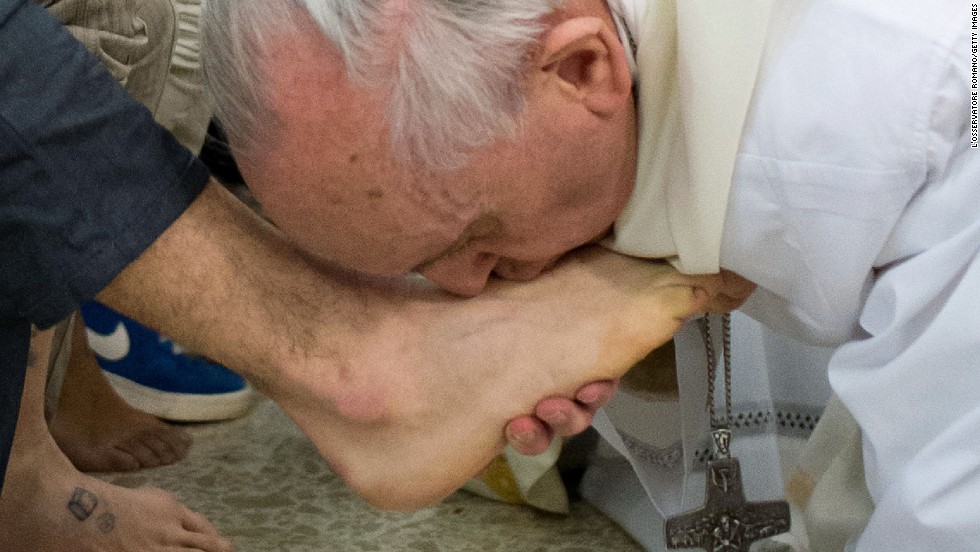
They say a picture is worth 1,000 words. One such picture was taken when Pope Francis washed the feet of prisoners on Holy Thursday, in strict observance of Jesus’ command to follow the Divine example from the night of the Last Supper (see John 13). But the picture captured something more, when the Pope bent over and kissed the feet of the convicts.

The Pope goes by titles such as Bishop of Rome, Vicar of Jesus Christ, Successor of the Prince of the Apostles, Supreme Pontiff of the Universal Church, Archbishop and Metropolitan of the Roman Province, Sovereign of the Vatican City State, Servant of the Servants of God, and His Holiness. That kiss spoke volumes about the person and his understanding of wealth and his responsibility as head of the Church.

His humility is, arguably, his greatest legacy.

Heavenly Father, we thank you for replenishing Your Holy Church with the servants who lead by example. Accept the offerings of all, and in the offering of humility by Pope Francis, may I find an example to live for others with my life. Amen.

Sharing: Responsibility not Mourning

At the invitation of the Armenian Students and Shaké Balian, the group’s sponsor, the 110th anniversary of the Armenian Genocide was commemorated at John Burroughs High School on April 23, 2025, where Fr. Vazken presented the message of the day.

The Last Requiem

Armodoxy for Today: The Last Requiem

On April 19, 2015 I conducted the last requiem service for the Martyrs of the Armenian Genocide. That year was the 100th anniversary of a program of systematic annihilation of the Armenian population in the Ottoman Empire. The Armenian Church announced that on April 24, 2015, it would canonize the martyrs of the Genocide as saints of the Church. The April 24 date has always been used as a marker for the Genocide remembrance for it was on that date in 1915 that the Armenian leadership was rounded up, killed or deported in Constantinople, what is referred to as Istanbul today.

Designating the martyrs as saints was long over due by the 100th anniversary. Martyrdom implied that their life was given for higher principles, in this case for Christ and nation. But even more, the shift to sainthood was a change in mind-set for the Armenian nation. As saints, the martyrs are classified as “victorious in Christ” and therefore, not victims.

“If anyone desires to come after Me,” says Jesus, “Let him deny himself, and take up his cross, and follow Me. For whoever desires to save his life will lose it, but whoever loses his life for My sake will find it.” (Matthew 16)

Requiems, a tradition misleadingly referred to as hokehankist in the Armenian Church, are not conducted for saints. They have been crowned by Christ!

On that Sunday, in 2015, I had the distinct honor of celebrating the Divine Liturgy at the St. Leon Armenian Cathedral of the Western Diocese. It was the western most Armenian Church and the delayed timing of the day, had me reciting the Martyrs of the Armenian Genocide in the requiem prayer for the very last time ever. Having grown up with Genocide survivors (my grandparents) this was a most sacred moment in history.

In the days that followed the conversation would shift in a manner that only Christ can change. Christ, the one who took the words of condemnation “Take and eat” in the Garden, and madse those same words “Take and eat” into words of salvation, was now leading the Armenian nation to victory. The mind-set had been altered.

Let us pray, Lord, our God, You are with us in every transition and change. Open our hearts to the great change from victim to victor, which You demonstrated with Your glorious Resurrection. Help me to accept the change and welcome the newness of that victory. Amen.

Cover Photo: Luna & Gregory Beylerian

Meaty is Okay: HH Pope Francis

Armodoxy for Today: Meaty is okay with me

“Hope” is the name of Pope Francis’ autobiography. This past Lent I decided to read the book as part of my Easter time ritual of accenting spirituality in my life. It took me a while to get through the book, not because it was long or because it was boring. Actually, it was just the opposite. I found the book to be anything but boring and as I read through the 300 pages, I would not have minded if it went longer. The book was meaty. You know what meaty is, right? The fat has been trimmed off and every bite is nutritious. You want to savor the flavor, so you take your time getting through it.

Pope Francis life was meaty. He was a simple man, but the fat had been trimmed off to the point that each bite was nutritious. You were in no rush to end the meal.

Four days before he was elected Pope, Archbishop Bergoglio wrote, Thinking about the next pope: a man who from the contemplation and adoration of Jesus Christ, helps the Church to go out from herself to the existential peripheries, that helps her to be the fruitful mother who gains life from “the sweet and comforting joy of evangelizing.” (p.187, Rome March 9, 2013)

When you read something as meat as this, you can’t just swallow it. You have to chew it, figure out the different tastes, contemplate and apply to your own circumstances. Meaty is a good thing. Pope Francis gave us much to think about through his humble life which he lived modestly. He was grounded and centered in the Gospel. It was what he believed, the way he lived and died. He gave us all much to ponder and much to absorb. We were nurtured by his words and actions.

Let us pray. Heavenly Father, we thank you for the life of your servant His Holiness Pope Francis. May we keep his memory alive in our hearts by allowing his example to nurture our spirits in your Love. In all things we glorify You along with the Son and Holy Spirit, now and always. Amen.


Pope Francis, Another Brother

Armodoxy for Today: Another Brother, Pope Francis

This morning I woke up to the news of Pope Francis’ passing. Thoughts of him at Sunday’s Easter Mass quickly came to my mind. I heard about the Vatican Easter service on my car radio. I was on a long-drive home from the Coachella Valley, where I had celebrated the Easter Liturgy at the St. Garabed Armenian Church.

News of the Vatican service kept me focused on the day’s message of resurrection. The news item was clear that the Pope attended the Easter Mass though the celebrant was one of the Cardinals, the Pope’s representative. The Pope was struggling with health issues and even though his doctors recommended that he get plenty of rest, he did not want to (could not) stay away from the Easter Mass.

Following the service, from his wheelchair, he offered his Easter message. True and consistent to himself and his vows as a priest, he remembered the poor and the marginalized. For my ears, his call for peace between Armenia and Azerbaijan was a call that only someone with true commitment and compassion for the cause of peace would dare to reiterate as often as he did.

And now, this morning I was hit by the reality that this voice for peace and compassion had gone silent.

He went out of this life the way he lived it, as an Apostle of Jesus Christ, proclaiming the Resurrection. Neil Young has a line that I especially appreciate, “It’s better to burn out than it is to rust.” The Pope voice would never have rusted.

Back in 2016, Pope Francis visited Armenia in what was billed as “Pilgrimage to the First Christian Nation.” There was a small graphic-patch that was used as an icon on all the broadcasts, a drawing depicting the back of Pope Francis’ and Catholicos Karekin II’s heads. I’ve included it as the cover of today’s message. At the time, on my podcast I referred to their meeting as two brothers reuniting. St. Peter and St. Thaddeus, both lived and breathed with our Lord Jesus Christ. They both were witnesses to the Resurrection. Both of them carried the message of Resurrection to new lands, Peter to Rome and Thaddeus to Armenia. Two thousand years later, their successors, the Bishop of Rome and the Bishop of Ararat, had embraced as brothers.

Pope Francis’ legacy is a great one. He touched people on many levels as he did the soul of this priest. We will continue with more reflections in the days to come. Today, we join our voice with the millions throughout the world in praying for his soul but also praying for the echo of his voice in our world.

O Christ, Son of God, forbearing and compassionate, have mercy upon the soul of Your servant Francis. Be mindful of him on the great day of the coming of Your Kingdom. Number and glorify him in the company of your saints at Your right hand. For you are Lord and Creator of all, judge of the living and the dead. To you is befitting glory and honor. Amen