
 2025 Fr Vazken
Catechumens: Oral to Written
Armodoxy for Today: Bible Origins
We are in a four-day period on the Armenian Church calendar called the Fast of the Catechumens. This fast is unique to the Armenian Church. To follow on our lesson from yesterday, regarding the lack of specific scriptural readings for these four days, today we will look at the structure and make-up of the Bible.
On Pentecost, 50 days after the Resurrection of Christ, (Acts 2:1ff) the Holy Spirit descended upon the Apostles and the Church was born. The Apostles were the first Christian community, the first Christian Church. They had no “Bible.” The Gospel or the “Good News” which they preached was that Christ had risen – resurrected! This was an earth-shaking experience in the lives of the Apostles, and their mission was to spread the Good News—Christ had risen, giving an opportunity for all humankind to share in this new life. This was the first Gospel and it was transmitted orally.
The first Christians felt that Christ’s return would be imminent. In fact, throughout the first century, they were living with the expectation that the Second Coming of Christ was right around the corner. They lived their lives accordingly. (See I Thessalonians 4:13-18.)
The Apostles spread the Gospel to various parts of the world. New Christian communities sprouted. As time went on, problems arose in the communities – daily problems – which were complicated by their expectation of an imminent end. The communities were faced with questions such as, “Should we obey the local authorities if Christ is due back any day?” Or “Is it proper for us to marry, if Christ will be returning soon?” Or, “What will happen to all those who die before Christ returns?”
To address these problems, the Apostles, now scattered throughout the known world, wrote responses to the communities, giving specific instructions on how to conduct their lives until Christ returned. Among the most popular letters were those of the apostle Paul. The books in the New Testament which follow the Gospels are the letters St Paul wrote to the Christians in Rome, Corinth, Thessalonica, Ephesus, and so on. The first of these letters (I Thessalonians) was written in the 40’s.
The Church existed without a bible. The Church had its worship services, which included partaking of the Holy Eucharist, reading psalms or prophetic literature of the Old Testament, and prayer. The letters they received such as those from the apostle Paul, were read during the gathering of the faithful, and are regarded as epistles, that is general letters to the community.
As more time went on, and Christ had not yet returned, further problems developed. For one, all the eyewitnesses to Christ’s life on Earth were passing away. Who would covey the stories of Christ’s life to future generations? Furthermore, the communities and churches were asking about the details of Christ’s life, for example, His birth, His upbringing, whether He was baptized, and so on. For this reason, the Gospels were written to provide the details of Jesus’ life. Again, the point must be made that they were written for the sole use of the Christian Church. The Church demanded it, and, therefore, they were produced.
The Gospels according to St. Matthew, St. Mark, and St. Luke, including the Book of Acts, (called the synoptic gospels) were written between 60 and 80 AD. The Gospel according to St. John was written sometime later. Although these books were written, they had not yet been put into the form of a “Bible.”
There were other books about Jesus’ life as well. For example, there was the Gospel of Thomas, or, as the author called his book, The Secret Words Which Jesus the Living Spoke and Jude Thomas Wrote Down. It might be thought of as a more complete Sermon on the Mount. There was also a book called the Gospel of the Infancy of Jesus Christ. It is one of the more fascinating books of what is called the New Testament “apocrypha” or “hidden books.” One story relates how Jesus, while still in the cradle looks up at his mother and says, “Mary, I am the Son of God.” Another story is generated from the account of the anointing of Jesus by Mary Magdalene. The story claims an old lady kept Jesus’ navel string in an alabaster box of old oil of spikenard. It was out of this box that Mary took the oil to anoint Jesus. Still another story relates how Jesus and some other young boys were molding clay figures of animals. Upon Jesus’ command, the clay figures begin to walk and fly. The entire book is filled with miraculous stories of this nature. This was one of many books that were circulating in the 2nd Century.
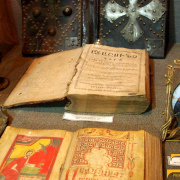
It was the Church that decided which books would be considered “The Bible,” designating them as scriptural canon. All of the books that are in The Bible as we know it today are in a list compiled in the 2nd century, except the Book of Revelation. It was in 419 AD, at the Regional Council held in Carthage that the Book of Revelation was accepted as being canonical. So until the 5th century the Church existed without the Bible that we know.
Tomorrow, we will journey further through the Fast of the Catechumens to learn closer the beauty of Christ and the Christian faith.
Let us pray, a prayer for Catechumens, from the Roman Catholic Tradition, We thank you for these catechumens whom you have called. Strengthen them in faith, that they may know you, the one true God, and Jesus Christ, whom you have sent. Keep them clean of heart and make them grow in virtue, that they may be worthy to receive baptism and enter into the holy mysteries. Amen.
 2026 Epostle




 2025 Fr Vazken
 2025 Fr Vazken
Leave a Reply
Want to join the discussion?Feel free to contribute!