

ePostle Presents a Vision for the Future of Armenian Christian Education
This article is based on a presentation by Fr. Vazken Movsesian and Gregory Beylerian of ePostle.net, delivered at the Western Diocese’s annual Sunday School Conference, where they shared a vision for the future of Armenian Christian education, outreach, and heritage preservation:
ePostle is exploring how emerging technology can extend Armenian Christian education beyond the physical walls of the parish.
- ePostle Presents a Vision for the Future of Armenian Christian Education
- Sunday School leaders, educators and Archbishop Hovnan Derderian hear a bold vision for immersive learning, global outreach and the digital preservation of Armenian Christian heritage.
LOS ANGELES — August 22, 2026 — What might Sunday School look like when the classroom is no longer limited by geography?
What if an Armenian child living hundreds of miles from the nearest parish could enter a Sunday School classroom, interact with other children, explore an ancient monastery, hear sacred music within its original setting, or even encounter figures such as Mesrop Mashtots through immersive technology?
These possibilities were presented by ePostle during a gathering of Sunday School leaders and educators of the Western Diocese, organized by the Christian Education Council (CEC) of the Western Diocese and presided by the Primate Archbishop Hovnan Derderian. At the invitation of CEC Chairman, Zaroohi Der Mugrdechian, educators and individuals concerned with the future of the Armenian Church assembled for this informative session. With her years of active participation within the life of Armenian Church, and in particular with Christian education programs, Der Mugrdechian, organized this program to provide resources for educators, but also to extend a vision to the generations to come.
Rather than focusing only on what Sunday Schools should teach today, the ePostle presentation invited participants to consider something larger: how the Armenian Church might teach, connect and preserve its heritage in the world that is rapidly emerging.
Established in 2022 on the initiative of Eric Esrailian, ePostle has organized its work around three interconnected pillars: education, outreach and heritage preservation. Today, the platform has a steady number of visitors each month, between 25,000 to 35,000, from places far beyond established Armenian communities and throughout the world.
The central challenge is increasingly clear: while Armenians live throughout the United States and across the world, many live nowhere near an Armenian church, Sunday School or established Armenian community.
Technology may now provide a bridge.
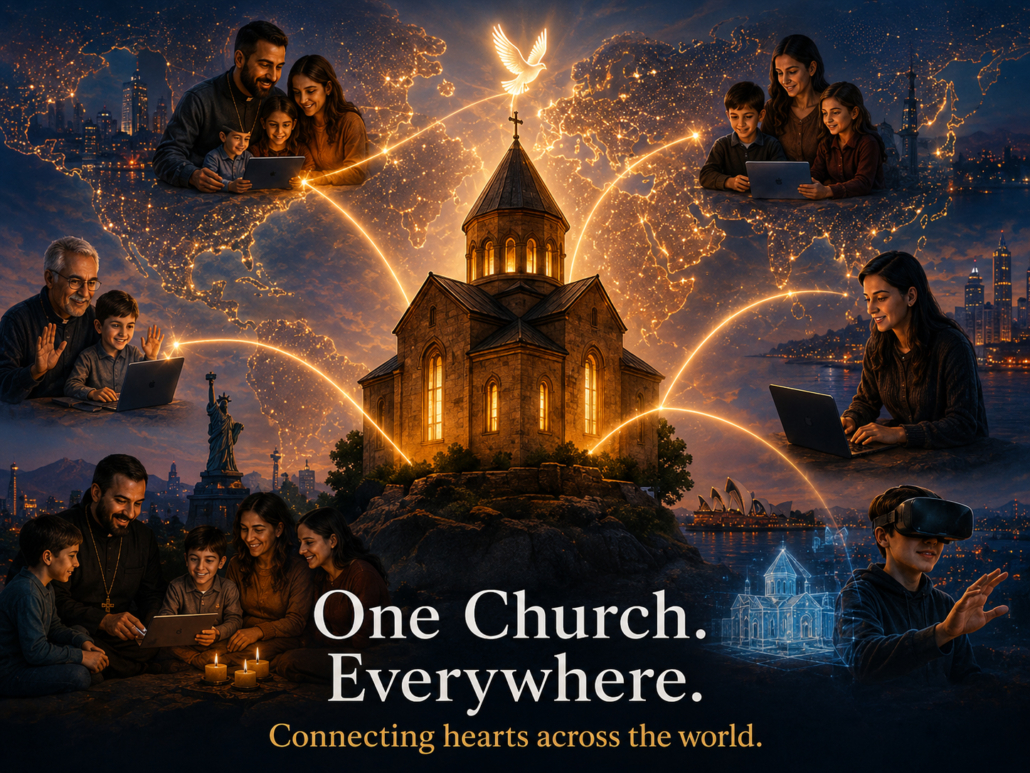
A vision of one Armenian Church connecting families across cities, countries and continents.
Beyond the Walls of the Church
During the presentation, ePostle outlined a model in which an existing Sunday School classroom can become accessible to children and families anywhere in the world.
The goal is not to replace the physical church or the experience of gathering together. It is to reach those who do not have access to one.
A teacher could continue teaching children physically present in a parish classroom while, through ePostle’s digital infrastructure, allowing children in another state, or another country, to participate as well.
The idea grew in part from seeing communities already searching for this kind of connection. For example, one Armenian group in a town distanced by several hundred miles from a brick and mortar Armenian Church, began using ePostle’s Sunday Expressions as a gathering point, for their community.
As the presentation emphasized, there are countless Armenian families facing the same challenge: they want their children to know their faith, heritage and identity, but geography has placed the traditional institutions of Armenian community life beyond their reach.
The emerging question is therefore not simply, How do we bring people to the Church?
It is also: How can we bring the Church to people?
From Online Learning to Immersive Experience
ePostle has already begun experimenting with the answer.
An early pilot program at St. James Armenian Church created a virtual Sunday School environment that students could enter using inexpensive Chromebooks, phones, tablets or virtual-reality headsets.
This is not a Zoom classroom!
One environment transported students virtually into Tatev Monastery using three-dimensional photographic capture. Other spaces included a virtual exhibition devoted to Armenian heritage and an immersive amphitheater designed for lectures and presentations.
But this first generation was only the beginning.
During the August 22 presentation, ePostle Creative Director Gregory Beylerian described a rapidly approaching generation of lightweight immersive technology in which what today requires a headset could increasingly resemble an ordinary pair of glasses.
Within such an environment, education becomes experiential.
Students might walk through an Armenian monastery rather than merely see its photograph. They could stand beside their teacher and classmates even while living thousands of miles apart. They might explore Armenian music alongside a recreation of Komitas, learn the origins of the Armenian alphabet through an interactive Mesrop Mashtots, or enter historical environments connected to St. Gregory the Illuminator.
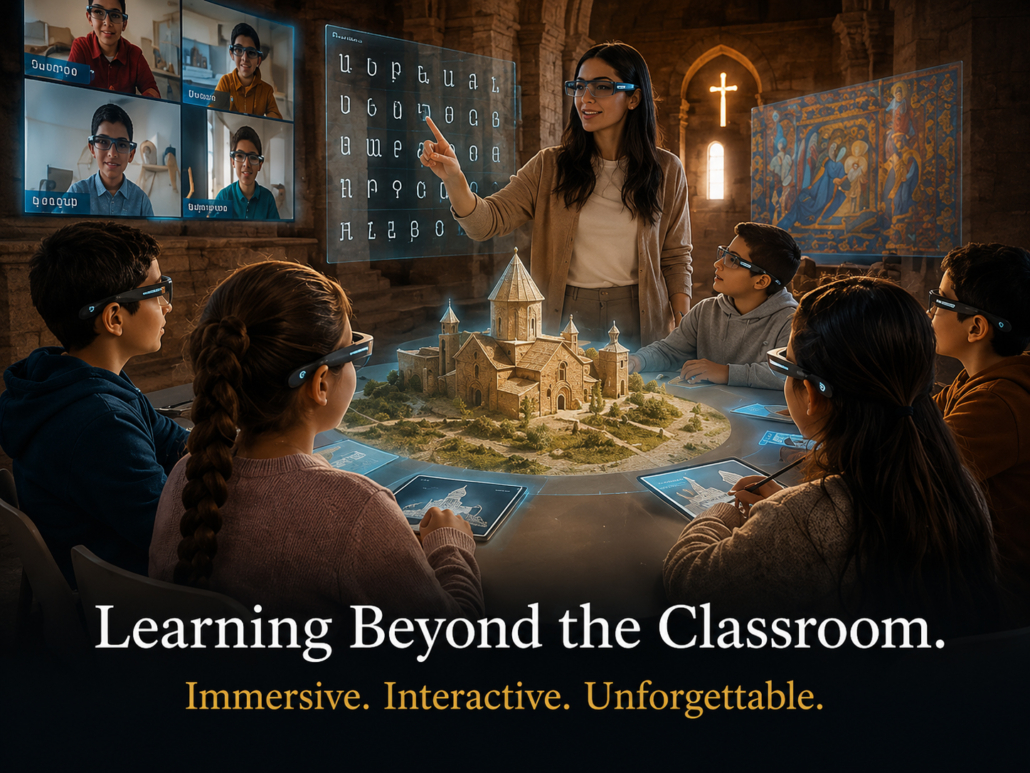
Immersive technology could transform Armenian Christian education from something students simply watch into something they can enter, explore and experience.
The objective is not technology for technology’s sake.
It is to use new tools to make learning memorable, human and alive.
As Beylerian explained, a compelling subject can become lifeless when poorly transmitted, while even a difficult subject can become extraordinary when the experience surrounding it awakens curiosity and wonder.
Preserving What Can Be Lost
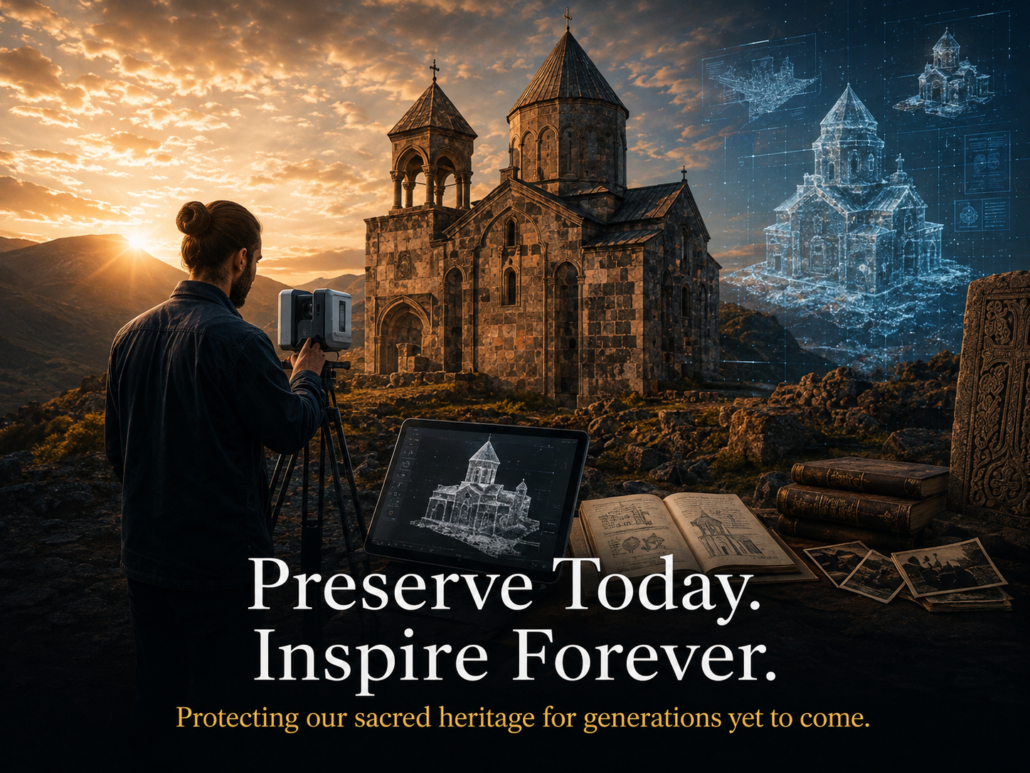
Photogrammetry, 360° capture and 3D modeling can preserve Armenian sacred spaces digitally—even when physical access is lost.
The implications extend beyond education.
Long before some Armenian sacred sites became inaccessible, ePostle’s founders were already experimenting with technologies capable of preserving them digitally.
During a 2014 journey to Artsakh, three-dimensional photographic documentation was made of sacred sites including Ghazanchetsots Cathedral in Shushi. At the time, the recordings were experimental. Today, their significance has dramatically changed.
With Armenians no longer having access to Shushi, those recordings have become a form of digital cultural memory—allowing future generations to enter and experience a representation of the church as it existed before the region was lost to Armenian control.
Using photogrammetry, drones, 360-degree imagery and spatial audio, sacred architecture and environments can now be documented in ways that allow people not simply to look at them, but to experience a sense of being within them.
This places ePostle’s work at the intersection of ministry, education and cultural preservation.
Technology Is the Tool. Connection Is the Mission.
Throughout the presentation, one point was repeatedly emphasized: immersive technology is not intended to replace embodied community, worship, teachers or churches.
The technology is simply another instrument through which the timeless mission of the Church can travel.
Fr. Vazken Movsesian, Founder of ePostle, explained that just as stained glass, printing press, radio, television and the internet each became tools for communicating faith to new generations, today’s emerging technologies offer another means of carrying that message forward.
The bridge may be technology. But the heart remains the Armenian Church.
The next phase of the project is therefore being approached deliberately.
Rather than rushing another experimental program into use, ePostle is envisioning the coming year as a period for development, training and collaboration with educators, with a target of September 2027 for the next major phase of the Sunday School initiative. The intention is to build an adaptable platform rather than impose a new curriculum, giving teachers and Church educators the ability to shape the educational experience themselves.
Investing in a Generation We May Not Yet Fully See
In his closing remarks, Archbishop Derderian recognized both the unfamiliarity and the potential of what had been presented.
With warmth and humor, he described Fr. Vazken Movsesian and Gregory Beylerian as being almost like “aliens” to the present generation, not because the ideas were disconnected from reality, but because they were arriving ahead of the culture’s ability to fully imagine them.
He suggested that a future generation may someday look back and recognize that the work being undertaken today was not simply for the Western Diocese, but for the Armenian Apostolic Church more broadly.
“You are investing for the future generation,” the Archbishop told them, adding that children yet to be born may one day thank those who had the foresight to prepare these pathways for them.
His comments returned the conversation to its essential purpose.
Whatever technology may come, the mission remains the same: education of the new generations.
The Archbishop described Sunday School as “the heart of the community” and emphasized that the purpose of Christian education is ultimately to help young people encounter Christ and develop a living relationship with God.
That may be the most important perspective from the day.
ePostle is not attempting to predict the future for its own sake. It is preparing the Armenian Church to enter that future with vision. For a people scattered across continents, technology now presents an extraordinary possibility: distance no longer has to mean disconnection.
A child in Tennessee, Maine, Montana, Europe or anywhere else in the world may someday be able to enter an Armenian Sunday School, walk through the sacred spaces of Armenia, learn alongside other children and experience the faith and heritage of their ancestors, not as something distant, but as something present.
The classroom can expand.
The community can expand.
The reach of the Church can expand.
And at the center of it all remains the same enduring purpose: to connect the next generation to faith, heritage, one another, and to Christ.

 2018 Susan Movsesian


 2025 Epostle

 2025 Epostle
 2025 Epostle
Leave a Reply
Want to join the discussion?Feel free to contribute!