Meeting Khoren of Khorenian


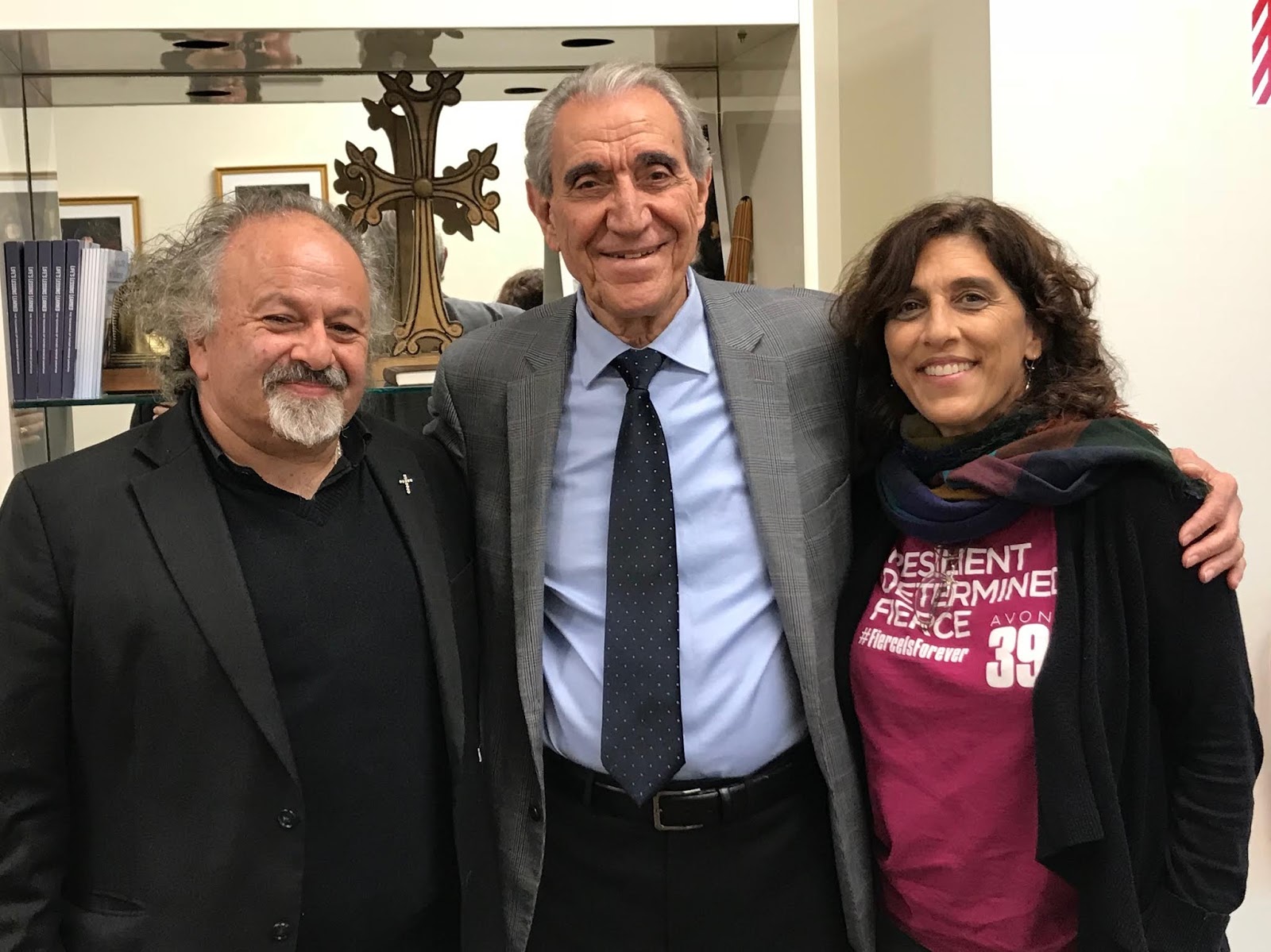
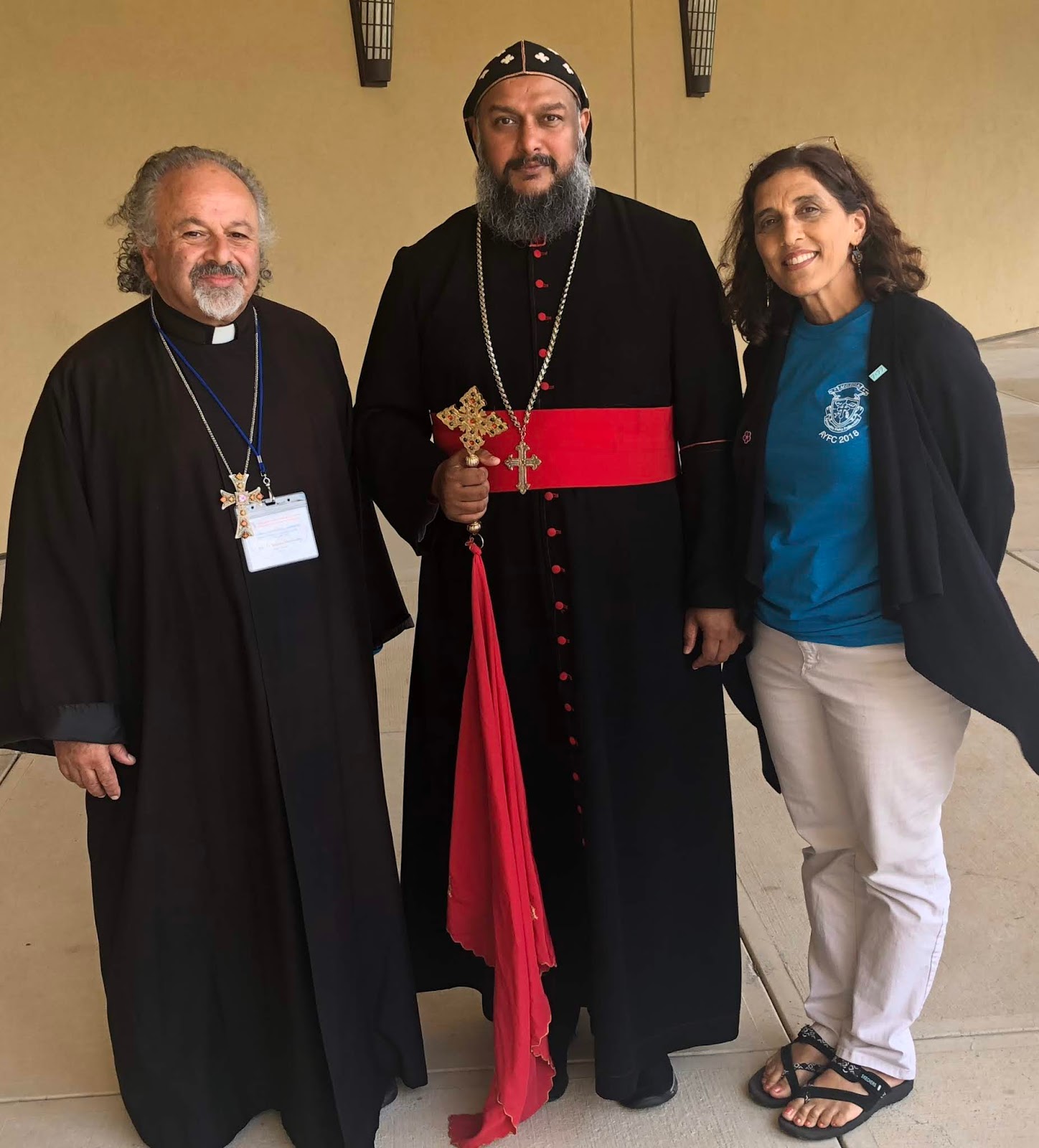
Maestro Khoren Mekanejian with Fr. Vazken & Susan
at the St. Nersess Armenian Seminary, Armonk, NY 2018
I wasn’t expecting this meeting. He introduced himself to me as Maestro Khoren. Could it be him? I thought. No. He was from long ago – a contemporary of Lusine Zakarian. He was at Holy Etchmiadzin when I was there in the 1970’s. The Maestro Khoren is the renowned and noted conductor of the Etchmiadzin Choir who has written one of the melodies and arrangements of the Divine Liturgies for the Armenian Church. If this was the Khoren of the Khorenian Badarak, what was he doing at the dining table at St. Nersess in Armonk, New York?
“He teaches us music and Armenian liturgical singing,” answered one of the students. Maestro extended his hand in introduction to me and said he was looking forward to celebrating the Liturgy together this coming Sunday at the Cathedral. I was still thinking: Could it be him? “Ah! You sound like you are a baritone,” said the Maestro to me as he walked out the door. “We will be able to sing in the higher keys.” I wish I understood how a low-note baritone gave permission to higher keys, but for that moment I gave a courtesy node and smile as he left the room.


“How often do you take classes with him,” I asked one of the seminarians. “Once a week. The rest of the week the Maestro is at the Cathedral.” It has to be him, I thought. Of course! That’s him.
 
An hour later we took a tour of the seminary. The seminarians were eager to show us around. I was anxious to check out my hunch. He was on break, between class sessions. He was challenging one of the students with a question about Aravod Looso: Which verse of the 36 verses (corresponding to each of the 36 letters of the Armenian alphabet) does not follow the rhythmic rhyme of repeating the first character (and therefore the phonetic sound)? I got into the act. I had not done my brain teaser for the day; it was a challenge I wasn’t going to pass up.*
 
Established: This is theMaestro Khoren. I’ve had a burning question that I’m sure he will be able to answer. I’ve kept this mp3 file in my Drop Box for just such an occasion. It is Zarouhi Vartian, singing Marmin Derounagan during my ordination Badarak. It is a unique melody which I have only heard sung in a few churches, including at my first parish in Cupertino. I play it for Maestro. He admits he’s never heard it but starts playing some chords on the 1990’s Yamaha keyboard in front of him. We’ve been invited to his classroom. He explains that the chord progressions suggest, what Komitas called “The Urbanized Armenian hymns.” Armenian hymns are sung and expressed by the villagers, who intertwine the spirit of the land and air into our prayers, he clarifies. Today, everyone wants to get out of church. They would not tolerate such a long and drawn out hymn. “Do you know how I came about to write the music for the Badarak?”
 
This is it!  We’re sitting one-on-one with the man who wrote one of three (Yegmalian, Komitasian, Khorenian) authorized melodies for our Divine Liturgy. And now, in front of this keyboard, we’re about to hear the story of how our Church took on a new form. Yes! It happened, not in the 21st century, but forty years earlier.
 
He shared his story. He begins by admitting, “I’m not a composer. I direct choirs. I’m a choral leader.” And from this humble admission he tells the story of what may seem like an accident of events, but in fact, as we found out, is how the Divine works through our lives.

Khoren Mekanejian was the choir director at the Mother Cathedral of Holy Etchmiadzin. Among his many singers was Lusine Zakarian, the “nightingale” of the Armenian Church, if not, of Armenia. The Catholicos of the time is the venerable Vazken I, who has a front row seat at every Badarak celebrated at Etchmiadzin. One Sunday, the Catholicos calls Maestro into his office following the Liturgy. He has a criticism of the way “Miayn Sourp” is sung. Lusine is accenting the first syllable of Mi~ayn and this conjures negative imagery. “Mi” = do not! “Mi nusdir” = do not sit! “Mi khosir” = do not talk! The Catholicos didn’t want the negative wording of “Mi” to be accented. He told Khoren to please instruct Lusine to accent the second syllable, draw out the second syllable, Miayn~.

After Badarak, in the mashutka that takes the singers back to Yerevan, Maestro tells his star singer to please accent the second syllable. She agrees.
 
The next Sunday, during Badarak, once again, Lusine accents the Mi in the Miayn. Vehapar hears the obvious. After church he summons Khoren into his office. “Didn’t you tell her?” “Yes I did Vehapar Der.” What happened? He sends a deacon to summon Lusine to his office. She arrives and admits that Khoren had told her but she did not comply. With a smile on his face Khoren tells us that at that point “I was relieved. The fault was off of me.”  
 
The following Sunday, the same thing happens: Lusine accents the Mi instead of the Ayn. Now Vehapar is truly upset. So much so that he did not come to church the following Sunday. This cannot happen, thinks Khoren. So he writes the music for Miayn Sourp, with the notation to cut the duration of the Mi and make up for it by extending the duration of ayn. He hands it to Lusine and they practice. Come Sunday morning she sings Miayn Sourp to the specification the Maestro had written. Vehapar is pleased and thanks the Maestro.
 
Now he says that there are variations of the Miayn (=only/along/unique), particularly as it is sung in Amen Hayr Sourp, Vorti Sourp, Hoki Sourp. Maestro contemplates the expression of the Trinity in the Armenian Church as Three Persons in One Nature. His challenge is to present three persons – Father, Son and Holy Spirit – as unique expressions and yet united in One Nature. He composes the music for the hymn and it flies! Vehapar loves it.
 
So now Vehapar asks for Der Voghormia. He wants a new expression appealing for the Lord’s Mercy. The Maestro has had enough. “I’m not a composer,” he protests. “I’m a choir leader.” But Vehapar wants to hear a new Der Voghormia.
 
Khoren lives by Dzidzernagabert. He prayed. The flames, the smoke, the air gave him the melody. He plays a few bars for us on the keyboard. We are moved to tears.

He took the music to Lusine’s house and played it for her on the piano. She sang and they worked together to perfect the harmonies. His head was hurting from the stressful demand of this project. He asked her to make him some coffee. She went to the kitchen and continued singing while he played the piano from inside. Minutes later she brought him his coffee. She had mistakenly mixed salt in it instead of sugar! The demand to produce this hymn was just as stressful for her.
 
The Khorenian Der Voghormia was being sung at the Sunday Badarak on a regular basis. Catholicos Vazken was drawn to tears every time he heard it. Once a group of nuns from Rome had come to Armenia and visited the Holy See. When they heard the Der Voghormia in the Mother Cathedral of Etchmiadzin they were all wiping away tears. Vehapar called Khoren to his side and pointed to the sisters saying, “Do you see, it’s not only me who feels this way about your rendition.”
 
Now Vehapar upped the ante; he wanted the entire Badarak written by Khoren. This was going over the top! How could I write a Badarak or even dare to be in the league with Yegmalian and Komitas? Khoren once again extended his humility in a request to Vehapar to abandon this project. And once again, the venerable Vazken I, in a display of his wisdom argued back, “The Catholics have 20, 30 maybe even 40 different renditions of the Divine Liturgy. Is it too much to ask for a third for us?”

“Your Holiness,” Khoren continued his protest, “There is Aram Khatchadourian. There is Babajanian. They are all composers. I’m a choir leader!” To which Vehapar answered, “Yes, but they have not breathed in the khung (incense) of our Armenian Church. The Church is in your system.”
 
The Khorenian Badarak was written. It was celebrated once a month in Etchmiadzin and in several churches throughout Armenia. He admits that that was the case only because Catholicos Vazken insisted upon it with his bishops, many of whom had expressed opposition to something new being introduced into the church. Today, it is regularly celebrated at the St. Gregory Cathedral in Yerevan and in other churches as requested.
 
It was a memorable moment we shared with Maestro, a reminder that new tunes, new harmonies and new melodies are all possible. Of course, for me, the musical expressions are a metaphor for things even greater. But this afternoon, our tears have choked us up to be in his presence and hear his story.
*Answer to Maestro’s challenge: The stanza that begins with the “vo” letter, since it is connected with the ‘vieun” and therefore makes the sound of “oo” in one of the verses.

Protocols and Faith

Next Step #535: Protocols are used in institutions and in life, but why the resistance in church? Back from Nebraska and the 60th Anniversary of the C-130 Shoot Down. Fr. Vazken shares thoughts and comments with this dedicated group from the US Air Force. Singing the Requiem Hymn in memory of the 17 victims of 1958. A look at the handing off the flag at the grave of fallen service people. Sharing the Faith: Evangelism or Dialogue? Also, topics from the links below:
Saren Kouga, Arax
Last Week’s Next Step (on US Air Force Shoot Down)
Larry Tart’s Message to the 60th Anniversary gathering of the C-130 Shootdown
Piece of the Plane Presented to Fr. Vazken
Sasnashen and the US Air Force Aircraft Shoot Down
Leon Gabrielian Thriving Life Club Podcast
John Lennon Stamp Release
Celebrating with the True Cross of Christ (in New York)
Flag Presentation Protocol
Engineered by Ken Nalik
Produced by Suzie Shatarevyan for InHisShoes.org
Subscribe to In His Shoes » Next Step with Fr. Vazken by Email
Look for The Next Step on blubrry.com
Listen via Stitcher Radio on demand!

If Only A Grasshopper This Week

Next Step #534: Air Force C-130 shot down in Sasnashen 60 years ago this week. Fr. Vazken reflects as he prepares to address the commemorative gathering. John McCain: Why America has stopped to pay homage and respect? Dolbear: the light bulb, phone and radio could have been his… but dots have been connected.
Gumri by Roupen Matevosian – Erevan Choral Society
Sasnashen and the US Air Force Aircraft Shoot Down
Larry Tart Website: www.larrytart.com
Price of Vigilance by Larry Tart
Joe Biden Eulogy for McCain
Sunsash Blessing
Amos Dolbear (Astounding Universe)
Cricket Temperature
Thriving Life Club Podcast
Engineered by Ken Nalik
Produced by Suzie Shatarevyan for InHisShoes.org
Subscribe to In His Shoes » Next Step with Fr. Vazken by Email
Look for The Next Step on blubrry.com
Listen via Stitcher Radio on demand!

Social Waste

Next Step #533: The Coptic pope orders monks and himself off social media after a bishop’s murder: Lessons on waste of life and purity. The power of turning OFF. Challenging limits of critical mass in bringing about change. The Courage to Be: Anxiety of Death and Fate and the answers. Proper aligning of the self with the technology.
Hayastani Aghchigner: Mariam Matossian
Coptic Pope on Social Media Ban
The Courage to Be
AC101
Pre-Nebraska Read
Catholicos Vazken I Scrapbook
Photo: Stillness of Death, Fr. Vazken 2018
Engineered by Ken Nalik
Produced by Suzie Shatarevyan for InHisShoes.org
Subscribe to In His Shoes » Next Step with Fr. Vazken by Email
Look for The Next Step on blubrry.com
Listen via Stitcher Radio on demand!

Immortality Now: Diva in the Church

Next Step #532: Immortality in the here and now. Aretha Franklin joins the ranks of the immortals. Cecil Franklin on music and the Gospel Message of Jesus. And bringing it home with reflection of His Holiness Vazken I, new insights on this giant among the 20th century clergy. Road Trip: A scrapbook with articles and pictures from the 1960 first visit of the Supreme Patriarch: First glance. Libraries, photography, sound preservation and cloud storage, making way for immortality.
Walk in the Light & Cecil Franklin on music
Aretha Franklin Passing
Paul McCartney Tweet on the Aretha
Vazken I – NY Times on passing
Libraries Destroyed
Scrapbook of 1960 Visit – watch for link coming soon
Engineered by Ken Nalik
Produced by Suzie Shatarevyan for InHisShoes.org
Subscribe to In His Shoes » Next Step with Fr. Vazken by Email
Look for The Next Step on blubrry.com
Listen via Stitcher Radio on demand!

Empire through Wyoming

Next Step #531: Warhol’s “Empire” and “Sleep” movies in the context of forgotten beauty found. Fr. Vazken discovers something not lost but forgotten in the skies over and mountains of Wyoming. Scriptural references: Luke 2:41-52 and John 15.
Empire” by Andy Warhol
Sleep” by Andy Warhol
“Been Too Long” by John Darnall Under the Stars
St. Mary & Grape Blessing
Cover photo: Fr. Vazken from the Woods by Susan Movsesian
Engineered by Ken Nalik
Produced by Suzie Shatarevyan for InHisShoes.org
Subscribe to In His Shoes » Next Step with Fr. Vazken by Email
Look for The Next Step on blubrry.com
Listen via Stitcher Radio on demand!

Orthodoxy with Our Malankara Brothers and Sisters

Finding Brothers and Sisters in the Poconos
 
“Abouna?” asked the voice on the phone.
 
“Yes,” I answered, not sure where this conversation was going but I knew any request that was followed with “Barekhmor” had to lead to something meaningful for our ministry. Barekhmor means “Bless, O Lord,” the same as the Armenian priestly greeting “Orhnya Der.”
 
The voice identified himself as a priest of the Indian Orthodox Church, specifically from the Malankara Archdiocese of the Syrian Orthodox Church of North America. “We’ve seen your videos on the Internet and would like to invite you to address our youth at our annual conference.” Of course, “our” videos are “their” videos. The Malankara church is a member of the Oriental Orthodox group of churches and therefore a sister Church of ours. We share a common faith and enjoy communion in our Lord Jesus Christ. As expected, when two siblings find each other the conversation was warm and real. It was a dialogue which landed us in the Poconos Mountains last week for the 32ndAnnual Youth and Family Conference of the Archdiocese.


Over 750 Attend the Conference

 Seven hundred and fifty members of the church had travelled from throughout the country to the beauty of the Pennsylvania Mountains to share, worship and grow together with their Primate, His Eminence Mor Titus Yeldho, Archbishop and Patriarchal Vicar. Even more, young and old came together with their clergy for this special week held at the Kalahari Resorts and Convention Center. The excitement level was high. The event had sold-out only a month after reservations began being taken earlier this year!

With the Youth at the Conference
 
Yn. Susan and I immediately felt the warmth and charm of this community on our arrival. We met with priests, we met with their families, and we met with the youth. The enthusiasm throughout the Convention Center was contagious. The days began and ended with prayer. I was the keynote speaker for the Youth and as such most of our time was spent with the younger generation both at prayer and classes.
 
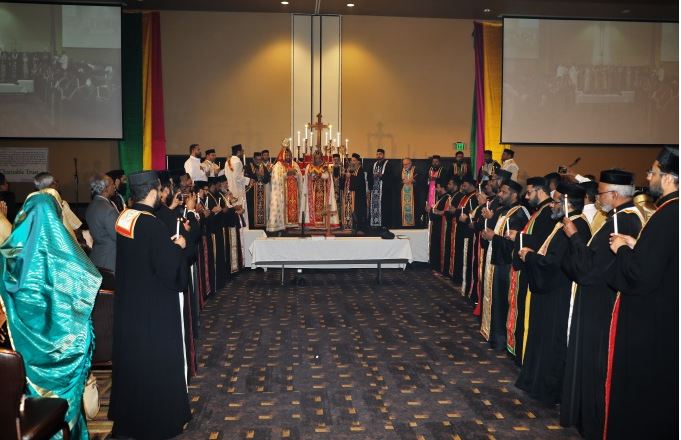
The clergy processed into the Convention Center where the Archbishop chanted the hymns of praise and officially started the gathering. As we processed the people greet the collection of clergy with soft songs and shining lights. I was overwhelmed with emotions when I first saw the name of the event on the posters decorating the Convention Center wall. The gathering was called “Youth and Family Conference.” It may seem like a small matter but in that small gesture of placing the youth ahead of all else, the church and its leadership, from archbishop to priests, lay-leaders to volunteers, was making a bold statement about their priorities: The youth are first and foremost.

The comparisons between both our communities – Armenian and Indian – are striking. Issues that we struggle with in the Armenian Church – such as culture and religion, language, assimilation, relevancy – are part of the common conversation. The Indian Orthodox Community, they told me, came to America in the 1970’s, about 70 years after the first Armenian communities were established here. Many of the challenges we encountered during the first few decades of our church’s life in the New World are the ones they feel today. In a very real sense, while speaking to many of the members of their church I felt as if I was looking at the church of our grandparents. We are here in America with new sets of rules and conforming to the societal pressures while trying to remain steadfast to the values and traditions that uniquely define us and give our lives meaning. While in this “time-travel” state I was hoping that reciprocally, in me they would have an opportunity to peer at the church of their grandchildren. There is a lot to learn from each other. While the Armenian Church has been here almost twice as long, ironically it still struggles with the hurdle of language – a hurdle which the Indian community has jumped and, as we witnessed, the youth participate at a very real level of engagement in the liturgies and prayer services.

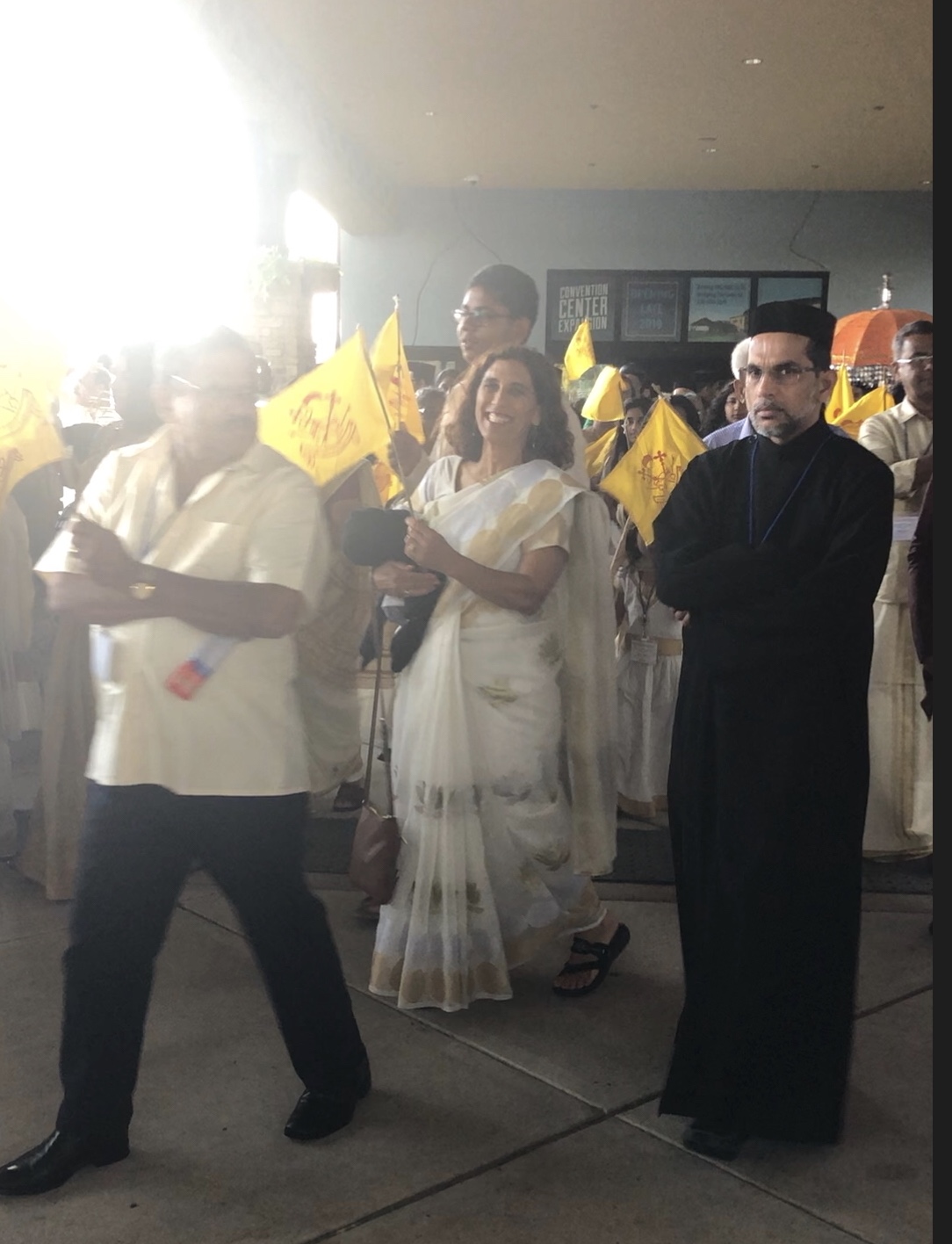
Susan during the parade


The theme of the week was “Living a life worthy of the Lord” (Colossians 1:10).  I had a chance to present three different lectures/discussions, one on the concept of Lord-worthiness, another on the challenge of the Cross in the worthiness walk, while the last talk was intended to empower youth in activism.
 
In the 1990’s, while serving as the Parish Priest at the St. Andrew Armenian Church in Cupertino, I was approached by a group of Indian Orthodox asking if they could use our church sanctuary while their church was being built. With the permission of our Primate, they would come every Sunday following our service and worship in our sanctuary for about a year. When the church was completed, a high ranking cleric came from India to dedicated and consecrate the building. I was invited to the ceremony and took my place in a humble location, not to interfere with the proceedings. Suddenly I was asked to come forward and meet His Holiness. I was not expecting this honor and felt the anxiety of the moment. I greeted him and kissed his hand. He then did something which not only will I never forget, but it gave me a direction for my own ministry.
With His Eminence Archbishop Titus


In front of the hundreds of parishioners gathered inside the new church, His Holiness took off his Pontifical ring, the ring of authority, and handed it to me. Puzzled, I looked at him for an explanation. He then asked me to read the inscription inside the ring. To my surprise, it was written in Armenian! It was gift given to him by the late Catholicos of All Armenians, His Holiness Vazken I, of blessed memory. He said he wore this ring given to him by his “brother-in-Christ” because it is a constant reminder of the plight of the Armenian people. He went on to explain to all of us by pointing to me and thereby to the Armenian Church saying that the Indian Orthodox had always enjoyed a place of respect in their country. “We have never known Christianity through suffering. The Armenians, on the other hand, have never known Christianity without suffering! We must be aware of their story.”
There it was. His Holiness’ words were given to the community to listen and learn, to me, they became an invitation to present the message of the Cross – the story of suffering and sacrifice – as witnessed by the Armenian people.
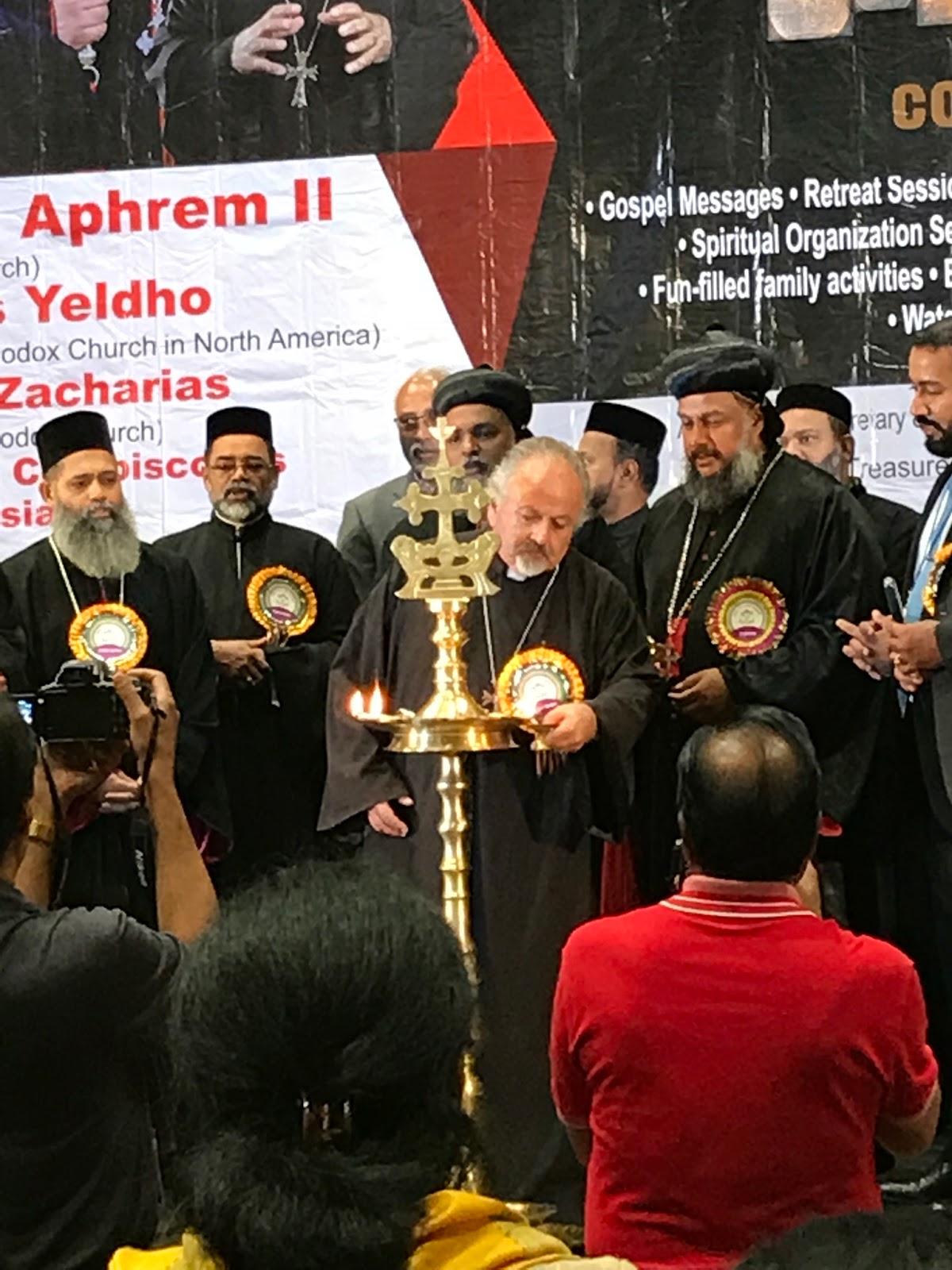
During the Opening Ceremonies

Those words became my motivation to bring the dimension of outreach and healing to my ministry. And here, a quarter of a century later, I had a chance to share the Gospel message, as it passed through the Armenian people and Armenian Church, to our brothers and sisters in Christ. Personally, this was a very humbling and spiritually rewarding experience.

 
The last evening of the Conference was a celebration and sharing of culture. We enjoyed dances, songs and cheer. The week came to an end with the celebration of the Divine Liturgy. We prayed, sang, worshipped and communed in the One Single Faith that unites us all: Our Lord Jesus Christ.
 
I passed along the greeting of our Primate His Eminence Archbishop Hovnan to the head of the Malankara Archdiocese, His Eminence Archbishop Titus and thank them both for this opportunity to share our Faith. During the Divine Liturgy Fr. Joel Jacob, one of the young priests who was part of the organizing committee, placed a priestly stole around my neck so that I may participate in the Celebration. Following the service, as I folded the holy vestment to return it, he said it was mine to use whenever I attended a Malankara Orthodox service. It was a gesture which reflected the warmth and hospitality we enjoyed with our brothers and sisters.
 
-Fr. Vazken Movsesian
 
To learn more about the Malankara Orthodox follow these links

More Pictures

Processing the Poconos

Next Step #530: Following through on an order: Fr. Vazken recounts an “order” that was given to him a quarter-of-a-century ago (Cupertino) and the blessing found among Oriental Orthodox Christians gathered in the Poconos. The Gospel of Suffering & the Cross. Articulating goodness & blessings with our greetings and embraces. The sound of the Youth of Orthodoxy.
Malankara Orthodox Church
Youth & Family Conference Schedule
Press Release on Conference
Fr. Vazken’s Blog on the Conference
Larry Tart’s Page
Freedom through Vigilance by Larry Tart
Grape Blessing Instruction
Grape Blessing – AC101
Engineered by Ken Nalik
Produced by Suzie Shatarevyan for InHisShoes.org
Subscribe to In His Shoes » Next Step with Fr. Vazken by Email
Look for The Next Step on blubrry.com
Listen via Stitcher Radio on demand!

Poconos

Next Step #529: “Living a Life Worthy of the Lord” (Col 1:10) thoughts from the Poconos at Youth and Family Conference of the Malankara Archdiocese of the Syrian Orthodox Church. Incident in Armenia and Lincoln Nebraska 60 years later. Lessons in miseducation: the ease of fighting for religion rather than living faith.
Malankara Church Music
The Malankara Archdiocese of the Syrian Orthodox Church
Shootdown incident – 1958 in Armenia
Colossians 1
Monsters on Maple Street
The Day After
Kalahari Resort in Poconos
Engineered by Ken Nalik
Produced by Suzie Shatarevyan for InHisShoes.org
Subscribe to In His Shoes » Next Step with Fr. Vazken by Email
Look for The Next Step on blubrry.com
Listen via Stitcher Radio on demand!

A Spare Pair


Next Step #528 – July 19, 2018 – Stories inspire us on many levels. Some are true stories of individuals who share the gift of God with us all, others teach with metaphors. Fr. Dajad Davidian (1934-2018) is remembered for his ministry and inspiration. Thoughts from Walden Pond, Thoreau and Jethro Tull’s 1973 release of the “Hare Who Lost His Spectacles” are the food (savored this time around) for thought in this week’s edition of the Next Step.
Komitas Medley by Anush & Inga 
Fr. Dajad Davidian Remembered
Our 2014 Meeting 
Passion Play Lyrics
Hare Who Lost His Spectacles
Pashinyan Democracy – Time Magazine
Hans Christian Anderson’s Emperor’s New Clothes
Syriac Orthodox Conference
Cover Art: (c) 1987 Anush Avejic ~Essentially Anush
Engineered by Ken Nalik
Produced by Suzie Shatarevyan for http://InHisShoes.org