The Blame Game: Expulsion

Armodoxy for Today: The Blame Game

In his 1970’s TV variety show, Comedian Flip Wilson developed a character named Geraldine Jones, a sassy and liberated Southern woman who, when caught doing something naughty would respond, “The devil made me do it.” In behavior that would be considered tame by today’s standards, those words would be her excuse and would trigger thunderous roars of laughter, and serval blushed faces among parents watching the weekly family show with their kids.

Even farther back in time, the Bible references God catching Adam and Eve in disobedience to his law. The “naughty” moment for them (Genesis chapter 1-3) is when they come to realize that they are naked in the Garden of Eden because their act of disobedience opened their eyes. Genesis chapter 3 reads Adam conversing with God, “I was afraid because I was naked; so I hid.” And God said, “Who told you that you were naked? Have you eaten from the tree that I commanded you not to eat from?”  The man said, “The woman you put here with me—she gave me some fruit from the tree, and I ate it.” Then the Lord God said to the woman, “What is this you have done?” The woman said, “The serpent deceived me, and I ate.”

And the rest is history. What is called “The Fall” follows. God outlines the expulsion of man and woman from paradise in the verses that follow.

“The Devil made me do it!” It was convenient escape clause for the first man and woman as it was for the comedian entertaining on his variety show. And it can elicit the same type of laughter.

Faith is not to entertain us. It’s not make believe. Playing the blame-game, is an immature way of escaping responsibility. Think of it for a moment, if the devil makes you do something, then you are not accountable for your actions. The Devil made me do it! Blame the devil! Blame the woman! Blame the man!

During the Lenten season we are seeking to mature in Faith, or as St. Paul says, “When I was a child I thought as a child, I spoke as a child, I reasoned as a child. But when I became an adult, I put away childish ways.” (I Corinthians 13)

Expulsion Sunday is a call for us to take responsibility for our actions and our deeds. In other words, no one makes you do it. You do it because you want to do it. We journey deeper into the Expulsion tomorrow.

Expulsion Excerpts

Armodoxy For today, expulsion Sunday

This Sunday of Lent is called expulsion Sunday. When looking at the Gospel passage prescribed to us by the Church Fathers, we understand that we are being called to a more mature understanding of our faith and our responsibility as children of that faith.

Expulsion refers to humanity’s exile from Paradise, as told in the book of Genesis. Interestingly enough, the Scriptural passages for the day from both Romans 9 and 10 and Matthew chapter five, all point to our practicing the Gospel of Love as presented to us by Jesus Christ as I read the Gospel passage, listen carefully to what Christ is asking of us. The entire passage is from Matthew chapter five, verses 17 through 48 I will read an excerpt.

Jesus says, You have heard that it was said to those of ancient times, you shall not murder, and whoever murders shall be liable to judgment. But I say to you that if you are angry with your brother or sister, you will be liable to judgment.

So when you are offering your gift at the altar, if you remember that your brother or sister has something against you, leave your gift before the altar and go, First be reconciled to your brother or sister, and then come and offer your gift.

You have heard that it was said you shall not commit adultery, but I say to you that everyone who looks at a woman with lust has already committed adultery with her in his heart.

You have heard that it was said from ancient times, you shall not swear falsely, but carry out the vows you have made to the Lord. But I say to you, do not swear at all.

You have heard that it was said An eye for an eye and a tooth for tooth. But I say to you, do not resist an evildoer.

You have heard that it was said, You shall love your neighbor and hate your enemy, but I say to you, love your enemies, pray for those who persecute you, so that you may be children of your Father in heaven, for he makes his sun rise on the evil and on the good, and sends rain on the righteous and on the unrighteous.

As I mentioned earlier, this is merely an excerpt from the entire Gospel passage, and I hope you will take some time to read the entire passage here, you understand that there is a law, but Jesus’s message is higher than that law. It is the fulfillment of that law. In other words, you know the law, but there is a higher standard, one that Jesus gives to us, one which he summarizes at the end of the passage by saying, “Be perfect, as your heavenly Father is perfect.”

So we are responsible for how our lives are lived. You see in the book of Genesis, in the story of the expulsion, the blame game was played, first by the woman, then by the man, then by the tempter. The woman made me do. It says the man to God who questions man’s disobedience, the serpent made me do. It says the woman, what Jesus tells us is, you me, we are all guilty of doing it. This week, we’ll take a closer look at that sin, what it means to us during the Lenten journey, how we deal with it, and what it means in our lives as Christians,

A 316 Sentence Meditation

Armodoxy for Today: Meditation on a Sentence

John 3:16, which is has a unique notoriety among different generations and people of different backgrounds, is often referred to as the Gospel in brief. The marking, which colors t-shirts and baseball caps, and can be found on business cards, and fast food containers is shorthand, to inform people that a believer is close by. “For God so loved the world,” begins the verse that ends with the glorious explanation, “that He gave his only Son, so that everyone who believes in him may not perish but may have eternal life.”

To claim this passage as “The Gospel in brief,” says more about us, people, than it does about the words and expression. We are all too quick to find shortcuts around anything that might take an investment of time and resources. Why read the book if I can skim the outline? Why skim the outline, if I can watch the movie? Why watch the movie if I can read the review? And we finally come down to; can I consolidate it in a quick sentence?

Still, John 3:16 does have a certain popularity that is not avoidable. So, during Lent, when we are investing more time into our spiritual wellness, let’s see what it says.

John 3:16 is simple enough. God loves so much that He gives us His Son, Jesus Christ. The challenge comes from the second part, which involves believing in His Son. What does that mean? Is belief merely acknowledgement that Jesus existed, or even more, exists? Or is there something more demanded of us?

God so loved us, He came to us. The invitation is for us to return to Him, to Love Him so much, to give our lives to Him. Through prayer we connect with God, through actions our prayers are materialized and through commitment and sacrifice we find the way to not perish and have eternal life.

We pray, O Lord Jesus Christ, I believe in You. May those words come alive in me by the measure of my actions to love, care and assist my neighbor. Amen.

Symbols that Point

Armodoxy for Today: Symbols that Point

Lent Day 4

The first Wednesday of Lent in the Eastern Tradition is known as Sad or Sorrowful Wednesday. In the Western Tradition it is known as Ash Wednesday. There is no special designation to the first Wednesday of Lent in the Armenian Church tradition.

Each community of believers have unique sets of traditions and activities that help them focus on the essentials of their Faith. When entering an Armenian church, it is hard not to notice the candles that are lit by the faithful in different niches provided throughout the building. The candle, in itself, is a pointer to something greater. We call these symbols. They point to something that is unexplainable.

God said, “Let there be Light” on the first day of Creation according to the Genesis story. How do you understand light when according to the same story, the Sun and stars were not created until a few days later? Jesus says, “I am the Light of the World. Whoever follows me will never walk in darkness but will have the light of life.” (John 8:12)  In lighting a candle at church, we are invited to meditate and contemplate these ideas. The candle reminds us that as long as there is light at its tip, there is no darkness. So too, Christ brings Light – the eternal Light – to the darkest places in life.

Ashes are there as a pointer to one of the basic theme of Lent, namely, that this life is much more than the physical. As God tells Adam, “for dust you are and to dust you shall return,” the ashes remind us that our origin as humanity is from the earth and the inevitability of death.

Symbols are used by various traditions to help us focus on thoughts and concepts that are bigger than us.

Our prayer today is a simple one from Psalms, Let my prayer be counted as incense before you, and the lifting up of my hands as an evening sacrifice. (141:2)

Necessary Steps: Lent

Armodoxy for Today: Necessary Steps

I saw a performance by Paul McCartney this morning. It was in a sold-out stadium somewhere in the world, which is usual fare for him. The cameras were being switched between McCartney, his band, the audience and wide angles covering the large arena.

He was wearing a t-shirt with writing on it. The words “No more…” at the top of the shirt caught my eye. For a moment there I thought, how appropriate at the beginning of the Lenten season to be advocating for vegetarian diets. He’s known for being a passionate advocate for plant-based diets, promoting animal rights and environmental sustainability. Lent? Meatless diets? No, there was a greater message underneath the words.

NO MORE LANDMINES, yelled out the words on his shirt.

Landmines: they maim and injure people with lifelong scars, both physical and psychological. I remember a few years back, spending a few days at the Halo Trust in Artsakh and learning how they meticulously and methodically, one-by-one cleared the fields of these vicious weapons of war.

I wondered why McCartney hadn’t opted for the bigger issue of “No More War”? Why stop at landmines? And then I caught myself. It’s just a t-shirt with a message.  It’s the message he wanted to spread. It was a message I aligned with, but he was the one wearing the shirt, not me.

As we begin the Lenten season, we are called to use this period of the Lent, the 40 days to prepare ourselves for the bigger picture, namely life. Much in the same way that getting rid of a landmine is a process toward a bigger goal, the forty days of Lent are not an end in themselves. They prepare us for the 325 days that follow, that is, our lives. Lent is our m means to methodically evaluate our lives and selves to better function in this world in harmony and peace.

Pray today for strength and patience, as we take the small steps of fasting and introspection to deliver us to a more productive and blessed life. To borrow from the Taoist tradition, we keep in mind that a journey of a thousand miles begins with a single step.

God is with us

Armodoxy for Today: For God is with us

Today’s message comes to us from Archbishop Hovnan Derderian.

Lent is a journey of transformation. It is a return to God, a healing of the soul, and a preparation to encounter the risen Christ. It invites the faithful to move from repentance to renewal, from struggle to resurrection, and from death to life. Lent begins with honest self‑examination, something each of us can practice in the quiet moments of our daily lives—at home, at work, and within our families. Through prayer, God grants us the courage and wisdom to cleanse our soul and mind, making our heart a worthy dwelling place for Him.

“For God is with us.”

Each morning, I repeat these words as the prayer of my heart. They remind me that God walks with us through every ordinary and extraordinary moment of life. I thank Him for guiding my thoughts and steps, helping me strive toward a pure and meaningful life.

In God alone we find true peace and purpose. When we live with the awareness of His presence, we are embraced by His loving care, and our hearts are filled with a joy that words cannot fully express.

“For God is with us.”

Choose one moment tomorrow—morning, midday, or evening—to quietly repeat “For God is with us” and let it center your thoughts, guiding you to live with peace and purpose throughout the day.

From Archbishop Hovnan Derderian’s 2026 Lenten Meditations. Archbishop Hovnan serves as the Primate of the Western Diocese of the Armenian Church of North America.

Lent is Here!

Armodoxy for Today: Lent is Here

GREAT LENT – A Primer

Watch for Daily Messages – Armodoxy for Today – to guide you through this important period of time, or check out the many Lenten program from the vast Epostle library, including 40 days to healing, 40 days to the Divine Liturgy, and 40 days of the Lenten Journey

2026 Lenten Messages begin on Monday, February 16 at Epostle.net

Check out – 40 Recipes – Meatless Vegan Meals by Deacon Varoujan

What is Lent?

The period just before Holy Week is called Lent. It is a time for reflection and self-evaluation. The Church guides the individual believer through this period by offering means of self-discipline and instruction.

When?

Lent begins on the Monday following Poon Paregentan (Day of Great Living) and continues through the Friday before Palm Sunday. This year Great Lent 2026 begins on February 16 and ends on March 27, 2026 just before Holy Week.

The Purpose

During the 40-day period of Lent the believer is called to taper life down to the bare essentials. You should ask yourself what is really necessary to live? You’ll find that much of life is made up of excesses, which clutter our lives and our values. When tempted in the wilderness, our Lord Jesus reminds us that “One does not live by bread alone, but by every word that comes from the mouth of God.”

Dietary Restrictions

Part of the Lenten journey involves “giving up” certain foods. In the Armenian Church you are called to abstain from all foods that come from animals. This includes all animal products, including flesh meats, milk & dairy items, eggs, fowl, poultry, fish, etc. – anything that comes from an animal! Find Lenten Recipes! 40 of them

Diet is only one small part of the Lent. Jesus instructs us, “It is not what goes into the mouth that defiles a person, but it is what comes out of the mouth that defiles.” (Matthew 15:11)   In this spirit, the individual believer is asked to inspect the content of his or her character and act in charity.

The Most Essential

Certainly, LOVE must be at the focus of your Lenten journey because it is the one ingredient of life that gives meaning and purpose to our existence. Love is the necessity of life that needs to be cultivated and nurtured during Lent so that it becomes the main purpose of existence after the Lenten period. While abstinence and restrictions are one part of Lent, the greater task for the believer is to be in love and harmony with his or her family, friends and nature.

Church Services

Even the physical church in the Armenian Church changes in outward appearance during Lent. The curtain is drawn across the altar to remind us that sin prevents us from truly enjoying God. The prayer “Havadov Khosdovanim” (= I Confess with Faith) is offered in particular. St. Nersess Shnorhali, the 12th century Catholicos, wrote this set of 24 prayers and they are considered among the most powerful prayers in the Armenian Church. By following the services, practices and prayer life of the Armenian Church, the believer comes to find the most essential of life’s joys. Peace through God is understood and Lent becomes a prelude to true Christian experience.

Lenten Sundays

Each Sunday of Lent has a unique name along with a unique message:

  • February 15 – Poon Paregentan – A day of good living, to remind us how God wanted us to enjoy life and His blessings. (Read Matt. 5-7)
  • February 22 –Expulsion Sunday reminds us of how sin enters into our lives and prevents us from experiencing the best of life and God’s fullness. (Genesis 1-3)
  • March 1 – Prodigal Sunday – The story of the Prodigal Son instructs us that no matter how much we stray from the good of life, there is always hope to be one with God. His love is unending and unconditional. (Luke 15:11…)
  • March 8 – Steward Sunday – God has given us a life full of responsibilities. How do we manage our lives, our families and ourselves? (Luke 16)
  • March 15 – Judge Sunday – Perseverance and the need to be in constant communion with God is revealed through an unjust and unrighteous judge who is the center of this day’s message. (Luke 18)
  • March 22 – Advent – Christ returns to Earth to judge the living and the dead. How can we be prepared? Listen to the message of his first coming! (Matthew 25)
  • March 29 – Palm Sunday – We enter Holy Week. The triumphant entry into Jerusalem by our Lord also signals the beginning of the holiest days of Christianity. (Matthew 26 & on)

Mountain Talk

A Conversation with Father Vazken Movsesian and Gregory Beylerian on Identity, Creativity, and the Mystery of Being.

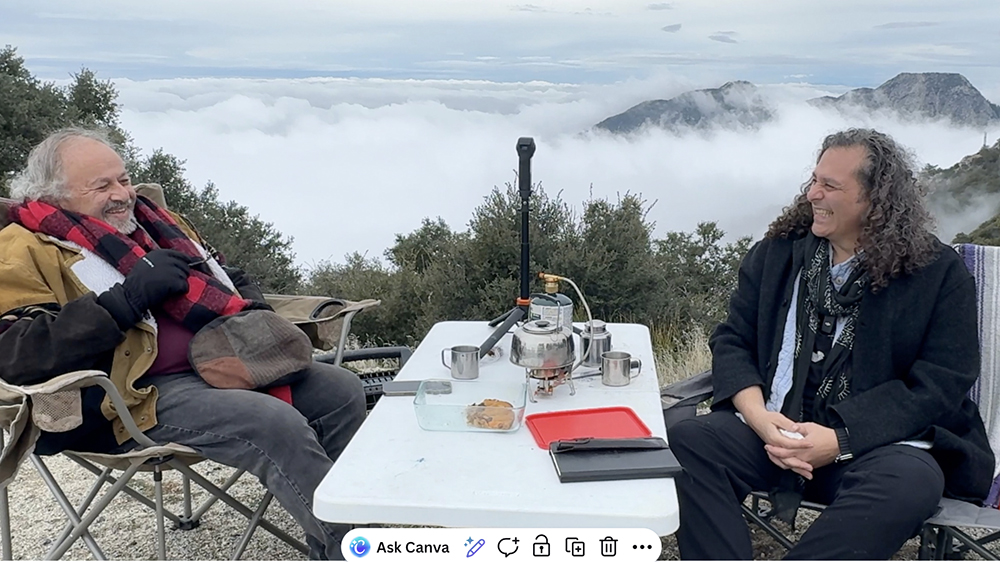
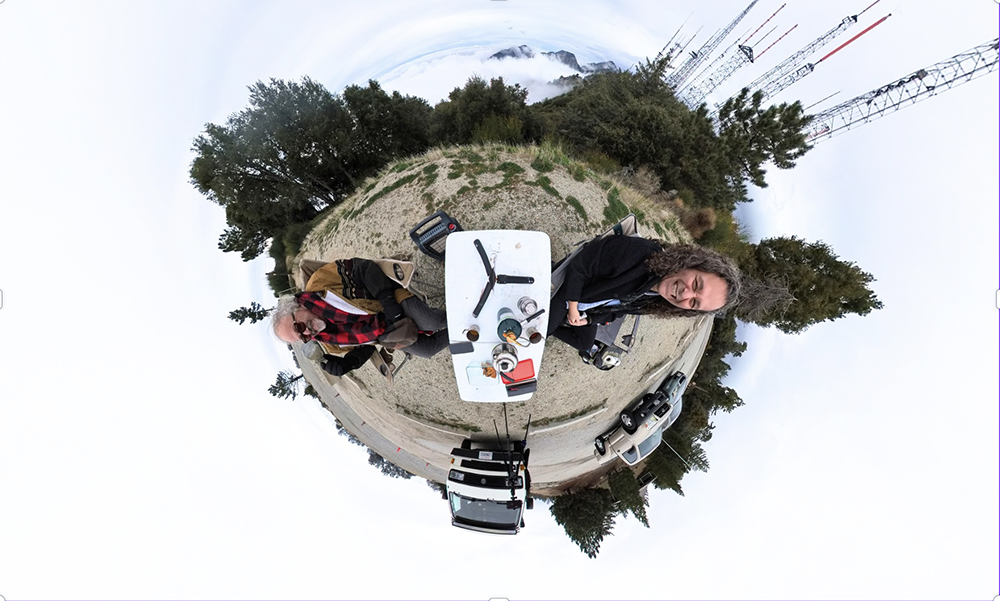
On a quiet mountaintop overlooking the vastness of creation, Father Vazken Movsesian and artist Gregory Beylerian shared tea and reflection, an unscripted exploration of life, identity, spirituality, and the state of humanity. What emerged was a deeply human conversation, rich with humor, humility, and insight into the challenges and beauty of modern existence.

Roots and Identity

Their dialogue began with something simple, homemade rojig, a sweet made from Armenian grapes grown in Pasadena. From there, they explored the meaning of cultural connection and belonging. How does identity shape who we are, and how can it both liberate and limit us?

For both men, identity is not merely ethnicity or history, but a living bridge between past and present. As Father Vazken observed, “It’s not only for yourself, but in defining who you are in the bigger picture.” Gregory expanded the thought, recalling how ancient Indian mystics once taught children to identify first with the cosmos, to root their identity in the whole of creation before nation or tribe. Such a perspective, he said, inspires unity rather than division, compassion instead of competition.
Living in the Now

Father Vazken reflected on how religion often misdirects people’s attention toward “a time to come,” missing the spiritual essence of the present moment. “Jesus wasn’t teaching about something far away,” he said. “He was showing us how to live right now, peace on earth, goodwill toward one another.”

Gregory connected this with the need to evolve beyond survival thinking. Humanity’s progress, he suggested, requires cooperation, mirroring the harmony already present in nature. “Nature doesn’t show survival of the fittest,” he said. “It shows a cooperative relationship. That’s the wisdom we’ve forgotten.”

Education, Creativity, and the Human Spirit

Their conversation naturally turned toward education, how systems built on competition stifle creativity and curiosity. As a teacher and parent, Gregory lamented how children’s innate creativity is often the first thing cut from school budgets. “The art class isn’t just for making Picassos,” he said. “It’s where problem-solving, innovation, and social vision are born.”Father Vazken agreed, describing education not as a means to make money, but a way to connect, understand, and participate in the human story. “Education’s purpose is knowing that you’re not alone here, that you’re part of something bigger.”

Mass Formation and Higher Intelligence

Gregory introduced the concept of mass formation, the way collective consciousness can be manipulated when intellect is disconnected from higher intelligence. Propaganda works not because people lack intelligence, he explained, but because their awareness is confined by identity.

He drew a distinction between intellectual and divine intelligence: “Our intellect can be shaped by the world, but imagination, the higher mind, connects us to creation itself.” Father Vazken reflected that the danger lies in forgetting vision. “Where there is no vision, the people perish,” he said. “Knowledge is important, but that’s not education’s purpose. It’s about learning how to live, connect, and find meaning.”

The World at a Crossroads

Their conversation moved to the state of the world, war, environmental degradation, and political corruption. Both men agreed that humanity has the resources to heal these problems, yet lacks the creativity and moral vision to apply them. Father Vazken spoke passionately: “We fight fire with fire, and that just makes more fire. We’ve convinced ourselves there’s no other way, but there is.” Gregory noted that despite our technological evolution, consciousness has lagged behind. “We’re entering a time when people are waking up,” he said. “Maybe this isn’t a revolution of violence, but a revolution of awareness.”

The Return of Myth and Meaning

Gregory invoked Joseph Campbell’s reminder that societies survive through their myths, living stories that help people understand who they are and where they’re going. “Without vision,” he said, “a culture perishes. We need to retell the old stories in new ways.”

Father Vazken agreed: “Without relevance, even religion loses purpose. These stories were created to help us explain the mystery, to remind us of something beyond ourselves.”

They discussed the vastness of creation, from the first spark of light to the latest discoveries of modern science. “This isn’t just a 2,000-year-old story,” said Father Vazken. “It’s a 13-billion-year-old one. Everything we see, all of it, is part of that same beginning.”

The Hero’s Journey

Gregory reflected on Campbell’s Hero’s Journey as a metaphor for spiritual awakening. “You leave the comfort of your village, your security, and face the unknown,” he said. “The monsters you meet are really your own fears. When you conquer them, you return to your community with wisdom and gifts.”
Father Vazken added that different traditions describe this same journey in different language, “Follow God’s will,” “Listen to the universe.” , Gregoy responded “ ahh, trust the flow”. Each points to the same truth: we are guided when we open to mystery.

Eh, The Presence of Being

Among the most profound moments in their mountaintop dialogue was the exploration of the ancient Armenian letter “Eh” (Է), a symbol carved for centuries above the altars of Armenia’s oldest churches.

Gregory recalled asking Father Vazken what the mysterious sign meant, seeing it over and over in monasteries built atop mountains and inside caves. “It’s Eh,” Father Vazken explained, “the verb to be in the present tense.” In that one syllable lies the heart of Armenian spiritual philosophy: presence. It is not a noun or a static identity, but an active state, being.

Father Vazken described Eh as the essence of reality itself. “It is the ultimate verb, the living now,” he said. “Everything else passes. The past is gone, the future may not come, but this moment, this presence, is real. This is where life is.”

Gregory reflected that this symbol captures what mystics and teachers across traditions have tried to convey for millennia: the invitation to be here now. From the teachings of Jesus to the insights of Eckhart Tolle, the message is universal, the eternal resides in the present.

They both noted how children embody this truth effortlessly. “A child lives in the eternal,” said Father Vazken. “They wake up to a new day without carrying yesterday. What a beautiful way to live.” In this way, the Eh becomes more than a letter, it is a map back to consciousness, a reminder that God, existence, and awareness all meet in the same timeless point: Now.

The Power of Mystery and Presence

Both men concluded that the greatest loss of modern times is our comfort with not knowing. “We’ve forgotten how to live with mystery,” said Father Vazken. “Not everything can be solved or Googled.”

Gregory emphasized the need to remain open, to cultivate a “beginner’s mind,” even after decades of experience. “That’s how discovery continues,” he said. Their conversation ended as it began, simple, grounded, human. They spoke of the wisdom of children, who live fully in the present, unburdened by yesterday or tomorrow.

A Shared Vision

As the sun dipped below the mountain, their tea cooled, and the conversation settled into silence. Two friends, a priest and an artist, had traced the arc of human experience, from cosmic identity to earthly compassion, from intellect to mystery. In their exchange was a quiet reminder: that the way forward for humanity is not through more technology or ideology, but through awakening the heart, nurturing creativity, and remembering our shared belonging in the great cosmic story, in the eternal Eh of being.
Screenshot


 

Vartan, tbd

Armodoxy in Today: Body and Soul

Partners in mission, Leon (Ghevont) and Vartan, are noted for bringing the light to the darkness. Following on yesterday’s theme of Spirit and Flesh, today we look at the body with its soul. Of the two friends, brothers in Christ, Vartan was the warrior. He was the body with soul, a spirit that was grounded in his beliefs. The story of Vartan gets told and retold from generation to generation, from 451AD to today.

Armodoxy asserts that you cannot impose your beliefs on anyone else. Armenians have never pushed their faith on others. This is not a sign of apathy, sloth or weakness, it is an expression of tolerance and understanding. However, when it came to the practice of their faith, the Armenians would not give it up, even if the consequence was death.

To the Persians who were imposing their faith on Armenians, Vartan and the Armenian forces responded, “From this faith [Christianity] no one can separate us, neither sword, nor fire, nor any other force.” Armenians make the point of remembering that they were outnumbered on the battle field by a ratio of 3:1. With over a thousand Armenian casualties, Vartan fell.

I don’t believe there is another group of people on the planet that celebrates a military defeat. This was the first time anywhere that a battle was fought for the defense of Christianity. And the mere fact that the Armenian Church exists today and is the center of the Christian tradition of the Armenian people, is proof that the battle was lost but the war was won.

The historian Yeghishe records that Vartan and his soldiers took an oath, We are ready for persecution and death and every affliction and torture for the sake of the holy churches which our forefathers entrusted to us by the power of the coming of our Lord Jesus Christ, whereby we were reborn ourselves by torments and blood. For we recognize the Holy Gospel as our Father, and the apostolic universal church as our Mother. Let no evil partition come between us to separate us from her.

Remembrance of the saints Vartan, Ghevont and those who sacrificed their lives as an act of defiance, is a reminder that our faith in Christ cannot be compromised. In a sense, the Battle of Vartan, 451AD is a page of history that has a comma at the end of it, to be decided in the Battle of Vartan in the 21st century. For we recognize the Holy Gospel as our Father, and the apostolic universal church as our Mother. Let no evil partition come between us to separate us from her.

Let us pray, “Lord, our God, through the intercession, memory and prayers St. Vartan and St. Leon, who lived and died for Jesus and the Fatherland and whom we commemorate today, grant us the gift of peace and of your great mercy. Amen.”

Angels before Valentine Day: Two Friends

Armodoxy for Today: Spirit & Flesh

Angels are flying and hovering all around us on Valentine’s day, and mostly of the chubby little cherub variety. With arrow drawn, Cupid takes aim at the heart twixt lovers. As for the other variety of angels, they’re called seraphim, they’re flying with their six wings in service to God.

We have developed quite an imagery of angels. Ironically, angels are spiritual beings, that is, they do not have physical attributes. Go ahead, look it up. Angels are spiritual beings. They are the messengers of God. We ascribe physical traits to them for convenience so that we can form an idea of what a spiritual being may look like.

It is the human being, who above angels, has been gifted with both spirit and body. Often, it is the struggle between spirit and flesh that is highlighted in many religious stories, especially in the Bible. Today we will look at the power found in bringing spirit and flesh together.

Over these two days preceding Great Lent, the Armenian Church commemorates two saints, who were contemporaries, brothers in Christ, and responsible for the continuity of the Armenian Church and therefore the nation. One is St. Leon the Priest (Ghevont Yerets), and the other is St. Vartan Zoravar (the Warrior).

In the 5th Century, the Battle of Avarayr was fought between the Christian Army, under commander Vartan Mamikonian and the Perian army. This was the first time anywhere that a battle was fought for the defense of Christianity. It led to the signing of a treaty in 484 which affirmed Armenia’s right to practice Christianity. This is the single most important and significant event in Armenian history and for this reason, St. Vartan is recognized by the Church but also by the people, as a national hero.

His friend and priest, St. Leon, is often forgotten, though his impact on the Battle and thus the victory, is recognized by all historians, as essential. The Church recognizes the two over the course of this week and emphasizes the importance of spiritual practices combined with physical prowess to overcome the worst of difficulties. More specifically, for us, we pray to God, but in the end, it is on our physical strength that we count on to stand or walk, to reach out or voice ourselves. In our daily struggles, the example of St. Leon and St. Vartan teach us how to balance the spirit and the flesh to achieve our goals. This then, becomes a prelude to the Lenten Season.

Tomorrow we will look closer at St. Vartan.

One of the more recent manifestations of the Divine presence in our lives was in 1968 when the Cathedral (the headquarters of the Diocese) in New York was consecrated in the name of St. Vartan. Forty-two years later, when the Cathedral in Los Angeles was to be consecrated a philanthropist came forward and asked that it be consecrated using his father’s name, which happened to be Leon, and so it was in 2010. Some may call this coincidence. Others, like me, want to believe it is God’s special messenger letting us know, the Armenian Church in America, is protected from coast to coast by St. Leon and St. Vartan, as they have for centuries.

Let us pray, “Lord, our God, through the intercession, memory and prayers St. Leon and St. Vartan, who lived and died for Jesus and the Fatherland and whom we commemorate today, grant us the gift of peace and of your great mercy. Amen.”