Memories of Purity: Thoughts at a funeral
Memories of Purity
Some thoughts and ties following a funeral…
by Fr. Vazken Movsesian
No matter how many or how often I have officiated at funerals, I cannot get used to the funerals of the young – those who leave us before their time. It’s been over 40 years that I’ve been officiating or serving at funerals.
The first time that I stood in front of a casket offering prayers, was for my friend Brad’s father. He died of cancer. Not yet ordained as a priest, I served as a deacon at that service. For many of us who were just coming of age, this funeral was a rude awakening to the limits on our existence and the finality that death brought to that existence. The funeral service was perhaps the most tamed portion of the entire death ordeal. In our collective memory is the death scene, the illness, the hospital machines and the crying and sadness that surrounded his passing.
Sadly, through the years, I’ve had to officiate at several of these young-death funerals which are in stark contrast to those who die of natural causes. Such are the funerals of those that have lived their lives to a ripe (by our standards) old age and have led a full (by our standards) life. Thanksgiving is as natural as the death which brought the end to their life. In thanksgiving we come to terms with death and are thankful for the quantity and quality of life the person spent with us. Sure, there is sadness in the passing of a loved one, but we reconcile with the loss by cherishing the full life they led.
The funerals at which thanksgiving is not the first word we utter, are of those who have died a tragic unnatural death. Children who overdose on drugs, accidents, suicides and sudden death to disease are in this category. I’ve stood with families as children were ripped from their embrace. I’ve even tried to console (if possible) the families of murder victims.
As tragic and devastating as unnatural death is, the deaths brought about by cancer, I place in a separate category. When someone dies of cancer, we, family and friends — and I consider myself as both family and friend to them — become witnesses, and therefore participants, in the dying process. We are involuntarily given a chance to watch the destruction of life, almost as if we are witnessing a gunshot video which has been slowed down so much so, that we watch the bullet enter, devastate, and finally kill the body over the course of months, sometimes years. Time has slowed down on that bullet so much that we have an opportunity to pray, to try to deflect and change the outcome of the shooting. Just like a sudden accident, a murder, or death by drugs, we know cancer can happen to anyone, no matter how much Vitamin D we ingest and regardless of whether or not we quit smoking 30 or 40 years ago, or never smoked at all. These types of death can happen to anyone. But unlike the rest, in the case of cancer we want to believe that we can divert the bullet because we have time to do so. And because we’re watching that bullet enter the body in slow-motion, we live with hope that the trajectory of the bullet will be off course. We pray for an alternate ending and when in the end cancer does physically take its victim, we are left with a multitude of thoughts and feelings to sift through.
The first time I had to deal with these cancer-generated thoughts was in my first parish in San Jose. I was a priest of only a few years and though I had stood with and eventually buried cancer victims on a few occasions, dealing with Aida was different. She was 25 years old when she succumbed to the disease. I visited her at her home, while stretched out on her living-room couch and enduring horrid pain. To this day, over 35 years later, I remember the expression on her face and the acceptance in her eyes as we prayed together. Her short life shared a lesson in hope and her death revealed the truth of the unfairness of life. At her funeral I remember talking about terms such as faith, hope and love, while feeling slighted by the terms of her life. I dealt with an anger that continues to this day as a part of my bag of emotions. I keep Aida in my heart every time that I have had to minister to someone fighting cancer and every time I have had to stand before the grave of one who has been victimized by this horrid disease. Aida was only eight years younger than me, and like a younger sister she has journeyed with me through my ministry. I personally keep her alive to help me, and therefore help others, as they come to terms with their mortality.
Aida’s family asked me if I’d help write the message on her gravestone. This is the message that outlasts your life. On Aida’s gravestone that dash between the year of her birth and year of her death was too small, so small that it angered me, and angers me when I hear people complain of being shortchanged in years after eight or nine decades of life. It is not ours to decide on how many years are enough. Even after 85 or 95 years, one more day is welcomed by most, lest they be suffering in intolerable pain. It is not ours to decide, but still, I am human and I was frustrated when I watched this young child lose her battle. There was nothing I could do to change the ending of this reality.
Several years back when I was dealing with cancer in my own life, one of my physicians, Dr. Mihran, expressed his participation in my healing process this way: Ours (doctors) is not to add days to life, but life to days. It was a profound statement, one which has its parallels in my profession in the healing of the spirit.
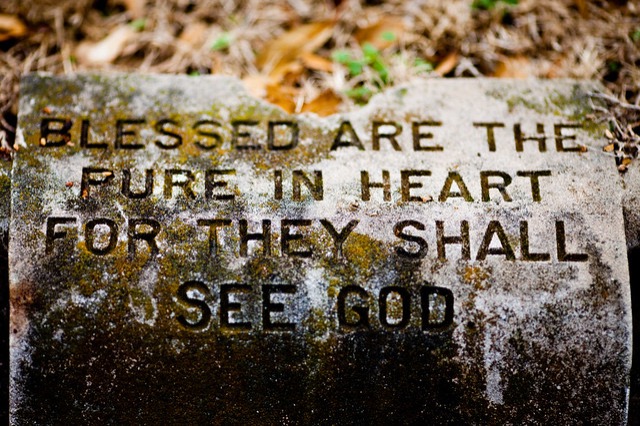
For Aida’s gravestone I chose one of the beatitudes given to us by Jesus Christ:
BLESSED ARE THE PURE IN HEART, FOR THEY SHALL SEE GOD.
– Jesus (Matthew 5:8)
I could not think of anyone or anything that was more pure than Aida and the purity of her faith, as she dealt with this wretched disease. Yes, she was the pure one who would see God. I sent the scriptural passage to the gravestone engraver and a few months later the stone was placed on the earth where she lay.
One day, as I was visiting Aida’s grave, I found her mother sitting there, flowers in hand, to decorate the area around the stone. We greeted each other, but this day she was troubled about something different, I could tell. She was bothered by me and my actions, but I didn’t understand why. I asked what was troubling her and she confessed that she was disappointed with my choice of a Bible passage to serve as a statement about her sweet daughter. (And here I must clarify, that all of the conversations between us, including this one, were always in the Armenian language.) She asked, why does it say she is “poor”? Indeed, if you were to read the statement with the slightest accent and with a limited understanding of the English language you might well be insulted by a comment aimed at you or your loved one as being “poor in heart.” I quickly interpreted the passage and assured her that purity of heart was what I saw in this young child. She was relieved and we continued a conversation, sharing about the purity of this life that was lost too early, but still touching us in many ways.
Through the years I’ve had to stand in front of the caskets and graves of other cancer victims.
—
Yesterday, I officiated at the funeral of another cancer victim. The year is 2021, almost 40 years since that day I said goodbye to Aida. This past year, because of the COVID-19 pandemic, has been filled with too many goodbyes and too many funerals. But this time, the life that was lost, was that of a mother, a wife, a sister, and a friend named Vilma. I read her biography and found it all too familiar. She grew up in my childhood neighborhood in Hollywood, attended and graduated the same schools that I journeyed through about three years before she did, Thomas Starr King Jr. High and Marshall High School. Here was yet another younger sister of mine, plagued and now having succumbed to cancer.
There I was at the funeral, expressing myself about this miracle-of-miracles, one who would be remembered not because of her death but because of the goodness that she did and the love she shared in this world. And though my thoughts and the articulation of those thoughts have matured since the time of Aida’s funeral, my anger has not been tamed. I’m still incensed by the way cancer can take over and seem to have the final word in the lives of beautiful and young people. Sure, we can find millions and trillions of dollars to invest in weapons to destroy life and to blow up the world several times over, and yet cancer research is limited by the money it receives. But this discussion was not the one for today.
By the very nature of the ministry that I profess – a ministry which celebrates resurrection over crucifixion – I must explain that the final words never belong to cancer. The expressions of Vilma’s children communicated with words and actions, their mother’s life story. Her husband’s expressions told of a life that made his complete. And quickly, we understood the magnitude of the life that was leaving us. Vilma was born in Romania. She came to the United States as a young teenager. She made a huge mark in life, which was attested to by the number of people in attendance at the funeral. The presence of friends from all walks of life, coming together, missing her and shedding tears, is the expression of victory over death. Because in the end, it is not about the length of that line that connects your birth and death year that matters, it’s about the quality of that line. Was it full? Was it filled with love? Of course, when you see so many people reacting the way they did at this funeral, you know that quality is measured by being loved. She was loved because she loved others, first.
Following the service in the church, we went over to the gravesite where we committed this mother to Mother Earth. I reached into my bag of emotions and found the anger of witnessing the slow-motion bullet which did her in, but I knew at this time, we were to reconcile with a reality that was painful and there was no sense making it even more painful for those who stood by. Her casket was lowered into the grave; we filled the grave with earth and with the final benediction dismissed the assembled crowd. People headed to their cars and began to leave the cemetery. A guest at the funeral approached me and inquired about our service, the faith of the Armenian Church and the words I spoke. Not to disturb the remaining family and friends, we went a bit away from Vilma’s new grave to an area under a canopy set-up to block the hot sun, positioning ourselves on the grass so as not to step on any gravestones. We spoke of faith and Vilma. As we finished talking on that field of graves, it became our turn to return to our cars and head home. Just after shaking hands with this inquisitive seeker, the grave marker which stood between us caught my attention. On the stone, was the name, birth and death dates of someone who had passed years ago. Under his name was written:
A pleasant reminder that cancer will never win. I’ll see to that because God has already seen to it.
vkm – 3 vii 2021