Holy Week – Great Tuesday (10 Maidens)

Holy Week Day #4 – Great Tuesday – The parable (Matthew 25) can be and must be turned into a story reflecting its message of preparedness. The Christian is always ready with good works and solid faith, in preparation of answering to God.
Song: “Stargazer” by Armen Donelian;
Produced by Suzie Shatarevyan for ePostle.net

Direct Link for Download

Holy Week – Great Monday

Holy Week Day #3 – The Farewell Discourse, John 14, Trust in God, Make Sense of the Chaos, Understand with your Heart and wipe away confusion – Comfort for the Passion Traveler.
Music: “Heru M’ertar” and “Lullaby for the Sun” by Night Ark in Wonderland, Cover: Death Valley at Spring

Direct Link for Download

Mt Davidson Time Capsule Unearthed

Time Capsule Unearthed at San Francisco’s 
Mt. Davidson Cross Commemorating First
 Easter Sunrise Service in 1923 Reveal of 90 year-old time capsule items and burial of new time capsule; 
Religious and political leaders joined for historic event

On Saturday, April 1st, 2023, a time capsule was unearthed from the foot of Mt. Davidson Cross in San Francisco in front of a large crowd of onlookers.  Ninety years ago to the day, San Francisco officials and community members gathered at the top of Mt. Davidson Cross to witness Boy Scouts of America Troop 88 bury a sealed copper box at the foot of the Cross to commemorate the first Easter Sunrise Service held there on April 1st, 1923.

“Historic moments like these held at Mt. Davidson Cross illustrates how our Armenian-American communities can enrich and inspire society by bringing people together under the ancient canopy of our resilience and hope,” commented Fr. Mesrop Ash, Pastor of St. John’s Armenian Apostolic Church in San Francisco and Board Member of the Mt. Davidson Cross Armenian Council.

During the time capsule unearthing, representatives from the San Francisco Historical Society were present to delicately receive the items which will be prepared for archiving and placed on display for the public to view at their San Francisco museum in June.

Among the items found in the capsule– which were much more plentiful than the organizers were expecting– were a leather-bound Bible, a San Francisco telephone book, pamphlets, a Boy Scout pin, a municipal record of 1933 and several newspapers including the March 27, 1932, edition of the San Francisco Chronicle, featuring a full front-page photo collage of an Easter celebration, and several other newspapers from the time, many with headlines referencing a murder case.

Following the unearthing of the old time capsule, a new, larger copper time capsule was buried at the same spot. Memorable items were presented by various local clergy leaders including Archbishop Salvadore Cordieone, Archbishop of the Catholic Archdiocese of San Francisco and Metropolitan Gerasimos, Metropolitan of the Greek Orthodox Metropolis of San Francisco.

In front of the crowd, Archbishop Cordieone read a poignant quote from Pope Francis in 2015 during his visit to Tsitsernakaberd, the Armenian Genocide Memorial in Armenia and placed a copy of that inside the new capsule.

On behalf of the Armenian American community, Archbishop Hovnan Derderian, Primate of the Western Diocese, placed a New Testament Bible from Constantinople (Istanbul) from 1884 belonging to a Genocide survivor and an Armenian Cross Stone (Khachkar) made especially for this event into the new time capsule.

Aside from the clergy, it was an honor to have many state and city politicians in attendance for this historic event. CA Lieutenant Governor Eleni Kounalakis, San Francisco Mayor London Breed, as well as San Francisco Supervisors Myrna Melgar and Ahsha Safai all provided brief remarks and ceremonially added their own small San Francisco-related momento into the new time capsule.

The historic event was organized by the the Council of Armenian-American Organizations of Northern California (CAAONC), a coalition of more than 30 Armenian-American organizations that purchased the Mt. Davidson Cross through a City of San Francisco public auction in 1997. The CAAONC has renovated the Cross and maintains it and the hilltop as an offer of thanks to San Francisco for becoming a safe haven for survivors of the Armenian Genocide.

“The San Francisco Armenian American community was gratified to save the Cross from demotion in 1997 and serve as its caretaker for the past 25 years in memory of the victims of the Armenian Genocide committed by the Turkish government, remarked Roxanne Makasdjian, Founding Board Member of CAAONC and event Mistress of Ceremonies.

“We do this as a way of thanking San Francisco for taking in the Armenian refugees a century ago, and as a way to honor our history, both as the first nation to adopt Christianity in 301 AD, and as descendants of Armenian Genocide survivors. For us, this Cross and this time capsule embody the importance and purpose of remembrance,” commented Makasdjian.

Watch the Video

Listen to The Next Step Podcast #390 by Fr Vazken Movsesian, produced on November 16, 2015, starting minute 33, when Fr Vazken recaps a Pilgrimage by a group of  St Peter Armenian Church members, Glendale, led by him. The Pilgrimage was to 7 Churches in 3 days, including a hike to Mt Davidson Cross.

Listen to the Podcast

Archbishop Hovnan Derderian’s Remarks at the Mount Davidson Cross

Watch the live stream here:

Holy Week – Palm Sunday

Holy Week Day #2 – Cleansing the Temple – The players are in place as the Passion Play begins. The invitation is extended to stand in the Procession to Jerusalem and to open the portals to our hearts, as Jesus cleanses the temple and the remnants of evil within us.
Song: “In the Moneylender’s Temple” by Ian Anderson and “Patz Mez Der” by Lucine Zakarian. Photo: Palm Sunday at Youth Ministry Center, Glendale 2005
Produced by Suzie Shatarevyan for ePostle.net

Direct Link for Download

Holy Week – Lazarus Saturday

Holy Week Day #1 – Reflections on the death and resurrection of Jesus’ friend Lazarus (John 11) and the question: “Do you believe this?”;
Song “At Their Father’s Knee” by Ian Anderson; Cover: Dali-e
Produced by Suzie Shatarevyan for ePostle.net

Direct Link for Download

18th Century Prayer Book from Soviet Union to the Church

Nersess Shnorhali’s “Jesus, Son” – gifted to the Western Diocese

Presentation at Reclaim 2023 by Fr. Vazken Movsesian

We often speak about the Armenian Genocide and it’s lasting impact on the Armenian soul and psyche. We must never forget what followed, that is, the 70 years of communism that swallowed up Armenia in the Soviet Union. Those were very difficult years for Armenians caught up in the Soviet State as it spewed its narrative of atheism and anti-nationalism.

In 1977 – 1978, I had a unique chance of a lifetime to study in Armenia at the seminary of Holy Etchmiadzin. It was there and then that I met Archbishop Hovnan, who was a seminarian at the monastery. For most people who viewed from the outside, studying at a seminary in a country which professed atheism, sounded like an oxymoron. But that was the magic that we experienced at Holy Etchmiadzin, under the leadership of Catholicos Vazken I. From the Holy shrine of Etchmiadzin, the Light of Christ was shining.
On weekends, as a break from classes, we sometimes ventured off to Yerevan where local bookstore were always a special stop for us. One Saturday, while browsing through books I came across a tattered and old-looking book of prayers. The cover page was torn, but I made out that it was St. Nersess Shnorhali’s “Jesus, Son” (Յիսուս, Որդի). It was at the bottom of a pile of “throw-aways” and after paying only a few kopeks, I took possession.

When I got back to the Seminary, I looked up the book in the seminary’s library. The earliest edition of this book was listed as 1643, with a possibility of a later printing by 1785. I was so excited. I had a treasure. Later on I would realize the treasure was what was written on those page.

I mentioned my acquisition to a few of the seminarians who were quick to notify me that anything that pre-dated the Bolshevik Revolution (1917) was to remain in the country. It was interest that everyone knew this bit of the law. Nothing with a day before 1917 could be taken out of the USSR. Of course, I now had a challenge before me, a challenge which was accented by the fact that books of this genre in the Soviet Union could have the fate of “Fahrenheit 451” in Bradbury’s America.

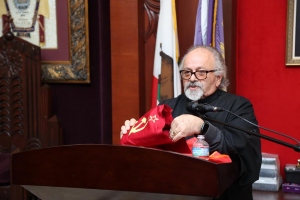
In that same bookstore, I found a book written in Armenian, “Marx, Engels and Lenin on Religion” (Մարքս, Էնգելս, Լենին Կրոնի Մասին) which sold for a few kopeks as well. There were stacks of these books, priced to sell and move into the hands of the public! I purchased one, and I also purchased a flag, the one which flew over Armenia during that period. It was red with a blue stripe, and in the corner the hammer & sickle were prominently situated. I took these books from the opposing camps – Shnorhali’s “Jesus, Son” and the Marx, Engels and Lenin’s “Religion” – and wrapped them up in the communist flag and mailed them to myself, hoping that the postal or custom inspector would view this packet as communist propaganda and allow it through the system. And, I guess it worked. When I returned back to the States the box was waiting for me. It had been opened, but all of the content was there.

It was only later that I understood the magnitude of the blessing that Shnorhali’s “Jesus, Son” was bringing. I painfully read through the classical Armenian and later discovered translations. It has been a cornerstone of my Bible Study classes and only a few years ago I did an entire season of Bible Studies on this Holy Text.

Today, as we offer “Reclaim a Voice” I’d like to present this book to His Eminence Archbishop Hovan, as a custodian of sacred texts. This book is a voice that the Soviets tried to suppress. It is no different than the countless Christian voices that have been attacked through the centuries and the voices that are held back today. This book belongs within the safety of our Diocesan Library, as an inspiration to others. I thank Archbishop Hovnan for placing such a high value on the written word creating a safe sanctuary for these classics and a place where we know that generations to come will be blessed with the sacred words of Shnorhali and “Jesus, Son.”

Reclaim 2023: A Voice!

A Voice is Heard: Reclaim 2023
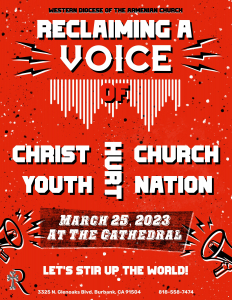
The 7th annual Reclaim Conference took place March 25 at the Western Diocese /St. Leon Ghevondyants Armenian Cathedral in Burbank. The topic for 2023 was “A Voice” with speakers, presentations and even a movie – the internationally celebrated “Amerikatsi” – accenting the necessity to “Reclaim a Voice” which has been lost or goes unheard.

Reclaim 2023 kicked off with the Primate, Archbishop Hovnan Derderian, calling for a moment of silence, to highlight the need to listen to the voices of struggle around the world. With his opening prayer, the conference participants who had filled the Hampar Room at the Diocese, were called to listen, absorb and take action on the string of “Reclaimed Voices” they would hear. His Eminence’s words were empowering. They invoked strength and determination to take on the Christian responsibility entrusted to each member of the Church according to his or her talents.

In his address, the Diocesan Primate commended the vision and outstanding organizational prowess of the Rev. Fr. Vazken Movsesian, in bringing the dream of the RECLAIM Conference to fruition. “I can earnestly say that the Rev. Fr. Vazken Movsesian is a visionary priest. We recall his zeal and enthusiasm in sharing with us the mission of the inaugural Reclaim conference seven years ago. For seven years, Reclaim, Fr. Vazken’s brainchild, has expanded globally as we witnessed participants from around the world when the conference was live-streamed on the world wide web. I greatly admire his passion for his craft in uniting people, sharing God’s word and His love with the community, and his unrelenting dedication to diocesan outreach missions. May the Good Lord continue to bless this outstanding priest and his ministry.”
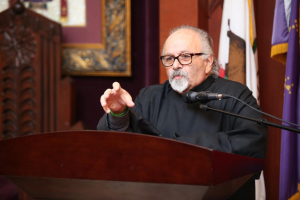
In his keynote address, Fr. Vazken referred to the English language expression, “No Duh,” as a response to obvious statements.  Citing the Armenian language counterpart, ba vonc, he opened the conference with the Scriptural account of the healing at the Pool of Bethesda (John 5). Here, Jesus approaches a man who has been paralyzed for 38 years, and while observing the obvious, Jesus dares to ask, “Do you want to be healed?” The necessity to “voice” our wants, concerns, and feelings, in the face of the obvious – in the face of the “No Duh” moment – is one of the take aways from the story. “Today we gather to reclaim a voice that might be obvious but is often unheard or even silenced.”
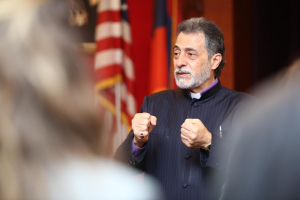
Conference attendees were given copies of Bishop Daniel Findikyan’s “Building Up the Body of Christ” book, which His Grace authored during his tenure as Primate of the Eastern Diocese and is heard as “a voice crying out in the wilderness” in its direction to the Armenian Church. The challenge to read or listen to the book (available in multiple formats), like everything else that was being presented this day is the point of the conference. Ultimately, it is the voice of the Church and therefore the Voice of Christ that is talking to us.

Deacon Dikran Harutunian, shared his thoughts as the chairman of the Diocese Deacons Council. His compassion and love for the Armenian Church were heard by all and was the foundation upon which speakers would build throughout the conference.
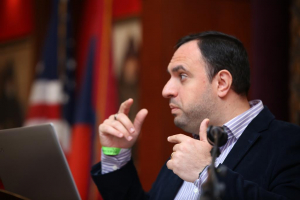
Diran Avagyan, the energetic and compassionate chaplain to the sick, the lonely, the grieving and the dying, gave a thought-provoking exploration of the “voice of the voiceless.” Using personal experiences from his chaplaincy at Adventist Health Glendale, he challenged the audience to think of the voiceless in our community, from the homeless, to the chronically ill who may be silent yet express the fundamental desire to be appreciated and respected with dignity. Since 2008, Diran has been a vital member of the Western Diocese team bringing his expertise in Christian ethics, pastoral care and counseling to the community of the Western Diocese. Archbishop Hovnan emphasizes the importance of Christian Ministry as one of the cornerstones of Diocesan life. Diran shares many of his insights on Social Media and can be followed on Instagram @holy_encounters.
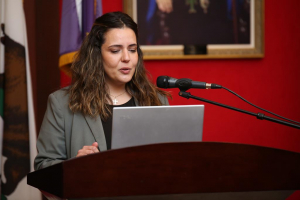
Savana Aghamal, who is a practicing Speech and Language Pathologist (SLP), masterfully presented a talk that weaved aspects of her profession with the Biblical narrative of care and expression. Savana currently provides services in the public schools and expresses her immense love for the Armenian Church and Armenian culture by singing in the Cathedral’s Shnorhali Choir. This combination made for a spiritually charged presentation that added to the “voice” conversation.

Two deacons of the Armenian Church, Nareg Kasian and Mike Dermendjian shared the stage for the next presentation when they spoke about “Voice as a Tool.” These young men who adorn the altar area of the Ghevondyants Cathedral with their voices and talents, talked about service as an expression of our deepest love. Their message was candid, uplifting and challenging. They engaged in a trialogue, one which included the audience as the third voice joining their dialogue. Dn. Nareg and Dn. Mike will be headlining a new show on Epostle.net, the Diocese’s electronic forum, that will bring the voice of the young deacons to everyday issues that are of pressing and of concern to the youth and all.
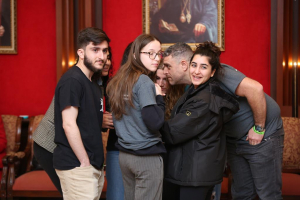
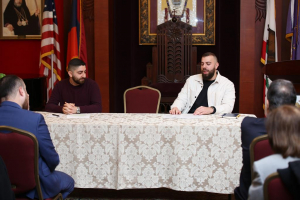
The ACYO, the official youth group of the Diocese, was up next in a panel discussion to share their voice. The panel was moderated by Deacon Charles Cherezian, who is a loud and moving voice on social media with his show, “In the Name of the Father.” He led the panelists in an invigorating Q&A about church, youth, service, and participation. Panelists were Victoria Amran, Daniel and Sarah Koloyan, Caitlyn Missakian and Grace Petoyan.

Amerikatsi – a special screening

The second portion of the Reclaim conference took place viewing and discussing the critically acclaimed movie, “Amerikatsi.” Michael Goorjian, the writer, director and star of the movie, was in attendance to field questions and share personal stories from the production of the film. He share intimate details for the production process which began at the same time the world locked down because of COVID in 2020.

“Amerikatsi” is a film about a dark period in Armenian History. After World War II, Stalin encouraged the Armenian diaspora to return home to Armenia. Thousands came from many parts of the world and a few hundred repatriated from America. This is the story of one of those repatriates, who finds the Soviet state shockingly different than the romantic expressions he held of his “homeland.”

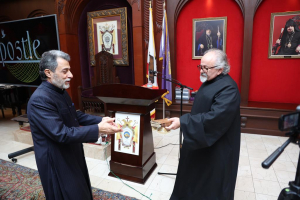
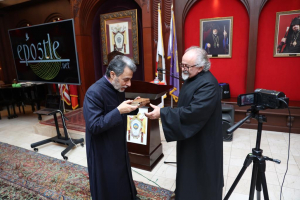
Before the screening, Fr. Vazken made a special presentation of a book, a 1785 printing of St. Nersess Shnorhali’s “Jesus, Son” which he brought out of the Soviet Union while a seminarian at Holy Etchmiadzin. His story (which appears separately online) was an additional stage-setter to the screening, as he recounted the challenges faced at the time.
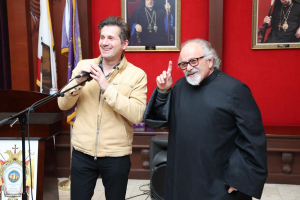
The “Amerikatsi” screening was a special “voice” that followed the theme of the conference. It was a voice that had been unheard until now. It was a voice of hope and resilience in the face of unwarranted torture.

The lights came on in the room after the showing, only to reveal the audience in tears. Michael Goorjian had touched the hearts of his audience in Burbank as he has throughout the world. “Amerikatsi” has been shown internationally and has won multiple awards at festivals and competitions. With tears in their eyes, the audience gave Goorjian a standing ovation.

“Amerikatsi” will soon be in theaters nationwide. While it was filmed in Armenia and reflects a period of history from Armenia, it speaks to people throughout the world at different levels.  The film has been recognized with awards a accolades at festivals and showings throughout Europe and the US, and most recently at Beloit International Film Festival, Fargo Film Festival and Cinequest.  As one critic writes, it is “a film of tremendous spirit and hope even in its darkest moments of despair.”

The Conference came to an end with Sousanna Pogosyan, recapped the day’s activities in her unique style of conversation. She shared the take-aways from Reclaim as she invited everyone to a networking event which followed.
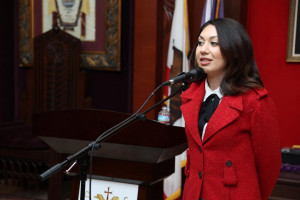
Reclaim 2023 was organized as an event of Epostle.net. Gratitude and appreciation is extended to Haikuhi Kavoukjian and the ladies of the Circle of Faith Bible Study for providing the lunch. The St. Leon Church, pastor Fr. Khajag Shahbazian, for hosting the event and the St. Leon ACYO for hospitality services. And specifically to His Eminence Archbishop Hovnan Derderian and the Reclaim 2023 committee that insured another successful event, in line with the Reclaims from the past seven years.

Lusine Takmazian is the appointed chairperson of Reclaim 2024 and invites those who are interested in being a part of the 8th annual conference to contact her via email: feedback at Epostle.net

Lenten Journey Day 40 – Worship


Lenten Journey Day 40 – Worship

What a beautiful day today is. It is day 40 – forty days ago we began this Lenten Journey. We feel a sense of accomplishment. It is a good feeling. It has been 40 days of fasting – abstaining from certain foods. It has been 40 days of intensifying our prayer life. It has been 40 days of charitable giving, not merely by writing out checks but giving pieces of ourselves. We have counted our blessings and our talents, contemplating our purpose and function within life and our world. It has been a time of reflection.

It is perfectly natural for us to look back today, perhaps even revisit some of the themes that we explored during this Season. In looking back, though, we must be honest. If not, we will be betrayed by our attitudes and actions.

Today as we gather on this 40th day of Lent we arrive as new creatures. We have been transformed. We have changed, perhaps not to the exact place we would like to be, but the change is noticeable. In particular we have a new outlook. We see ourselves differently, as individuals and within the structure of our communities and the world.

The one topic that follows, naturally is “Worship.” It is the one area that we have not explored. It is the most extraordinary and natural. It is the final step we need to take during this Lenten Season.

In worship we understand ourselves in relationship with God in a rather unique manner. Worship is not prayer . It is praise. Worship is not asking. Worship is giving. It is giving ourselves and humbling ourselves before that which is greater than ours self. And so, Worship is the final step in the Lenten period.

It has been a beautiful journey this year because we have grown, both individually and together. By listening, by talking, by sharing, by extending ourselves, that is, by Loving! Think of it for a moment. The Love that we share with others defines who we are in, for and around life itself. And we have a new definition today. We have a new lease on life today! We have opportunity to come face-to-face with this holy season, to look at the resurrection with new eyes. Our eyes are focusing beyond crucifixion and we see the empty tomb. We witness and become part of the Tomb.

Imagine that…. Sitting in the Tomb of Jesus. Imagine waking up after the torture of crucifixion. Imagine waking up after a burial. We can now share properly what we were intended to share from the very beginning – to become participants in the salvation process. It is not a question of being saved, but one of being a participant. And that is where worship grants us a perfect model.

Worship in the Armenian Church is participation. It is an act of participation. It is not witnessing, but throwing yourself into it holistically with all your senses. To visually see what is around you – the visual delights, the colors, the candles, the flowers. To smell the aroma of the flowers at the altar as well as the incense that takes our prayers to heaven. To be able to hear the beautiful tones and tonalities of the angels. Not saying I don’t understand so let the angels come to me, but rather asking, how can I fly with the angels. How can I participant? Our sense of touch is also important in the Worship services. We have to touch each another. We have to physically love one another. We have to kiss each other to say “You are important in my life just as I would like to be important in yours.” In that touching process we begin to understand what it means to put our feet in the shoes of others. In the shoes of our brothers and sisters, of our people, of others who are struggling. We place our feet in the shoes of others and we understand their difficulties. Perhaps the loss of a job? The loss of a loved one? Perhaps they have an inability to process the spirituality, to process the love that God has put in our heart. And so we reach out to one another physically.

Finally we appeal to our sense of taste. We participate by communicating, by communing with the Holy Eucharist, with the precious body and blood of Jesus Christ.
So we see that worship really is that final step in the Lenten Journey. It is a step that allows us to go beyond Lent, so that taking what we learned during these 40 days, we can apply it and make it a reality in our life, every single day and every single moment, in our relationships with one another, to draw on what we learned in the past, but not to stay there in the past, and to say that the life before me is so beautiful that I’m ready to walk. I am ready to take on the challenges. I am empowered by God. I have been given a new lease on life with Jesus Christ as my savior.

Jesus Christ. Love incarnate. I have been given a new lease on life through Jesus, through love.

We conclude with a meditation on John chapter 15, Jesus, the True Vine. Jesus says, “I am the vine; you are the branches. Whoever abides in me and I in him, he it is that bears much fruit, for apart from me you can do nothing. If anyone does not abide in me he is thrown away like a branch and withers; and the branches are gathered, thrown into the fire, and burned. If you abide in me, and my words abide in you, ask whatever you wish, and it will be done for you. By this my Father is glorified, that you bear much fruit and so prove to be my disciples.

“As the Father has loved me, so have I loved you. Abide in my love. If you keep my commandments, you will abide in my love, just as I have kept my Father’s commandments and abide in his love. These things I have spoken to you, that my joy may be in you, and that your joy may be full.

“This is my commandment, that you love one another as I have loved you. Greater love has no one than this, that someone lay down his life for his friends. You are my friends if you do what I command you.

Amen.
This concludes the Lenten Journey.

The daily messages continue tomorrow with the Holy Week series at Epostle.net

History Made: 4th Dimension at the 3rd

Next Step #771 – March 30, 2023 – History in the making: Mourning in a virtual environment. The 4th dimension of time is applied to the two dimensions of virtual gatherings and we arrive with a third dimension. A virtual Bible Study accepts and copes with the death of its member Meline Talarian. Also, Reclaim 2023 – a review of the 7th annual event. Voices of the voiceless and voices that go unheard are all in the mix. A prayer book from the Soviets arrives at the Armenian Church Links for this week:
Reclaim 2023 in Review & Photos
Prayer book through Soviet space
Bishop Daniel Findikyan’s Building Up the Body of Christ
Cat Stevens “Numbers” 
Cover: Dali-e
Produced by Suzie Shatarevyan for http://Epostle.net
Subscribe and listen on demand on your favorite pod-catcher!
We’re on StitcherPandoraSpotify and Apple Podcasts


Lenten Journey Day 39 – Light and Salt

Lenten Recipe

Recipe 39: Tropical Sweet Potatoes

Lenten Journey Day 39 – Light and Salt 

Change. We have changed through the Lenten Season. In fact, our Lord Jesus Christ is the author of change. He advocated our need to change. He taught us a path to get back home through repentance. He expressed through words and his life, that through simplicity we can find happiness and inner peace.

Christ has the ability to change evil into good. Certainly, at the Cross, he transformed the evil Crucifixion into a “Good” Friday event, by the power of the Resurrection. Jesus also changes word and concepts. For instance he took the words of condemnation and turned them into words of salvation. The first man heard the words, “Take and eat this will make you like God,” and was condemned. Jesus took those same words and made them into words of salvation, “Take and eat,” this will make you like God, for this is my body and this is my blood.

Jesus is the one who transforms us and in him we see a transfiguration. A renewal for our lives. In the Sermon on the Mount Jesus gives us a formula for happiness. In the Beatitudes we are told what is really important in life. In giving us hope and belief in tomorrow, he concludes the Beatitudes by once again changing us by giving an opportunity for us to partake in the Divine Nature. The same one who once said, “I am the light of the world,” now turns to us and says, “You are the light of the world,” giving us an opportunity, much like the disciples who witnessed the transfiguration, who saw His radiance, an opportunity to see the fullness of God.

According to the Old Testament, the first thing that God willed was light, “Let there be light.” This is independent of any celestial body. It is pure light. It is radiating light. It is healing light. It is the light that is from the beginning of time and continues forever.

Jesus gives us an opportunity to be that light. In the Sermon on the Mount Jesus says, “You are the salt of the earth. But if the salt loses its saltiness, how can it be made salty again? It is no longer good for anything, except to be thrown out and trampled underfoot.”

Using something as small and seemingly insignificant as a grain of salt, Jesus emphasizes how important our life is in the big picture. The Lord proclaims that you are important because you are that salt of the earth. That salt is used to flavor life, to give life its meaning and to give it content, that is, inner happiness, inner strength, inner peace.

In Armenian Church tradition a priest blesses the homes of his parishioners and part of that ritual involves blessing water for the spiritual needs of the family and blessing the bread for the physical needs of the family. Equally as important, the priest blesses salt because flavor is necessary in life. We are called to the happiness of life , to share in God’s love, in God’s kingdom, in the goodness that is all around us. Imagine, “You are the salt of the earth” because you give meaning to what we know as life.

Jesus continues, “You are the light of the world. A town built on a hill cannot be hidden. Neither do people light a lamp and put it under a bowl. Instead they put it on its stand, and it gives light to everyone in the house. In the same way, let your light shine before others, that they may see your good deeds and glorify your Father in heaven.”

There is a responsibility that comes with being light. Light needs to shine. Ours is to light the world. We do not have the right to hide light.

Today we find more opportunities of expressing our responsibility in God’s Creation. You are called to a unique responsibility of being salt, the flavor of life. You are the light which illuminates the darkness and illuminates the path to your heavenly Father. As night falls on the Lenten Season, we are given the responsibility to shine light on a world that is in need of illumination.

The sun goes down daily over our lives, but for many lives, the glimmer of hope for a new sun rise is nonexistent. Imagine leaving a room, turning off the lights and the room becomes so dark that those people in it cannot see the light switch. They don’t know where to turn. They don’t know where to reach to turn on the light. You are the light of the world. Shine. Turn on the switch. Provide hope, faith and love. 

Today God is calling upon you to become the light of the world, not to hide yourself under a table but to put yourself on the light stand. As someone who has gone through this Lenten season you now have a new responsibility to light the darkness and in so doing, to become an agent of Christ, to become a pillar of hope where there cannot be hope. You are the salt of the Earth to bring flavor to life, you are the light of the world to bring light into the darkness.

Let us pray the prayer of Saint Nerses Shnorhali (Norasdeghdzyal):
In the beginning the Word newly created the heaven and heavens out of nothing, and the celestial hosts: the watchers, the angels and the elements, contrary one to the other, and yet agreeing, by which the indescribable Trinity is ever glorified.

The thrice-holy One, dominion and Godhead in one nature, the light uncreated that creates, commanded that there be created light, which he made to shine on the first Lord’s day that was Sunday, by which the inexpressible Trinity is ever glorified.

O You Love, in love You humbled Yourself and took human form for our salvation, in the same body that was crucified, and laid in the tomb of death, this day You rose as God and the angels proclaimed; come you who are saved, sing with the angel praises to him that is risen.
Amen.